Catherine Wangari
February 9, 2024
Share article



In December 2023, Kasi Insight conducted an extensive Share of Wallet survey across 21 African markets. This survey provided valuable insights into various aspects of consumer spending, including sources of income, expenditure patterns, and the specific consumer-facing products purchased monthly.
In Zimbabwean households, a distinct hierarchy is evident among essential telecommunication services, with home internet leading in usage at 60%, closely followed by mobile phone services at 58%, and cable/satellite TV at 46%. Gender-specific patterns reveal a slight preference among females for home internet (61%) and mobile phone services (59%), while males lean more towards cable/satellite TV (47%) compared to females (44%).
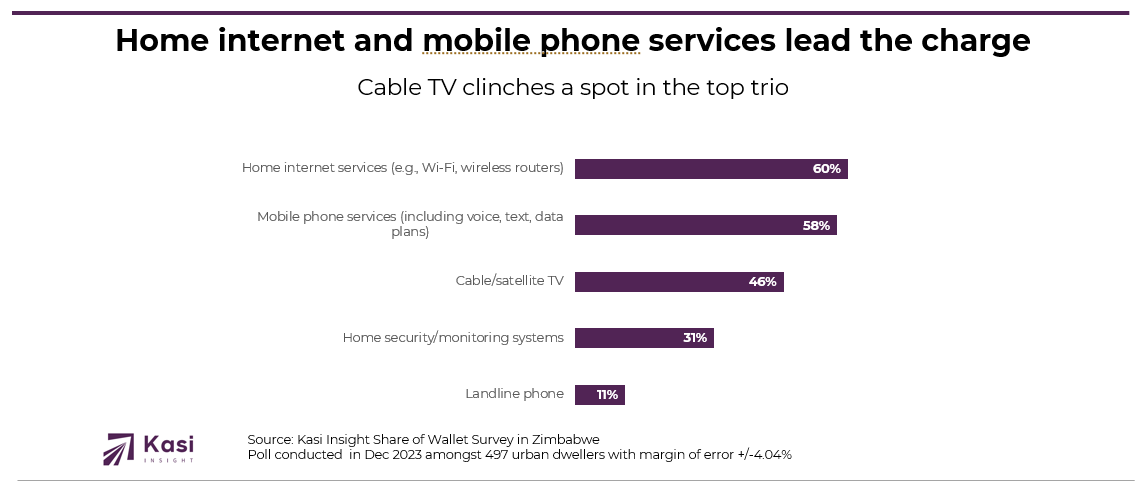
Examining generational dynamics, Gen X emerges as the primary user group for home internet services, boasting a substantial 66% usage rate. Following closely, Millennials exhibit robust usage at 59%, and Gen Z demonstrates notable adoption, with a 53% usage rate. In the realm of mobile phone services, Gen X again takes the lead with a 61% usage rate, followed by Millennials at 58%, and Gen Z at a respectable 52%. Surprisingly, cable/satellite TV preferences diverge, with Gen Z claiming the lead at 52%, followed by Millennials at 48%, and Gen X trailing at 39%.
Examining the expenditure data reveals a noteworthy trend, indicating that both mobile phone services and home internet are associated with higher percentages in the lower spending brackets. For mobile phone services, a substantial 70% of respondents spend less than $30, while for home internet services, 58% fall within these lower spending categories. In contrast, cable/satellite TV shows a different pattern, with only 17% of respondents allocating their budget within these lower ranges.
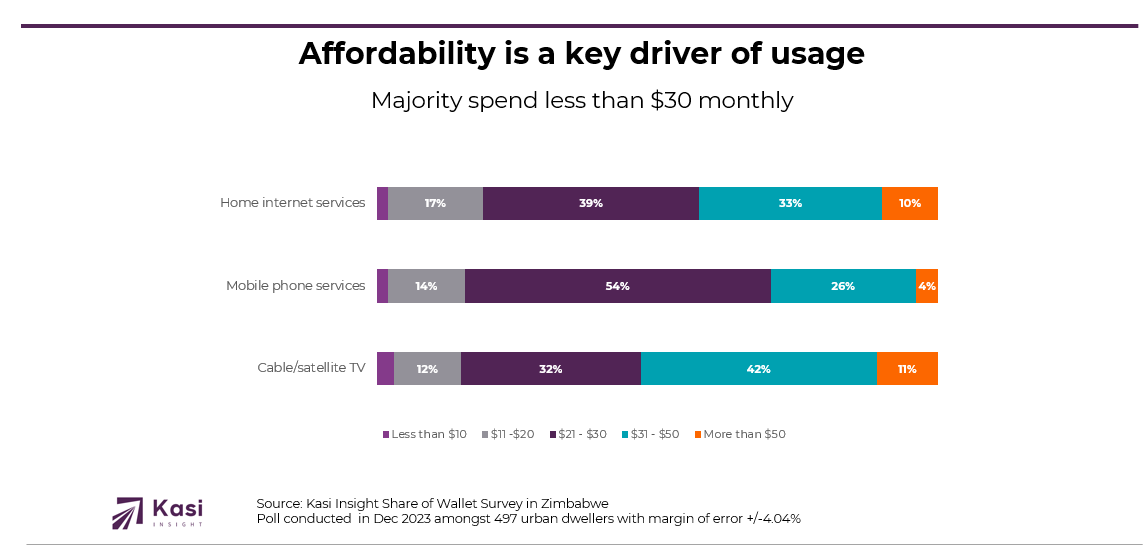
Instead, a larger proportion (53%) of respondents spend in the higher brackets of more than $30 for cable/satellite TV. These spending disparities align with the observed usage hierarchy, suggesting that the perceived affordability of mobile phone services and home internet compared to cable/satellite TV might contribute to their higher usage rates.
In the telecommunications landscape, distinct factors influence consumer choices, with affordability and network quality consistently at the forefront. Female consumers prioritize not only cost and network reliability but also place significant importance on brand reputation and internet speed, signaling a preference for reliable and esteemed services. In contrast, male consumers, while sharing an emphasis on affordability and network quality, lean towards prioritizing network coverage area and enticing mobile device offers, indicating a specific interest in seamless connectivity and device incentives.
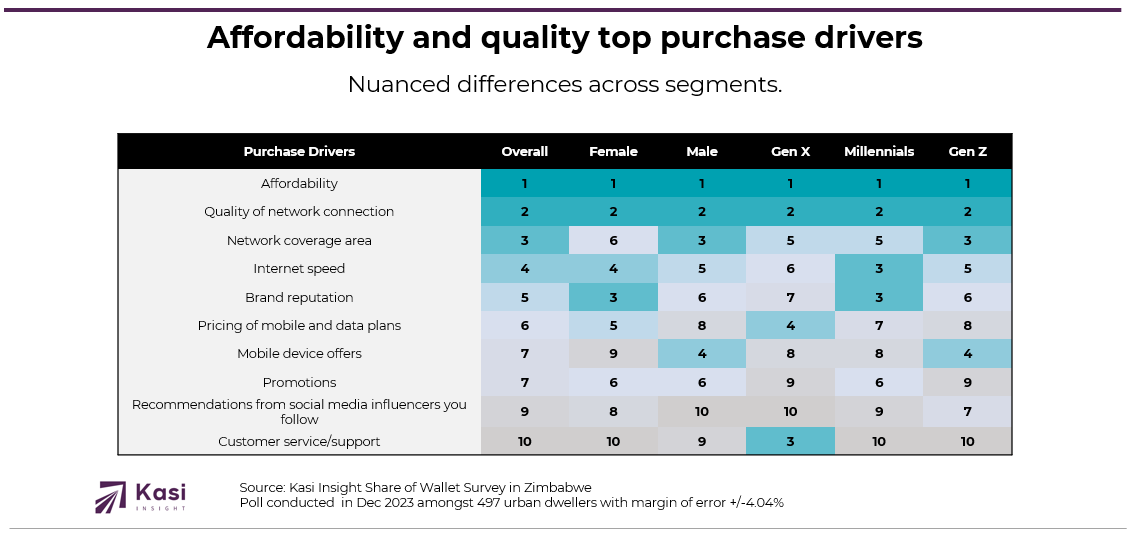
Gen X consumers take a comprehensive approach, considering affordability, network quality, customer service, and the pricing of mobile and data plans, reflecting a thorough evaluation that encompasses both service experience and cost considerations. Millennials showcase a tech-savvy and brand-conscious mindset by prioritizing affordability, network quality, internet speed, and brand reputation. Lastly, Gen Z's preferences, spanning affordability, network quality, network coverage area, and mobile device offers, underscore a pronounced enthusiasm for uninterrupted connectivity.
For telecommunications brands operating in Zimbabwe, the observed usage hierarchy among essential services indicates a clear opportunity for strategic targeting and marketing efforts. Home internet emerges as a frontrunner, presenting a prime market for expansion and service enhancement. Given the slight gender-specific patterns and the preference among females for home internet and mobile phone services, tailoring marketing strategies to resonate with these preferences could prove effective in capturing a larger share of the market. Additionally, the generational dynamics highlight Gen X as a significant user group for both home internet and mobile phone services, presenting an opportunity for brands to engage and retain this demographic through targeted offerings.
The affordability factor, underscored by the expenditure data, further emphasizes its pivotal role in driving usage patterns. Telecommunications brands that can effectively position themselves as cost-effective options for mobile phone and home internet services may gain a competitive advantage. This is particularly crucial given the higher percentages of respondents spending in the lower brackets for these services.
In terms of consumer priorities, the prominence of affordability and network quality across different demographic segments suggests that brands should focus on delivering reliable and reasonably priced services. Female consumers' emphasis on brand reputation and internet speed, as well as male consumers' interest in network coverage area and mobile device offers, provides valuable insights for brands to refine their offerings and marketing messages.
Share on socials using this caption: Dive into the heart of Zimbabwe's tech choices! 🌐💬 Unveiling household preferences, this article spills the beans on internet love, mobile mania, and cable cravings. Swipe through for a glimpse into the telecom trends shaping homes! 📲🏡 #ZimTechChronicles #ConnectivityRevealed
2163 views
Share article
Kenya’s H1 2025 telecom wallet reshuffle reveals new spending logic and growing pressure on brand loyalty
Starlink’s Global Outage Reveals Fragility in Africa’s Connectivity Progress
Mobile money outpaces fintech in Ghana’s digital finance