Sandra Beldine Otieno, MSc
June 17, 2025
Share article


Two years after making its debut in Africa, Starlink has moved from futuristic concept to a visible, active player in the continent’s internet ecosystem. Launched first in Nigeria in early 2023 and gradually expanding to Kenya, Ghana, Malawi, Zambia, Mozambique, and beyond, the satellite internet provider arrived with the bold promise of transforming connectivity in hard-to-reach places. The pitch was simple yet powerful: fast, stable internet access, unshackled from the limitations of fibre and mobile networks. Across much of sub-Saharan Africa, where infrastructure gaps have long dictated who gets online and how well, this was not just disruptive—it was exciting.
But in mid-2025, as usage matures and more consumers weigh the service against their needs and budgets, a more complicated picture is emerging. Awareness is widespread, interest remains strong, but adoption is stalling in several markets. In Kenya, Starlink now ranks as the seventh-largest internet service provider with 19,146 active subscribers. This is a significant achievement for a newcomer, but still a fraction of the market compared to traditional fibre and mobile data players. In Ghana and Nigeria, where subscription data is harder to consolidate, anecdotal adoption suggests a similar pattern visible curiosity, cautious trials, and mixed feedback on performance and value.
Kasi Insight's data from Kenya, Ghana, and Nigeria confirms that visibility is not the problem. Starlink awareness stands at 65% across the three countries, with Kenya leading at 75%, followed by Nigeria at 69% and Ghana at 52%. This high level of recognition has been driven by the brand’s association with Elon Musk and a strong innovation narrative. However, actual subscription intent tells a more cautious story.
Only 42% of respondents say they would subscribe immediately, while 49% prefer to wait and consider the service later. Ghana stands out with the highest future intent at 77%, reflecting widespread dissatisfaction with existing providers and unmet demand for better connectivity. In Kenya, 36% say they would consider Starlink in the future, but many remain hesitant due to cost and uncertainty about performance. Nigeria presents a more balanced split, with 48% ready to subscribe now and 41% expressing interest over time.
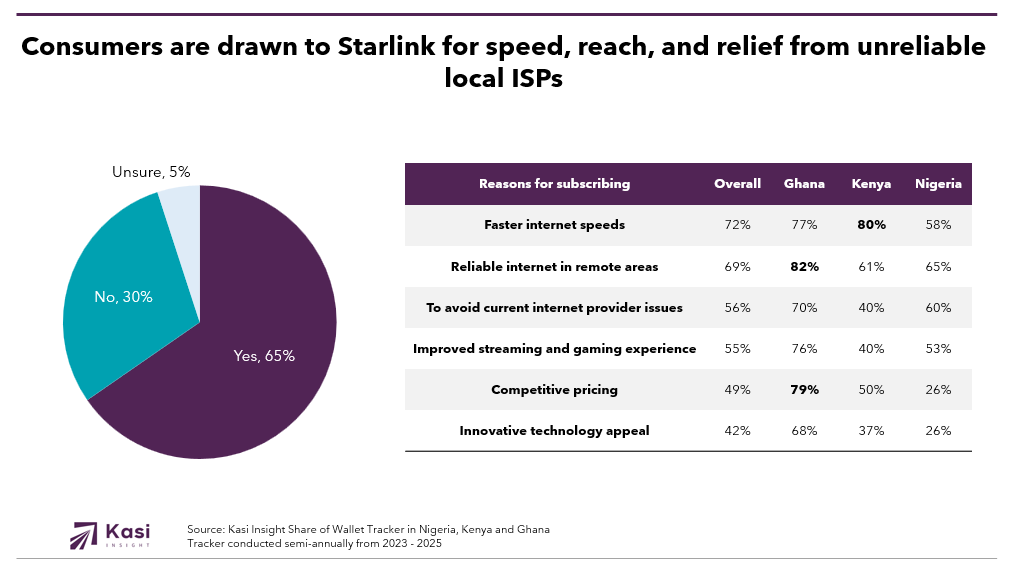
The reasons for interest are clear. Across the three countries, 72% of respondents cite faster internet speeds as the top reason to consider Starlink. Another 69% are attracted to the promise of reliable service in remote or poorly served areas. Dissatisfaction with current internet providers also plays a role, especially in Ghana where 70% mention it as a motivation. Streaming and gaming appeal is strongest in Ghana at 76%, while in Kenya and Nigeria, digital utility and stability appear to matter more than entertainment.
Despite strong brand recognition and interest, Starlink’s price point remains its most significant barrier to broader adoption. Overall, 43% of respondents across Kenya, Ghana, and Nigeria say the service is too expensive. In Kenya, the figure rises to 50%, while in Nigeria it stands at 45%. Although only 14% of Ghanaian respondents cite price as an obstacle, this likely reflects a skew toward early adopters rather than broader affordability.
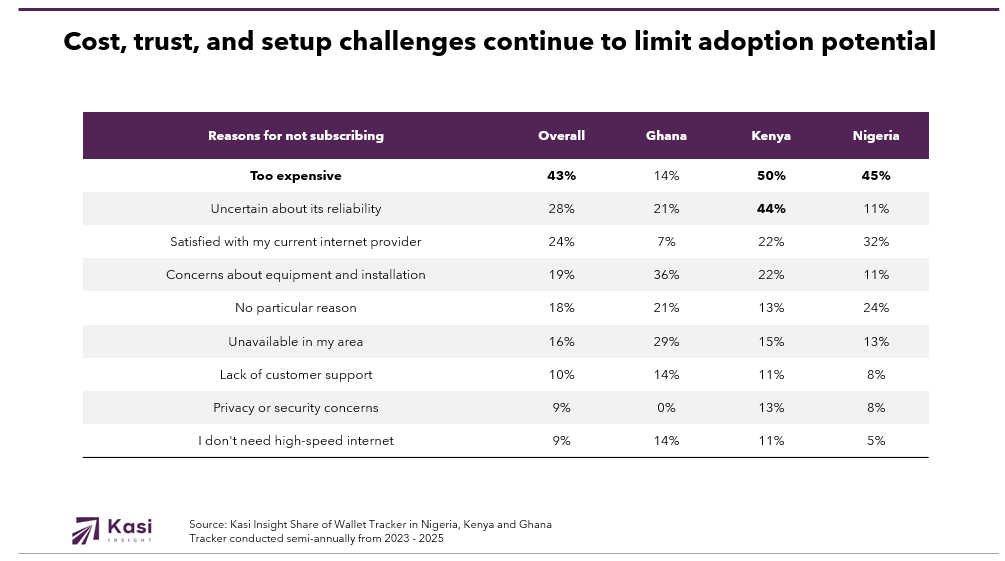
The monthly cost of service averages over USD 100 in many countries, excluding hardware and installation fees. For the majority of households, this is two to three times more than what they currently spend on internet access. And the price premium does not always guarantee a better experience. In Kenya, 44% of consumers express doubt about Starlink’s reliability. Across forums and user groups, complaints include signal dropouts lasting up to 30 minutes, speed degradation during bad weather, and reduced performance in areas with partial obstruction.
Installation and onboarding are additional friction points. Across the three markets, 19% of respondents report concerns about equipment or setup. In Ghana, the figure is especially high at 36%. Payment issues also persist, with users reporting challenges linked to card acceptance and foreign currency billing. While only 10% cite poor customer service as a major issue, complaints around slow support, limited local presence, and unresolved technical problems are common among early users.
Meanwhile, Starlink’s competitive advantage is narrowing. In Nigeria, 32% of respondents say they are satisfied with their current provider. Fibre and mobile broadband offerings continue to expand, with operators like MTN and Airtel introducing fixed wireless solutions that rival Starlink on performance and price. In Kenya and Ghana, bundled packages offering home internet, mobile data, and digital payments are making terrestrial alternatives more attractive.
The excitement around Starlink’s entry into Africa was driven by possibility. For millions of people in areas with limited coverage, the idea of satellite internet promised a chance to connect, work, learn, and grow without depending on broken infrastructure. But in its current form, Starlink remains a premium product. It is attractive to a narrow segment of early adopters, but far from becoming a mainstream option for the majority.
As of mid-2025, Starlink is officially available in at least twelve African countries. These include Nigeria, Kenya, Ghana, Rwanda, Malawi, Zambia, Mozambique, Benin, Sierra Leone, Eswatini, Mauritius, and Madagascar. In several other markets, such as South Africa and Zimbabwe, users access the service through roaming kits or grey market imports, often in violation of national regulations. While Starlink’s reach has grown quickly, its readiness to serve diverse markets with tailored solutions has not kept pace.
To remain relevant and competitive, Starlink will need to solve three core challenges. First, it must offer more flexible and locally priced packages. This could include prepaid data models, installment-based device payments, or partnerships with mobile money platforms. Second, the company must deliver more consistent performance across weather conditions, terrain, and usage levels. African consumers value speed, but they demand reliability. Third, Starlink must invest in regional support infrastructure. Installation, troubleshooting, and customer engagement cannot be outsourced indefinitely.
African consumers are digitally ambitious and increasingly discerning. They are open to innovation, but they are not easily impressed. Awareness is no longer the challenge. The real test is whether Starlink can deliver consistent value and earn long-term trust.
Share on socials using this caption: 🌍 Two years after launch, Starlink is visible across Africa but trust is lagging. With high awareness (65%) but low immediate uptake, consumers cite price, reliability, and support gaps as key hurdles. In Kenya, it ranks 7th with just 19,146 subscribers. Can it turn interest into impact? 🚀📡 #StarlinkAfrica #InternetInAfrica #DigitalInclusion #Connectivity #SatelliteInternet #TechInAfrica #Kenya #Ghana #Nigeria #DataDrivenInsights
1745 views
Share article
Kenya’s H1 2025 telecom wallet reshuffle reveals new spending logic and growing pressure on brand loyalty
Starlink’s Global Outage Reveals Fragility in Africa’s Connectivity Progress
Mobile money outpaces fintech in Ghana’s digital finance