Segun Sunmonu
July 23, 2024
Share article


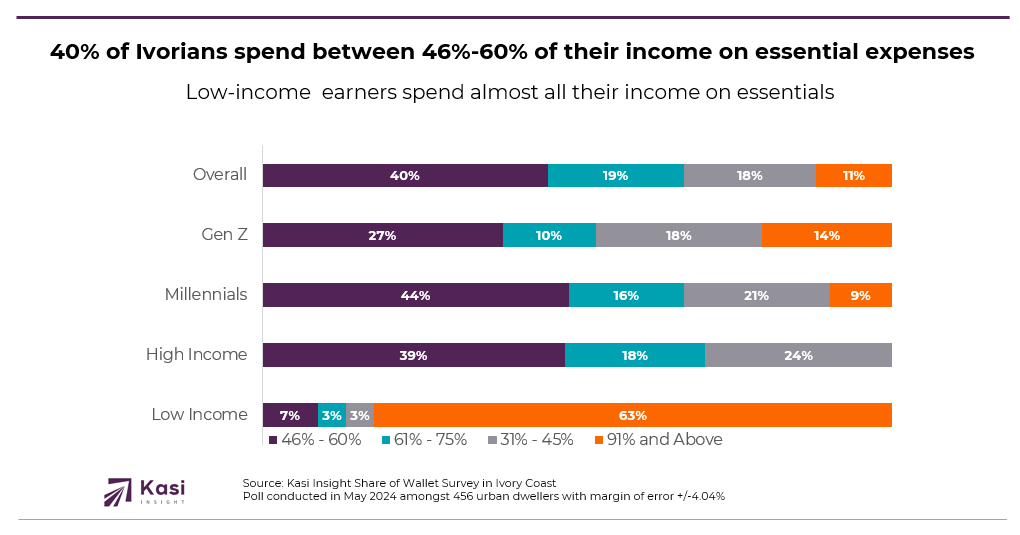
In May 2024, Kasi Insight conducted an extensive Share of Wallet survey across 21 diverse African markets, revealing valuable insights into consumer spending behaviors. This survey explored various aspects of expenditure, including sources of income and the specific consumer-facing products purchased monthly. In Ivory Coast, the data indicated that 40% of respondents spend between 46% and 60% of their household income on essential expenses. Millennials (44%) and Gen Z (27%) are particularly notable for their spending within this range. Among high-income respondents, only 39% fall into this expenditure category, whereas just 7% of low-income respondents do.
Mobile phone services are widely used, with 88% of respondents relying on them for voice, text, and data plans. Adoption rates vary: 93% of Millennials, 69% of Gen Z, 73% of high-income individuals, and 88% of low-income respondents utilize mobile services, highlighting their importance across different demographics. Home internet services are significant as well, with an overall usage rate of 63%. Millennials lead in this area at 66%, reflecting their heavy reliance on stable online connectivity. In contrast, only 41% of Gen Z use home internet. High-income respondents have the highest usage rate at 70%, whereas just 31% of low-income respondents have access, indicating a substantial digital divide.
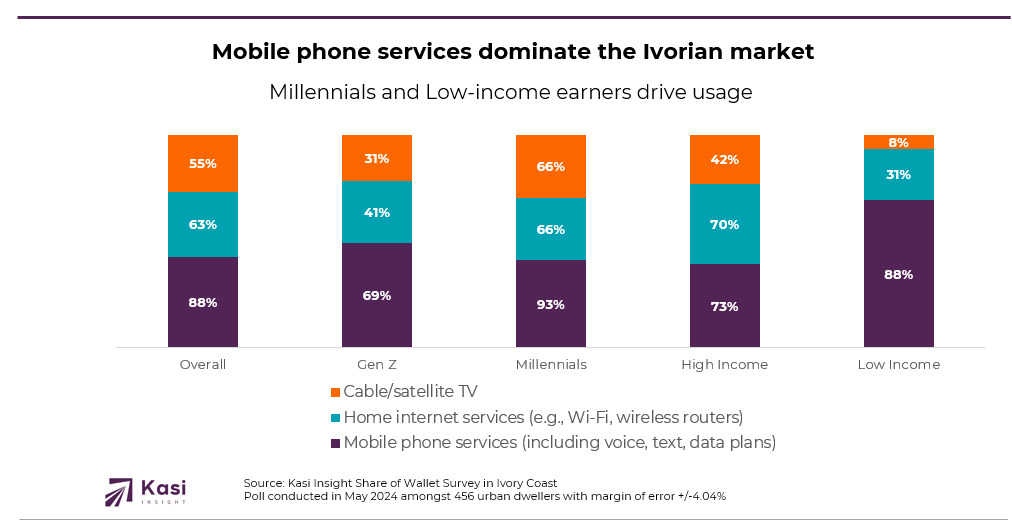
Cable and satellite TV is used by 55% of all respondents, with 66% of Millennials subscribing, compared to 31% of Gen Z. High-income individuals use these services at a rate of 42%, while only 8% of low-income respondents do, further illustrating disparities in media consumption between different income and age group
Several factors influence the choice of telecommunications providers among Gen Z, Millennials, and various income groups. Internet speed emerges as the most critical factor, with 63% of Gen Z, 61% of Millennials, and 57% of all respondents prioritizing it. Reliability and network quality are important for 53% of Gen Z, 34% of Millennials, and 40% of overall respondents. Network coverage area is significant for 45% of Millennials, 27% of Gen Z, and 36% of all respondents.
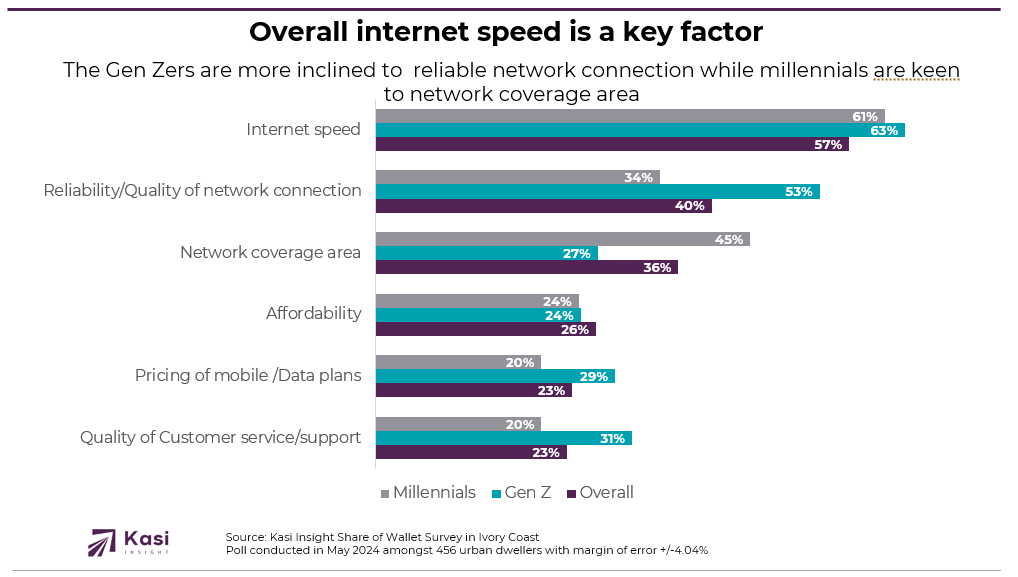
Affordability is crucial for 24% of both Gen Z and Millennials, 27% of high-income respondents, and 34% of low-income respondents, with 26% of overall respondents considering it essential. Pricing of mobile and data plans is important for 21% of high-income and 29% of low-income respondents. Furthermore, quality of customer service is more important to Gen Z (31%) than Millennials (20%), with 42% of high-income and 22% of low-income respondents placing a high value on this aspect.
The data from the May 2024 Kasi Insight survey underscores the need for telecommunications brands to tailor their offerings to different demographic groups. With 93% of Millennials and 88% of low-income respondents heavily relying on mobile phone services, telecom providers should focus on developing affordable and attractive mobile data plans for these segments. Additionally, internet speed and reliability are critical decision factors, with 63% of Gen Z and 61% of Millennials prioritizing these aspects. Brands must therefore invest in high-speed, dependable internet infrastructure to meet the expectations of these user groups, particularly Millennials who lead in home internet usage.
The survey also highlights a significant digital divide, particularly in home internet access, with high-income individuals enjoying better connectivity compared to low-income respondents. To bridge this gap, telecom companies should consider offering tiered pricing or subsidized plans to improve access for low-income customers. Furthermore, quality customer service is crucial, especially for Gen Z, who value it more than Millennials. Enhancing customer support and exploring bundled services that include media content could also appeal to different income groups. By addressing these needs and disparities, telecom brands can improve customer satisfaction, expand their market reach, and build greater loyalty among diverse consumer segments.
Share on socials using this caption: 📊📱 New survey insights reveal that in Ivory Coast, Millennials and Gen Z are major spenders on essentials and heavily rely on mobile phones, but face a significant digital divide in home internet access. Key factors influencing their telecom choices? Speed, reliability, and affordability. #TelecomTrends #IvoryCoast #DigitalDivide
3403 views
Share article
Kenya’s H1 2025 telecom wallet reshuffle reveals new spending logic and growing pressure on brand loyalty
Starlink’s Global Outage Reveals Fragility in Africa’s Connectivity Progress
Mobile money outpaces fintech in Ghana’s digital finance