Sandra Beldine Otieno
April 30, 2024
Share article



Heineken NV's Nigerian unit, Nigerian Breweries Plc, has temporarily closed two of its nine factories in response to severe currency depreciation that has escalated costs and eroded consumer purchasing power. This strategic move aims to dial back a 15% capacity expansion from the past decade and reduce operational expenses. In 2023, the company faced a substantial loss of 106 billion naira ($94 million) due to these heightened costs and broader economic instability. To shore up its finances, Nigerian Breweries intends to raise 600 billion naira from shareholders to manage its foreign-currency debts.
Within a challenging economic landscape, Heineken reported a sharp decline in Nigerian sales volumes, leading to a record net deficit of $240 million for its Nigerian operations. Globally, Heineken’s beer volumes decreased by 4.7% in 2023, with Vietnam and Nigeria accounting for 60% of the downturn. Furthermore, Heineken is exiting its investment in Champion Breweries, selling its 86.5% stake in Raysun Nigeria Company Limited to EnjoyCorp, thus refocusing on its core business in Nigeria. Under new leadership, Champion Breweries also noted a 6.7% revenue drop to NGN 8.36 billion ($5.1 million) for the first nine months of the year, culminating in a net loss of NGN 77.7 million ($51,000).
The Retail Demand Index for beer, as charted by Kasi Insight, acts as a revealing barometer of market trends and the exigent strategic shifts required in the Nigerian beer sector, particularly acute from 2023 forward. Despite a brief period of optimism in 2022, with the index climbing to a high of 49 in June, the trajectory soon reversed, descending sharply to 31 by March 2023. This downward trend persisted into 2024, with the index registering a low of 24 in March, indicative of a prolonged slump in consumer demand.
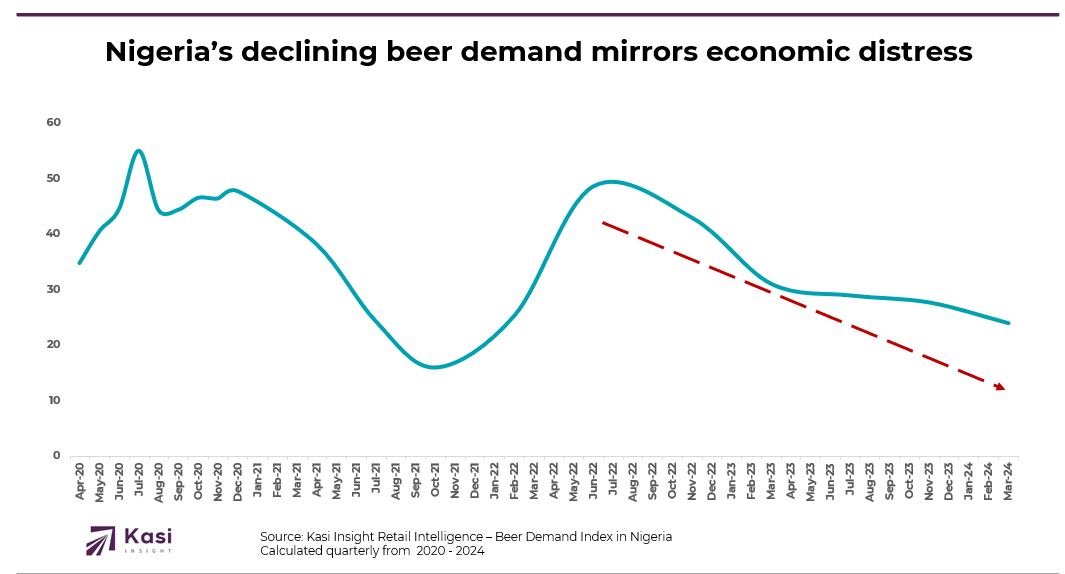
This protracted downturn is symptomatic of Nigeria's economic upheavals, marked by severe inflation and a significant devaluation of the naira, which have deeply influenced the operational dynamics of the beer market. The index's highs and lows—from a promising 55 in July 2020 to a disheartening 16 in October 2021—echo the volatile economic landscape and its direct bearing on sales volumes, resulting in dramatic revenue contractions and record net deficits for the industry.
This persistent low demand not only signifies the economic hurdles consumers face but also casts light on the waning purchasing power that is affecting the entire beverage sector. As a result, the industry has seen closures of facilities as part of a wider strategy to consolidate operations, curtail expenses, and navigate the financial storm, aiming to secure the long-term viability of the beer market in an unpredictable economic environment.
Like Heineken, several other multinationals, including Procter & Gamble, GSK, and Bayer AG, have either restructured or withdrawn from Nigeria due to similar economic pressures. Despite a recent appreciation, the Nigerian naira remains about 50% weaker than the previous year, continuing to place significant financial stress on businesses.
The continuous depreciation of the naira escalates operational costs dramatically and diminishes consumer purchasing power, creating a cycle of reduced spending that impacts revenue streams across sectors. This economic reality forces companies to rigorously evaluate their operational efficiencies and financial strategies. Businesses are compelled to implement stringent cost management practices and optimize resource allocation to avoid unsustainable expenditures.
Given the likelihood that these economic conditions will persist, companies must adopt highly adaptive business models. The necessity for flexibility in adjusting supply chains, streamlining operations, and possibly even reducing the workforce becomes critical in maintaining operational viability. Without significant adaptations, businesses risk severe consequences, including the need to scale down operations drastically or, in worst-case scenarios, shut down entirely.
The economic challenges faced by Heineken's Nigerian unit, Nigerian Breweries Plc, underscore the broader difficulties confronting businesses operating in Nigeria's volatile market. Severe currency depreciation, alongside operational setbacks, has compelled Heineken to take strategic measures, including factory closures and financial restructuring, to mitigate losses and ensure sustainability. These challenges are not unique to Heineken, as evidenced by the struggles faced by other multinationals operating in Nigeria, leading to restructuring or withdrawal from the market. The persistent economic instability necessitates a proactive and adaptive approach from businesses, requiring stringent cost management, operational flexibility, and strategic foresight to navigate the unpredictable landscape. Moreover, the retail demand index for beer in Nigeria, provided by Kasi Insight, serves as a critical indicator of market trends and consumer behavior, offering valuable insights into Heineken's sales performance and strategic adjustments. Companies that fail to adjust risk significant financial repercussions, while those that demonstrate resilience and flexibility stand better positioned to thrive despite the economic headwinds, ensuring long-term viability and profitability in Nigeria's challenging business environment.
Share on socials using this caption: 📉💼 Facing Nigeria's economic squall, Heineken restructures to keep the taps flowing. Factory closures, strategic shifts, and a fresh financial game plan – here’s to turning challenges into opportunities. #MarketResilience #HeinekenMoves #ResilienceInBrewing
2597 views
Share article
Cameroon’s protein market in 2026 is shifting from habitual consumption to structured and intentional demand
Consumer Choices Post COVID-19 Are Redefining Kenya’s Beverage Landscape
Nigeria’s alcoholic beverages market shows resilience in beer but steep H1 declines in premium categories