Yannick Lefang, Eng
March 3, 2026
Share article



Across boardrooms in Nairobi, Lagos, Johannesburg and Cairo, I’ve noticed something interesting. The conversation is changing. For years, executives asked for data, dashboards, reports, insights. Today, the question is different.
They are asking for foresight.
This is not just a new buzzword. It reflects something deeper. Business leaders across Africa are feeling the ground shift beneath them. The last five years have disrupted almost every assumption we used to rely on. Inflation has compressed purchasing power. Currency volatility has redefined margins. Youth unemployment has reshaped consumption behaviour. Digital platforms have leapfrogged traditional infrastructure. Political cycles have influenced consumer sentiment in real time.
Markets are no longer moving in straight lines. They are oscillating.
And when markets oscillate, backward-looking insight is no longer enough.
For a long time, many businesses operated with relatively linear assumptions. If GDP grows, demand grows. If the population increases, sales increase. If urbanisation rises, modern retail wins. But the reality we now face is more complex. Consumers are adapting faster. Trust is shifting. Informality is resilient. Digital ecosystems are evolving independently of traditional systems.
The pace of change has accelerated.
Foresight, in this context, is not about predicting the future. It is about preparing for multiple plausible futures. It is about understanding the structural forces shaping the next three to five years and modelling how those forces might interact. It is about asking disciplined questions: What happens to demand if inflation remains elevated for longer than expected? What happens to brand loyalty when disposable income remains under pressure? What happens to credit risk in a gig-dominated youth economy? What happens to formal retail if informal trade digitises at scale?
Foresight is not guesswork. It is structured anticipation.
To build that anticipation, organizations must go beyond traditional reporting. They need to understand the deeper drivers at play — demographic shifts, economic cycles, digital acceleration, institutional trust volatility, climate vulnerability, regulatory evolution. They need to model scenarios rather than rely on single forecasts. They need to stress-test strategy against more than one possible outcome.
And they need to monitor leading signals in real time.
But there is a critical foundation that is often overlooked in this conversation.
You cannot model the future if you do not deeply understand the past.
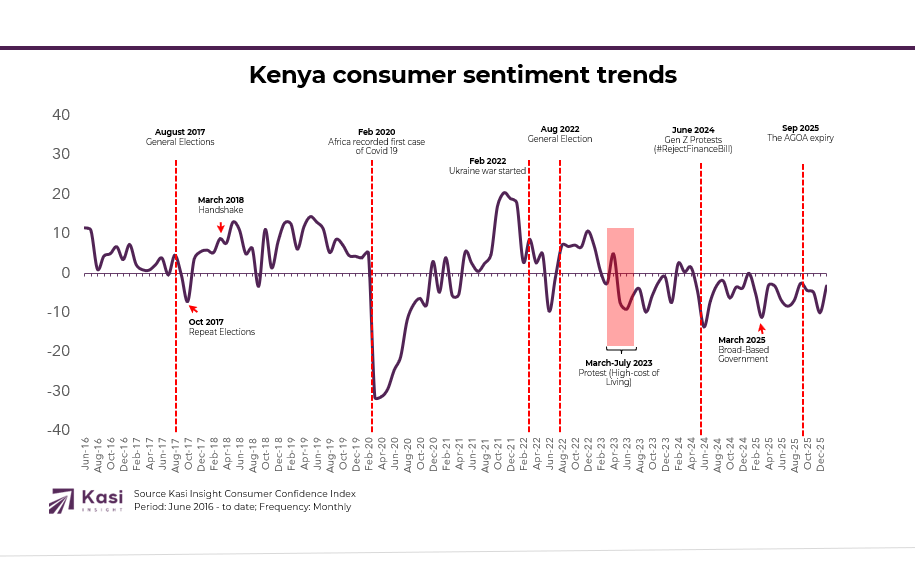
Foresight is built on historical depth. Not on one-off surveys. Not on quarterly snapshots. It is built on longitudinal data — consistent, high-frequency tracking that allows you to see patterns, thresholds, and inflection points.
Without multi-year data, you cannot identify when sentiment begins to weaken before demand contracts. You cannot measure how long it takes consumers to downtrade after a price shock. You cannot see which segments recover first after political uncertainty. You cannot detect whether sustainability preference is cyclical or structural.
Historical data gives you baselines. Baselines give you signals. Signals give you scenarios.
In Africa, this kind of structured, longitudinal consumer intelligence has historically been fragmented. Data has often been episodic. Short-term. Project-based. That fragmentation has limited our ability to build predictive infrastructure for the continent.
True foresight requires scale. Millions of data points. Thousands of consistently asked questions. Monthly or quarterly tracking. Granular segmentation across age, income and geography. The ability to correlate behavioural shifts with economic indicators. The discipline to measure sentiment before it becomes spending behaviour.
Only then can you build reliable consumer sentiment indices, retail demand forecasts, credit signal indicators and archetype evolution models. Only then can you assign probability to scenarios rather than simply describe trends.
Africa is one of the youngest and most dynamic regions in the world. It is also one of the most volatile. Rapid urbanisation, digital adoption, demographic expansion and informal market dominance make our markets uniquely complex. The margin for strategic error is shrinking. A bank that misreads credit sentiment risks portfolio stress. An FMCG brand that misreads downtrading loses share. A telco that misreads digital behaviour becomes irrelevant.
In compressed markets, mistakes compound faster.
Organizations that embed foresight into their decision-making gain a powerful advantage. They reallocate capital earlier. They protect margins before shocks fully materialize. They adjust pricing and product architecture ahead of compression cycles. They position brands around emerging realities instead of outdated assumptions.
A quiet divide is emerging in African markets. On one side are companies still reacting to yesterday’s dashboards. On the other are companies modelling tomorrow’s possibilities.
The second group will define the next decade.
Africa does not lack ambition. It does not lack entrepreneurship. It does not lack growth potential. What it has lacked, historically, is forward-looking intelligence infrastructure built specifically for its realities.
The future will reward those who invest in structured anticipation. Those who combine historical depth with scenario modelling. Those who treat uncertainty not as chaos, but as a system that can be analysed.
Foresight is no longer a luxury reserved for global consultancies or multinational corporations. It is becoming a strategic necessity for any African institution serious about sustainable growth.
In volatile environments, the future does not belong to the reactive.
It belongs to the prepared.
And preparation begins with foresight — grounded in history, disciplined in analysis, and bold in execution.
The future of African markets will not be shaped by those who react to volatility. It will be shaped by those who anticipate it. The institutions that invest today in structured foresight — grounded in historical depth, disciplined scenario modelling and live signal monitoring — will define the next decade of growth. The question is not whether the future will be uncertain. It is whether you are prepared for it.
At Kasi Insight, we believe Africa deserves its own foresight infrastructure — built on deep, longitudinal data and structural scenario modelling. We are committed to building it. The invitation is open to institutions ready to think beyond the quarter.
Contact our team today to explore how structured foresight can give your institution the edge to anticipate change, protect margins, and lead in Africa’s dynamic markets. Win with confidence with Kasi Insight. https://www.kasiinsight.com
Share on socials using this caption: 🌍📈 In African markets, backward-looking insight is no longer enough. The future belongs to institutions that anticipate change through structured foresight. Combine historical depth, scenario modelling, and live signal tracking to stay ahead of volatility and define the next decade of growth. #AfricaInsights #Foresight #StrategicGrowth #ConsumerIntelligence
325 views
Share article
A Strategic Material for Development Sustainable Roads in Africa
Africa’s Data Dilemma: Waiting for the Porsche While Refusing the Bicycle
AGOA’s uncertain extension is a warning for Africa’s industrial future