Joy Muindi
August 4, 2025
Share article



Uganda’s alcohol market is shaped by familiar favorites and emerging shifts. While beer remains the most widely consumed beverage across all demographics, wine commands the highest consumer spend. Insights from Kasi Insight’s Q2 2025 Share of Wallet Tracker reveal a layered market defined by generational preferences, evolving tastes, and distinct spending behavior.
Alcohol consumption in Uganda varies more by generation than by gender. Gen X leads the way, with 18% drinking daily and 57% at least once a week. Millennials follow with 45% weekly consumption, while Gen Z trails at 36%. However, Gen Z records the highest monthly consumption rate at 32%, suggesting a shift toward occasion-based, purposeful drinking.
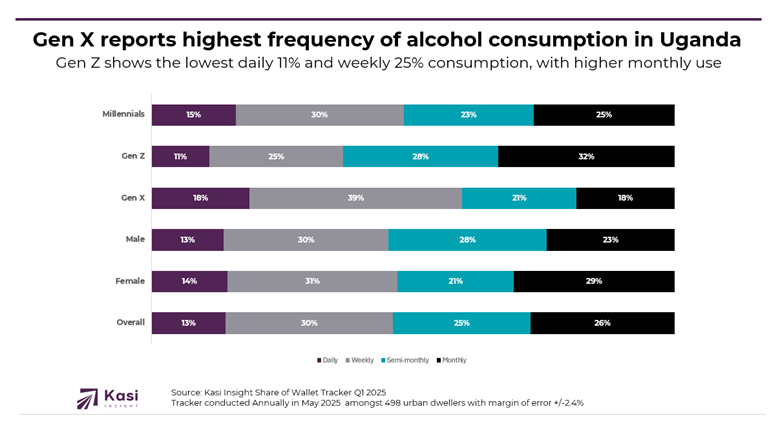
The gender gap is minimal. 14% of women report daily purchases, nearly matching the 13% among men. Weekly purchase rates are equally close, with 31% of women and 30% of men. These figures reveal a more balanced participation between genders in alcohol consumption.
Beer is the most consumed alcoholic beverage across all age and gender groups, confirming its mass-market dominance. Beyond this shared preference, however, the next-in-line choices begin to diverge, revealing growth opportunities for more targeted offerings.
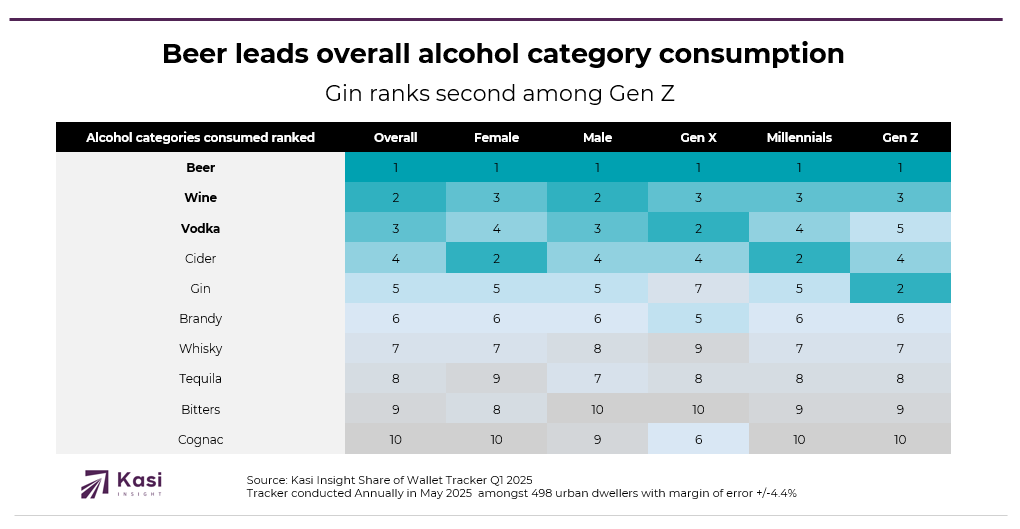
Among women, wine and cider rank just behind beer. Men prefer vodka and wine. Gen X leans toward vodka and wine, while Millennials show stronger preferences for cider and gin. Gen Z prefers gin first, then cider. These patterns highlight a generational pivot toward lighter, more experimental beverages and offer strong cues for innovation and segmentation.
Although wine is not the most commonly consumed drink, it holds the highest value per consumer. A third of wine buyers spend between UGX185,001 and UGX370,000 monthly, placing it firmly in the premium tier. Wine consumption appears tied to specific occasions and more affluent consumers, making it a high-margin category.
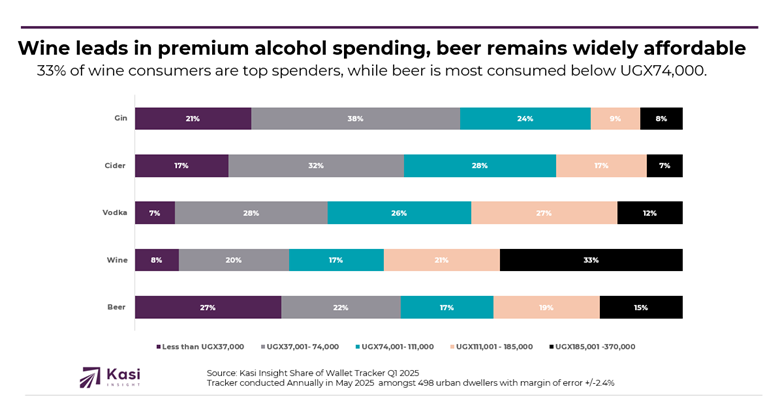
In contrast, beer maintains a more balanced spending pattern. 15% of consumers fall into the top spend bracket, but larger proportions spend less. 27% of beer drinkers spend below UGX37,000 monthly, while 22% fall into the UGX37,001 to UGX74,000 bracket. Vodka spending is concentrated in the mid-tier, with 27% of consumers spending between UGX111,001 and UGX185,000. Gin shows its strength as an accessible spirit, with 38% of its spenders falling in the UGX37,001 to UGX74,000 range.
Understanding who consumes alcohol and how often only tells half the story. Spending data reveals purchasing power and brand intent. Wine’s premium profile and lower frequency make it ideal for upscale channels such as fine dining, specialty retail, and gifting occasions. Beer’s wide reach and varied spend levels suit both traditional and modern trade, with opportunities for entry-level packs, multi-buy promotions, and premium tiers.
Vodka and gin, with their appeal to mid-income and younger consumers, are best positioned in supermarkets, convenience outlets, and digital platforms. Gin, in particular, benefits from campaigns that emphasize lifestyle, flavor, and value. Cider shares a similar trajectory and should be marketed through trend-driven, youth-focused channels.
Brands that succeed will be those that do more than meet demand. They will read between the data points, anticipate shifts in taste and wallet share, and adjust their strategies accordingly. In a market where beer wins on volume but wine wins on value, the most resilient players will balance breadth of reach with depth of relevance.
Share on socials using this caption: 🍺 Beer is still Uganda’s go-to drink, but 🍷 wine takes the lead in spending 💰 Gen Z is sipping smarter with a rising love for 🍸 gin and 🍏 cider less often, more intentionally 🙌 #ConsumerInsights #AlcoholTrends #UgandaMarket #GenZ #GinLovers #BeerVsWine #KasiTracker
1378 views
Share article
Nigeria’s alcoholic beverages market shows resilience in beer but steep H1 declines in premium categories
Fresh staples stay strong as Nigeria’s food market splits between value seekers and quality spenders
Tanzanian consumers are balancing value and purpose in their food purchases