Sandra Beldine Otieno, MSc
March 27, 2025
Share article


Donald Trump’s return to power has reignited political debates across the world, and Africa is no exception. Kasi Insight’s - Africa Sentiment on Trump's Administration Survey reveals a continent at a crossroads. While some African nations remain loyal to Trump’s leadership, others are looking inward, with a growing push for self-reliance and regional economic strength.
Trump’s approval rating in Africa stands at 54%, with 17% disapproving and 29% neutral, but a closer look reveals stark differences between countries. Nigeria leads with 72% approval, followed by Ivory Coast at 64%, Cameroon and South Africa at 57%, and Kenya at 49%. On the other hand, Ghana records the lowest approval at 34%, while Tanzania stands at 45%, with a notably high neutrality rate of 41%.
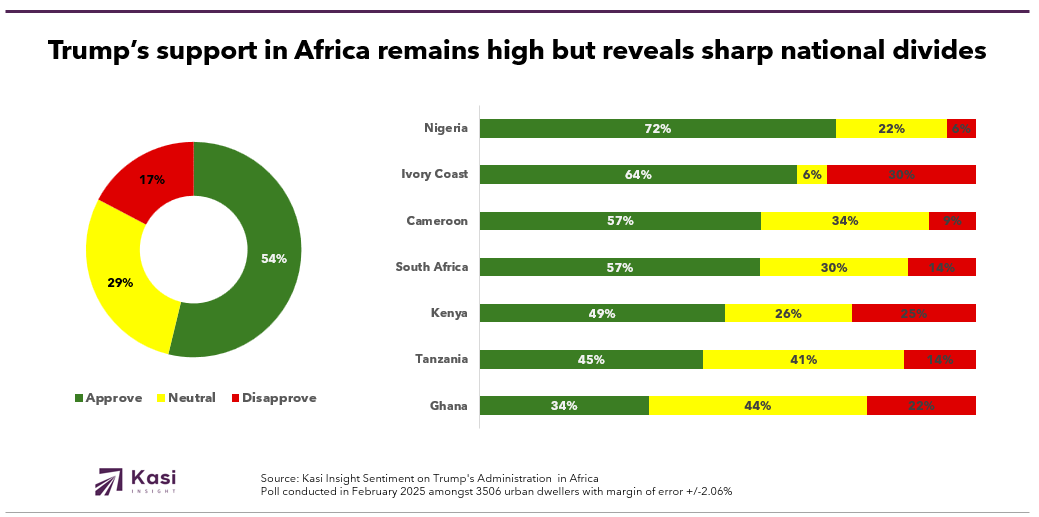
Nigeria’s overwhelming support suggests that Trump’s policies, particularly his firm stance on China, resonate with many Nigerians given the country’s historically strong ties with the United States. In Ivory Coast, 64% approve of Trump’s leadership while 30% disapprove, reflecting a more divided sentiment. Ghana’s low approval and high neutrality at 44% indicate hesitation, likely stemming from concerns about how Trump’s policies will impact Africa’s trade, foreign aid, and diplomatic relations. Similarly, Tanzania’s 41% neutrality suggests a population still weighing the risks and benefits of Trump’s leadership.
While some African countries remain optimistic, skepticism is growing in others. Ivory Coast at 30% and Ghana at 22% have the highest disapproval ratings, signaling unease over the potential consequences of US isolationism, shifting diplomatic priorities, and economic unpredictability under Trump. The divide suggests that while some nations see potential in Trump’s leadership, others are more cautious about its long-term implications for Africa.
The survey results suggest that many Africans are reconsidering their global alliances and looking beyond the US for economic partnerships. When asked how Africa should respond to Trump’s leadership, 42% favored strengthening intra-African trade and regional integration rather than depending on the US This view was strongest in Ghana (60%) and Cameroon (51%), reinforcing the push for economic resilience through initiatives like the African Continental Free Trade Area (AfCFTA). The momentum behind regional integration reflects a broader desire to expand African markets and reduce reliance on external economies.
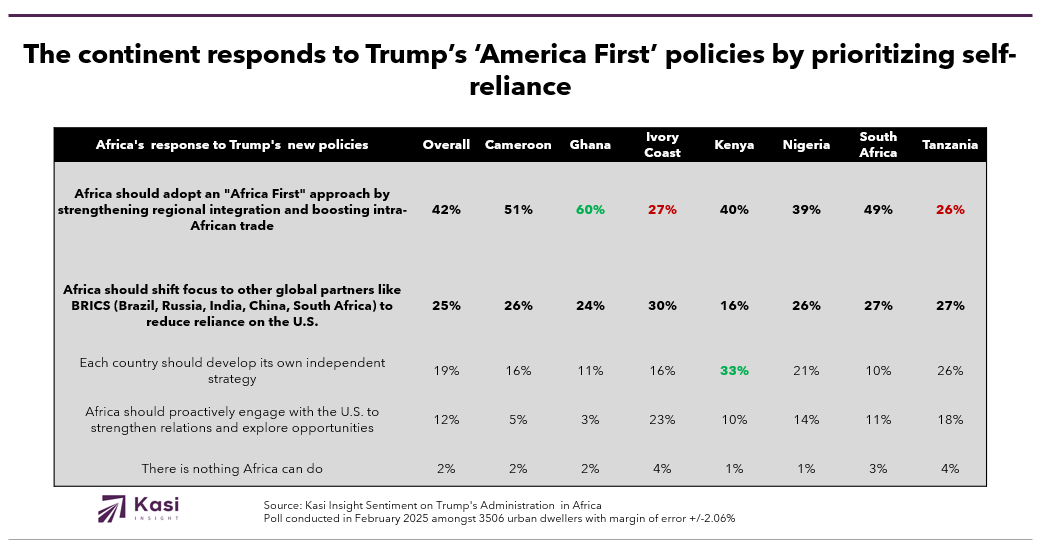
At the same time, 25% of respondents support shifting economic focus toward BRICS nations—Brazil, Russia, India, China, and South Africa. Ivory Coast (30%) and Tanzania (27%) showed the highest support for this pivot, reflecting growing interest in alternative partnerships. With China and Russia deepening their investments in Africa, many see BRICS as a more stable and long-term economic ally, particularly as Trump’s “America First” policies prioritize US interests over international cooperation.
Despite Trump’s continued backing in certain regions, only 12% of respondents believe Africa should engage more with the US, with Ivory Coast showing the highest support at 23%. Across the continent, skepticism toward US engagement is rising, and many nations prefer a more self-reliant approach. In Kenya, 33% of respondents support country-specific foreign policies, favoring bilateral agreements over broad regional or global alignments.
These shifting perspectives highlight a wider realignment of Africa’s diplomatic and economic priorities. While Trump remains popular in some regions, his return has accelerated conversations about self-sufficiency and new global partnerships. Africa is no longer waiting for the US to dictate its future. Instead, it is actively forging its own path.
The survey results point to a continent that is no longer willing to take a passive role in global geopolitics. The strong preference for regional trade, self-reliance, and diversified partnerships signals a decisive shift toward economic independence and long-term stability. African nations are reassessing their place in the global economy, prioritizing strategies that strengthen regional integration, industrial growth, and financial autonomy rather than relying on external powers.
While Trump’s presidency still has loyal supporters in some African countries, the broader trend suggests that African leaders and citizens are looking beyond the US and focusing on economic and diplomatic alliances that put Africa first. The momentum behind intra-African trade and the pivot toward BRICS nations reflect a continent intent on shaping its own economic destiny rather than adapting to shifting US policies. If these sentiments turn into concrete policy actions, Africa’s future will be driven by its own vision for sustainable growth, strategic partnerships, and a stronger regional economy.
As Trump’s administration unfolds, the question is no longer how his policies will affect Africa, but rather how Africa will assert itself in the changing global landscape. What is clear from the survey is that Africa is no longer waiting for US policies to define its next steps. The continent is moving forward on its own terms, actively building a future that is shaped by its ambitions, not by Washington’s agenda.
Share on socials using this caption: 📊 Trump is back, but Africa is not waiting. From Nigeria’s support to Ghana’s caution, the continent is pivoting to self-reliance, AfCFTA, and BRICS. Africa is shaping its own future — with or without Washington. #AfricaFirst #IntraAfricaTrade #BRICS #AfCFTA #TrumpAfrica #KasiInsight 🌍💼📈
1470 views
Share article
A Strategic Material for Development Sustainable Roads in Africa
Foresight Is No Longer Optional: Why Africa’s Decision Makers Must Move From Insight to Intelligence
Africa’s Data Dilemma: Waiting for the Porsche While Refusing the Bicycle