Sandra Beldine Otieno, MSc
July 3, 2025
Share article



As summer inspires fresh journeys, African travelers are revealing a quiet transformation that reaches far beyond the thrill of packing a suitcase. This change is about more than holidays. It reflects a search for identity, a renewed trust in local experiences, and the enduring belief that travel can expand one’s sense of possibility. Kasi Insight’s African Travel Perception Survey shows that while Europe and North America still hold the promise of prestige, more Africans are starting to look closer to home for meaning, connection, and value. This shift is fueled by aspiration, shaped by familiarity, and ultimately anchored by the feeling of safety and belonging.
For many Africans, vacationing abroad is not simply about leisure. It is an opportunity to affirm personal growth and unlock experiences that feel more rewarding. Across the seven countries surveyed, 47% of respondents say they plan to travel internationally in the coming months.
In Nigeria, this figure rises to 65%, reflecting a deep link between crossing continents and signaling personal advancement. The Democratic Republic of Congo shows a similar pattern, with 64% of respondents intending to vacation abroad. Even in Ethiopia, 53% of travelers express plans to explore beyond their borders. These numbers underscore how powerful the image of Europe or North America remains in the African imagination.
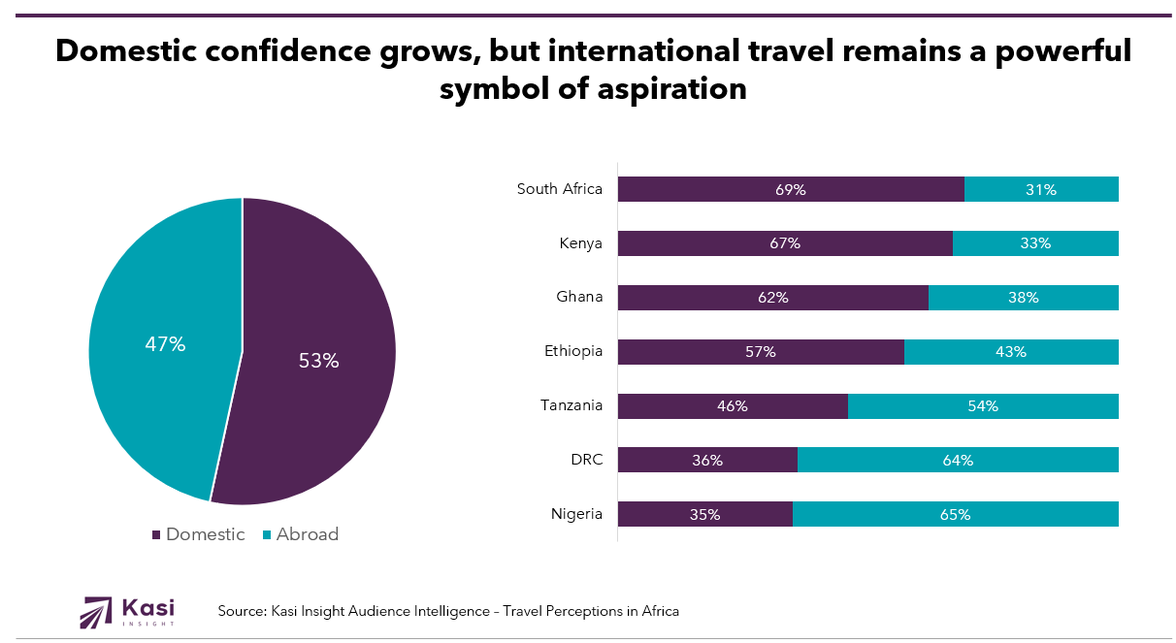
By comparison, Kenya and South Africa illustrate how domestic confidence can gradually replace the allure of foreign destinations. In Kenya, 67% of respondents plan to stay within national borders. South Africa reports an even higher share at 69%. These travelers show that when local tourism feels mature, safe, and reliable, the need to look outward diminishes naturally.
While the desire for international experiences is strong, budget realities often reshape priorities in unexpected ways. When asked where they would go if budgets were limited, 31% overall still selected Europe as their first choice. This share climbs to 44% in the Democratic Republic of Congo and 41% in Ethiopia, revealing how powerfully European destinations capture aspiration even under financial pressure.
However, in markets where local tourism has gained credibility, travelers demonstrate greater flexibility. In Kenya, 34% say they would explore within Africa if budgets were tight. Ghana matches this proportion, while Tanzania follows closely at 32%. These patterns suggest that when travelers trust what regional destinations can offer, their ambitions adjust without feeling compromised.
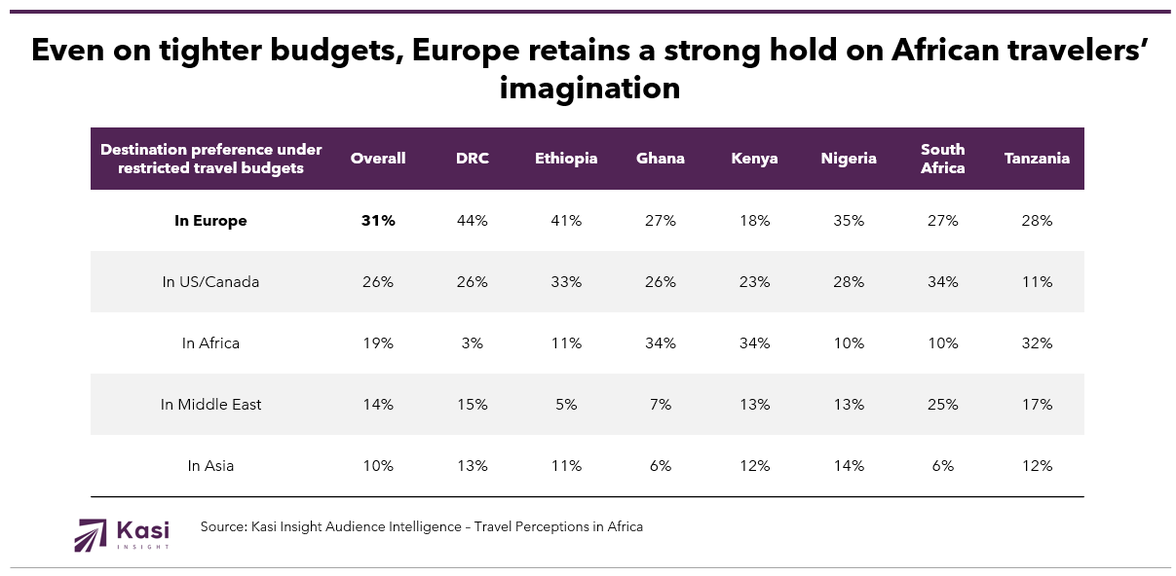
Despite this progress, the overall preference for intra-African travel remains relatively low at 19%. By comparison, European travelers report nearly 40% preference for regional trips. This gap points to an important opportunity: as domestic and regional experiences become easier to access and better marketed, more Africans may see nearby destinations as compelling alternatives to long-haul journeys.
One of the most persistent barriers to regional travel is not simply cost or infrastructure but limited knowledge. Many Africans have little familiarity with neighboring regions and therefore do not consider them viable travel options.
The survey shows that 69% of Kenyans feel they know East Africa well, and 72% of Tanzanians say the same. South Africans are the most regionally aware, with 69% indicating familiarity with Southern Africa. Beyond these zones, awareness declines sharply. In Kenya, only 21% recognize West Africa as a distinct region. In the Democratic Republic of Congo, only 14% can identify Central Africa despite its proximity. Even in Nigeria, which is part of West Africa, just 36% feel they know their own region well enough to consider visiting.
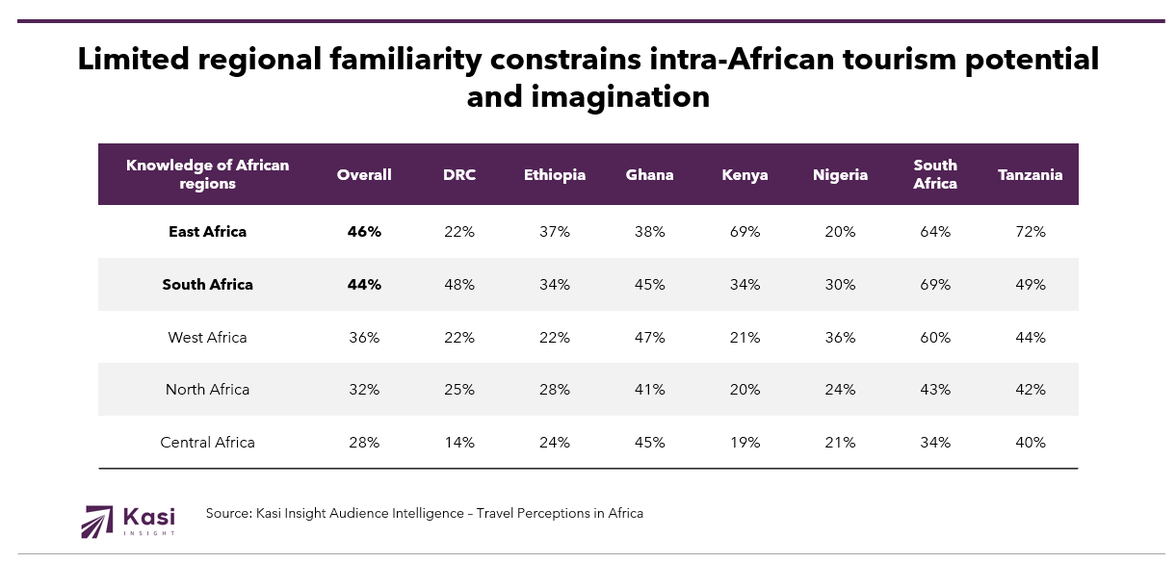
This lack of regional storytelling and visibility limits curiosity and constrains intra-African tourism. Destinations that invest in clear narratives, stronger marketing, and improved cross-border partnerships will have the best chance to inspire travelers to look inward before looking outward.
After aspiration and awareness shape initial interest, final decisions come down to factors that feel personal and profound. Across the continent, safety stands out as the most powerful influence. In six of the seven countries surveyed, safety ranks first, highlighting how strongly the need for predictability and peace of mind guides travel plans. Only in Ghana does safety fall to the tenth position, suggesting that travelers there may focus on other priorities or feel confident about baseline security. The friendliness of local communities is almost as decisive. Ranked second overall, it holds the top spot in the Democratic Republic of Congo and Ethiopia and the second position in Kenya. Whether shaped by shared language or warm welcomes, this sense of connection influences whether travelers feel a destination will be truly restorative.
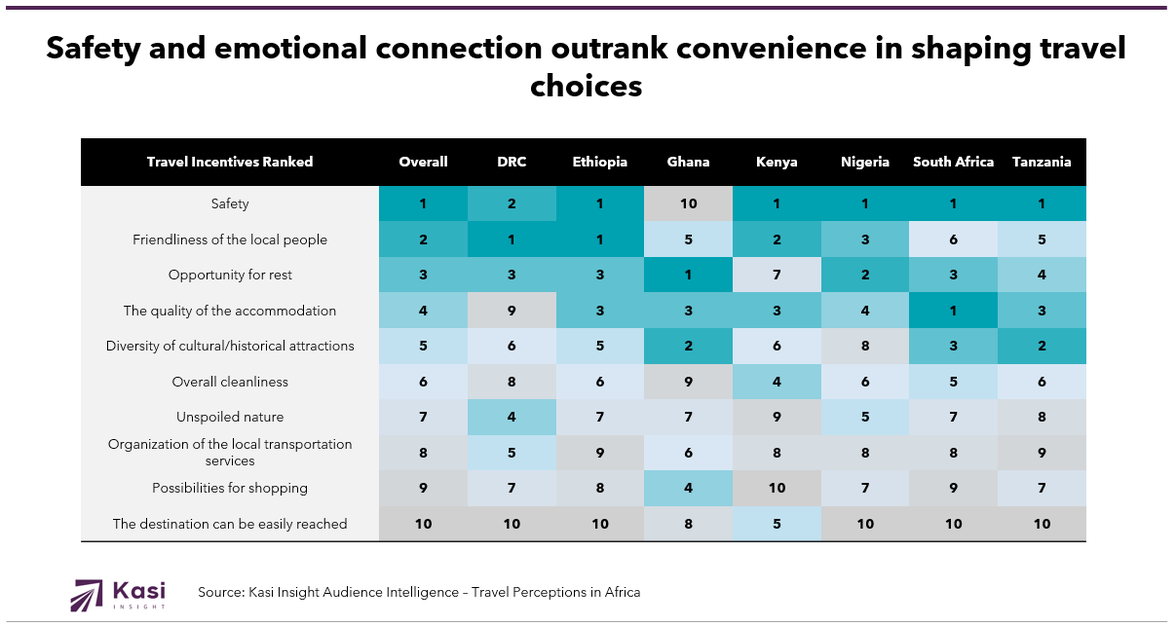
The opportunity for rest also carries significant weight. It ranks third overall and appears among the top three drivers in most markets. In Ghana, it comes first, while in Nigeria it is second and in Tanzania and Ethiopia it ranks third. This shows how many travelers value the chance to disconnect as much as the experience itself. In contrast, practical considerations such as shopping and convenience often rank lower. Shopping is placed ninth overall and falls to the bottom in Kenya, Nigeria, and South Africa. The ease of reaching a destination is ranked last in nearly every country. These patterns reveal that African travelers choose destinations less for material amenities and more for the promise of feeling secure, welcomed, and emotionally refreshed.
This research reveals a continent balancing longstanding dream of European exploration with a growing interest in local and regional journeys that feel authentic and trustworthy. While infrastructure gaps, air connectivity, and visa processes still pose barriers, the appetite for domestic discovery is unmistakable. As marketing becomes more vibrant and logistics improve, more Africans will see their own regions not as second-best but as destinations worthy of pride.
For tourism boards, airlines, and hospitality brands, this is an invitation to rethink how Africa is presented to its own citizens. Those who invest in clear information, inspiring stories, and visible commitments to safety will define the next decade of travel. The future belongs to those who help African travelers feel confident, respected, and proud of choosing their continent first.
Share on socials using this caption: 🌍✈️ African travelers are redefining where adventure begins! From the allure of Europe to the comfort of local escapes, safety 🤝 trust are reshaping every journey. Explore the data behind this quiet transformation. 💡✨ #AfricanTravel #TourismTrends #TravelAfrica #KasiInsight
1298 views
Share article
Senegal's Travel Odyssey: Decoding the Wanderlust Patterns
Moving into the holiday season, safety and culture for Tanzanian travelers is key.
Summer Traveling in Africa