Sandra Beldine Otieno, MSc
January 24, 2025
Share article



The year 2024 marked a defining moment in South Africa’s history, as political and economic landscapes underwent significant shifts. On May 29, the country held its most anticipated general election in decades, delivering a historic outcome: the African National Congress (ANC) lost its absolute parliamentary majority for the first time in three decades. This unprecedented result paved the way for the formation of a coalition Government of National Unity (GNU) on June 14, which formally took office on June 30 under President Cyril Ramaphosa. While the political renewal inspired hope for reform, the slow pace of economic recovery and persistent structural issues tempered expectations. Kasi Insight’s consumer sentiment data reveals a population oscillating between cautious optimism and deep frustrations, providing a lens into the challenges and opportunities facing South Africa as it enters 2025.
The run-up to the general elections in May was marked by widespread demand for change, with citizens growing weary of slow economic progress and governance inefficiencies. Anticipation for reform fueled public optimism, as evidenced by Kasi Insight’s Index of Consumer Sentiment (ICS), which climbed to a high of 70 in March. Similarly, the Index of Future Expectations (ICE) peaked at 79, reflecting heightened hope for meaningful change in governance and policy direction.
The May 29 election results heralded a new era. The ANC’s loss of its absolute majority led to intense negotiations, culminating in the formation of a diverse coalition government. The GNU included the ANC, Democratic Alliance, Inkatha Freedom Party, Patriotic Alliance, and other smaller parties. For the first time, South Africa faced the complexities of shared governance at the national level, raising expectations for accountability and collaborative problem-solving.
While the coalition brought political stability, the realities of managing such a diverse cabinet soon became apparent. The alignment of conflicting priorities slowed the rollout of urgent reforms, leaving a population eager for tangible progress. By year’s end, public patience had begun to wear thin as challenges such as unemployment and energy supply persisted without clear solutions.
Kasi Insight’s consumer sentiment data provides a nuanced view of how South Africans responded to the events of 2024. While optimism peaked in the months leading up to the election, sentiment became increasingly volatile as the year progressed. The ICS, which measures overall consumer confidence, experienced significant fluctuations, falling from 70 in March to -6 in June, as voters faced the uncertainty of coalition negotiations and the lack of immediate economic relief.
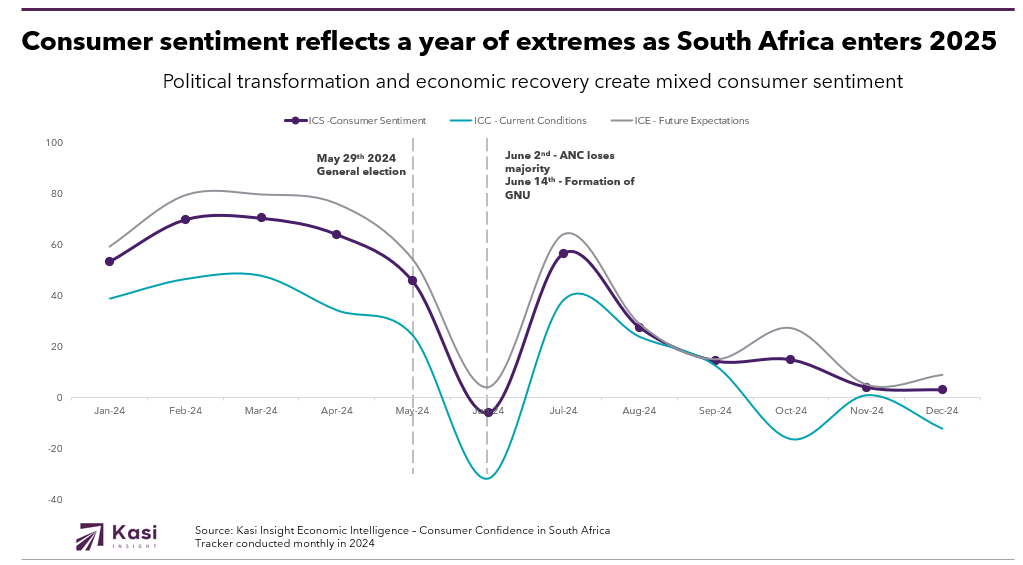
The Index of Current Conditions (ICC), which captures perceptions of daily economic realities, fell sharply to -32 in June, reflecting dissatisfaction with rising living costs, stagnant wages, and continued energy disruptions. This low point came as households struggled to manage their financial burdens amid limited signs of improvement in service delivery or job creation. Even after the coalition government took office in late June, the ICC remained negative, underscoring the persistent challenges facing ordinary citizens.
Despite a brief recovery in sentiment during July, when the ICS rebounded to 57, optimism quickly faded in the latter half of the year. By December, the ICS had fallen to just 3, and the ICE dropped to 9, reflecting widespread skepticism about the government’s ability to fulfill its promises. The volatility in sentiment throughout 2024 highlights a population torn between hope for reform and frustration over the slow pace of progress.
As South Africa steps into 2025, the Government of National Unity faces immense pressure to turn political stability into tangible reform. Key priorities include addressing high unemployment, reforming state-owned enterprises, and improving service delivery. Without swift, visible progress, the goodwill generated by the coalition’s formation risks eroding further, leaving the country vulnerable to deepening frustrations.
The sharp fluctuations in sentiment throughout 2024 reveal both the resilience and impatience of South Africans. While optimism remains, it is fragile and contingent on bold leadership and meaningful reforms. The coalition must focus on delivering measurable improvements that restore trust and meet the expectations of a weary but hopeful population.
Despite the challenges, 2025 offers a unique opportunity to reset South Africa’s trajectory. The diverse coalition, if managed effectively, can bring fresh perspectives and collaborative solutions to long-standing problems. With clear priorities and decisive action, the government can harness the resilience of its people to drive inclusive growth and stability. The stakes are high, but so is the potential for South Africa to emerge stronger and more united than ever.
Share on socials using this caption: 🌍✨ A new chapter for South Africa! After a historic coalition government in 2024, 🇿🇦 steps into 2025 with hope for reform, but the pressure is on to deliver real change. Can bold leadership restore public trust? #SouthAfrica2025 #LeadershipMatters #ConsumerSentiment #HopeAndReform #CoalitionGovernment
2534 views
Share article
A Strategic Material for Development Sustainable Roads in Africa
Foresight Is No Longer Optional: Why Africa’s Decision Makers Must Move From Insight to Intelligence
Africa’s Data Dilemma: Waiting for the Porsche While Refusing the Bicycle