Claudine Linda Wa Nciko
August 21, 2024
Share article



The Kasi Retail Demand Index offers valuable insights into consumer demand for various retail categories in Kenya. The index, which ranges from +100 to -100, measures how consumer habits influence demand across different categories. A higher index value indicates strong consumer interest and purchasing intent, while a lower value suggests decreased demand. In February 2022, the overall alcohol demand was strong, with an index score of 26.1. This demand gradually decreased, hitting a low of 7.9 in March 2023 before slightly rebounding to 10.8 in July 2023 and the lowest was in July 2024 (7.8), indicating a significant drop in overall demand over time.
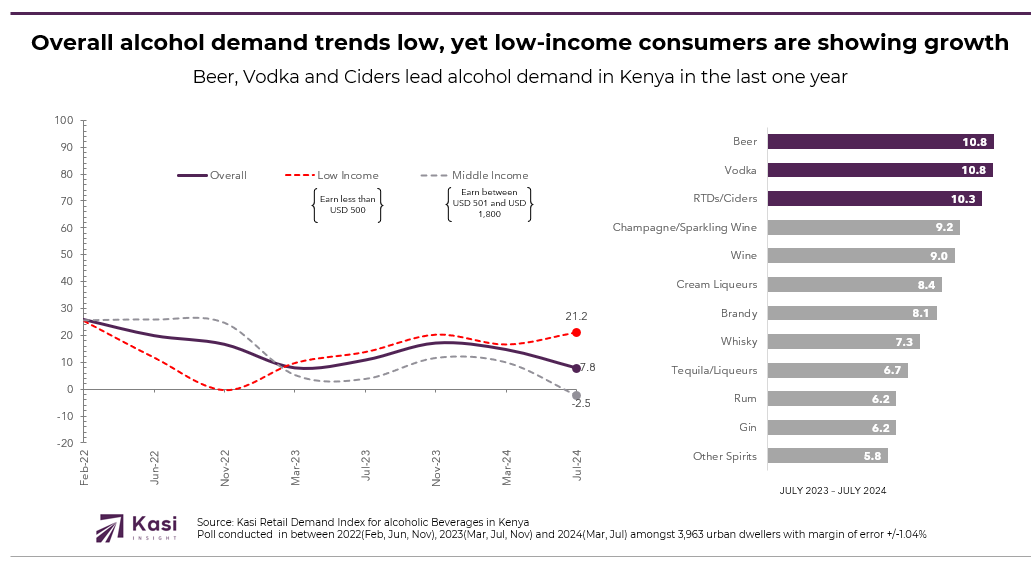
While there are marked differences in alcohol demand when viewed by income levels, the data indicates that gender and generational differences are less pronounced. The variations in demand are more closely tied to income, with middle-income earners showing the most significant decrease. Consumers in this segment saw demand fall from a high of 25.9 in June 2022 to a negative index value of -2.5 in July 2024, indicating a significant decline. Low-income consumers exhibited a different trend, with demand recovering from a low of -0.5 in November 2022 to 21.2 by July 2024, suggesting increasing demand over time.
Analyzing the demand trends for the top two alcohol categories—vodka and beer—across four quarters from Q3 2023 to Q2 2024, it is evident that 2023 saw significantly higher demand for these categories compared to the available data for 2024. Vodka demand stood at 11.2 in Q3 2023, rising to a peak of 14.8 in Q4 2023. In the first half of 2024, the demand for vodka dropped considerably, with the index falling to 7.3 in Q1 and slightly recovering to 9.7 in Q2 2024. This indicates a notable decline in demand compared to the previous year. Similarly, beer demand was higher in 2023, starting at 12.8 in Q3 2023 and increasing to 15.8 in Q4 2023. In 2024, beer demand experienced a sharp decrease, with the index dropping to 6.2 in Q1 and marginally improving to 8.2 in Q3, reinforcing that the demand in 2024 is lower than in 2023.
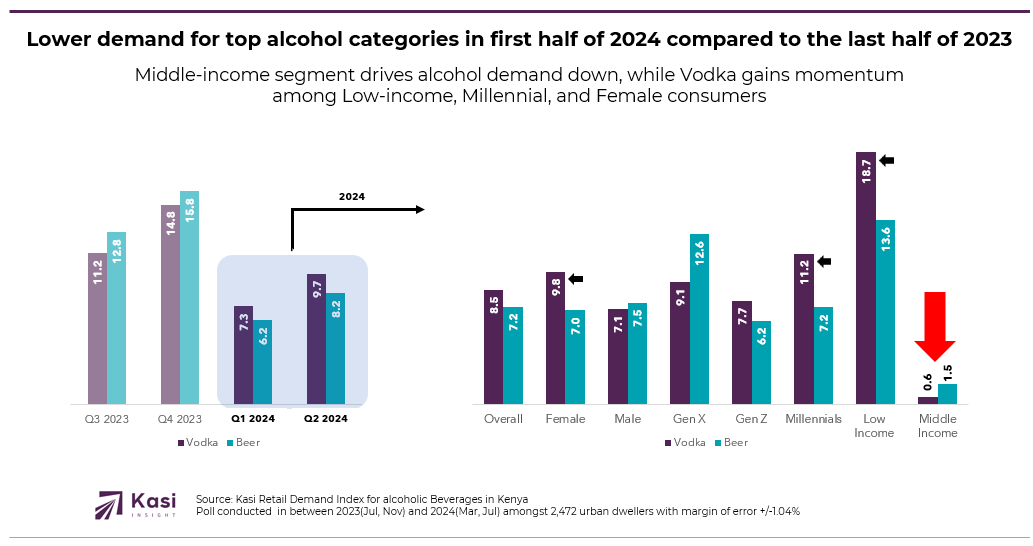
Examining the data for the first half of 2024 reveals that low-income consumers are driving demand, particularly for vodka. Overall, vodka demand in 2024 is 8.48, with low-income consumers contributing significantly at 18.7, while middle-income earners show minimal contribution at 0.56. Female consumers (9.84) are slightly ahead of males (7.10) in vodka demand. Millennials lead the demand with an index of 11.16, followed by Gen X at 9.09, while Gen Z shows relatively lower demand at 7.66.
For alcohol brands operating in Kenya, these trends present both opportunities and challenges. This data suggests that income level is a crucial factor in marketing and product strategies, particularly focusing on the unique trends and behaviors of different income groups. The growing demand among low-income consumers suggests a potential market expansion opportunity, particularly for affordable alcohol options like vodka, beer, and ciders. Brands might consider tailoring their marketing strategies to target these consumers, leveraging the popularity of these beverages.
Additionally, the declining demand among middle-income consumers signals the need for brands to re-evaluate their offerings and marketing tactics to reinvigorate interest within this segment. Understanding the preferences and behaviors of different demographic groups will be key to capturing market share and driving growth in the competitive Kenyan alcohol market. Since 2024 is still unfolding, it’s essential for brands to monitor these trends closely to adjust their strategies in real-time as the year progresses.
Share on socials using this caption: 📉 Dive into the latest trends with the Kasi Retail Demand Index: Vodka overtakes beer as the top choice among low-income, female, and millennial consumers in Kenya. 🍸🍺 #ConsumerTrends #KenyaRetail
12482 views
Share article
Cameroon’s protein market in 2026 is shifting from habitual consumption to structured and intentional demand
Consumer Choices Post COVID-19 Are Redefining Kenya’s Beverage Landscape
Nigeria’s alcoholic beverages market shows resilience in beer but steep H1 declines in premium categories