Sandra Beldine Otieno, MSc
June 25, 2025
Share article


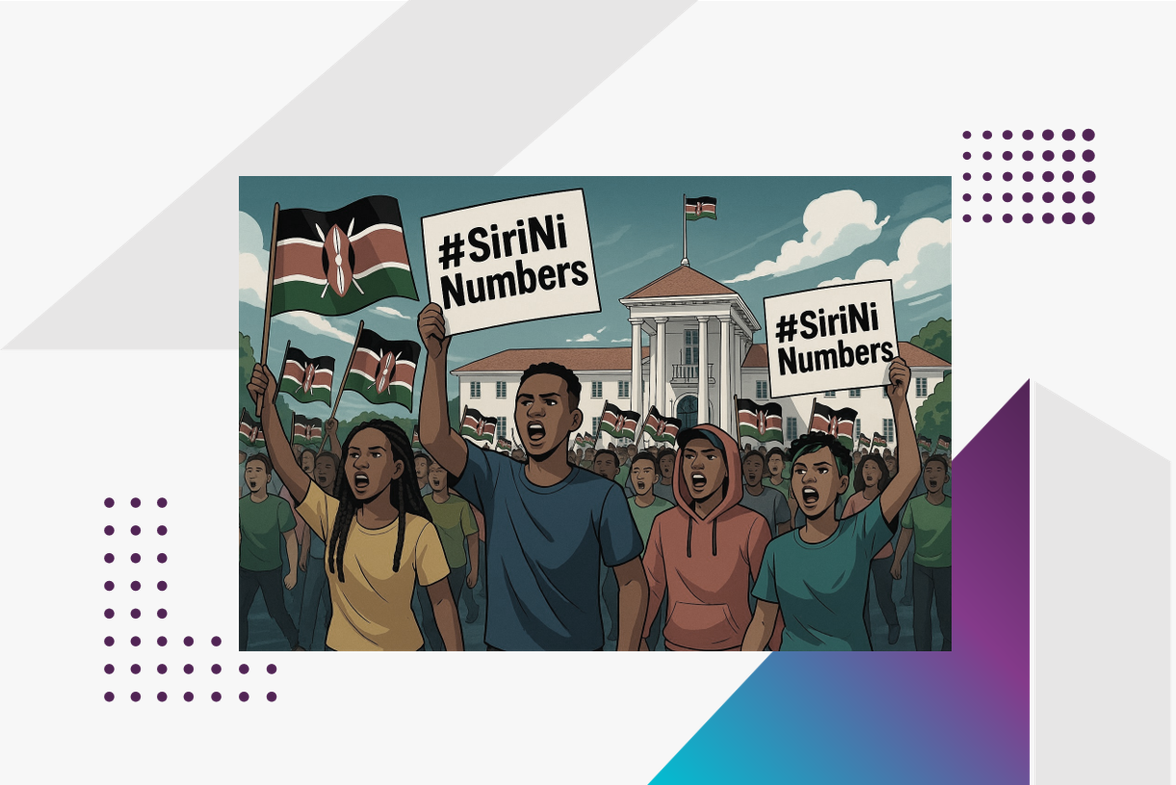
On 25 June 2024, Kenya’s Gen Z staged one of the most defining protest moments in the country’s modern political history. The #OccupyParliament movement was driven by frustration with the Finance Bill 2024, but it was rooted in deeper economic and institutional disillusionment. One year later, youth organizers announced that they will take to the streets again. This time, they will march to State House to commemorate lost lives and demand systemic change. Kasi Insight data over the past 12 months confirm that Gen Z’s frustrations are not anecdotal. They are measurable, consistent, and growing worse.
Kasi Insight’s Index of Consumer Sentiment for Gen Z stood at –10 in June 2024, capturing the unrest brewing ahead of the protests. In the same period, national sentiment was –11, while older generations were at –12. Over the months that followed, sentiment remained negative across all age groups, but Gen Z displayed the most volatility. In July 2024, their confidence rose slightly to –7 before slipping back to –10 by September. A brief surge in April 2025 pushed their sentiment to +5, marking the highest point in a year, but this optimism faded quickly as the score returned to 0 just one month later.
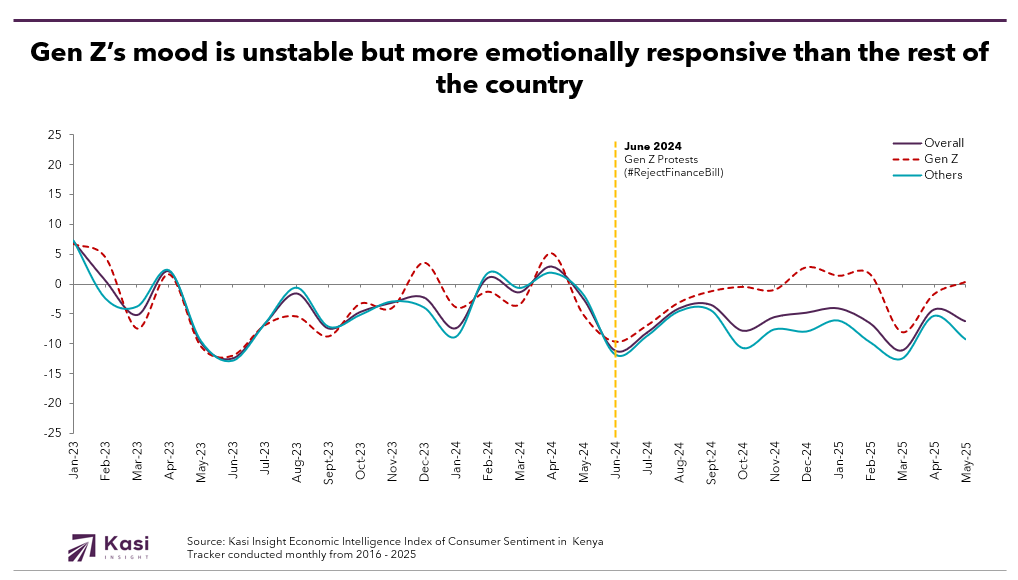
Older groups experienced a comparable but less severe cycle, peaking at +2 in April before slipping back. What sets Gen Z apart is not only the depth of their pessimism but its unbroken pattern. For twelve consecutive months, they recorded non-positive sentiment, with nine months below –5. This points to more than economic anxiety. It reflects a growing emotional fatigue and a breakdown in belief that things can or will improve. Their sentimental trajectory has flattened into a state of emotional numbness and enduring skepticism.
The Job Prospects Index for Gen Z was already bleak in June 2024 at –77. Over the next eleven months, it declined further to –87 by May 2025. Throughout the year, it remained trapped between –75 and –89, showing no signs of real improvement. This data indicates a sustained labour market crisis where hope for employment is no longer just low but nearly absent. For Gen Z, the crisis is no longer unfolding. It has become a daily condition.
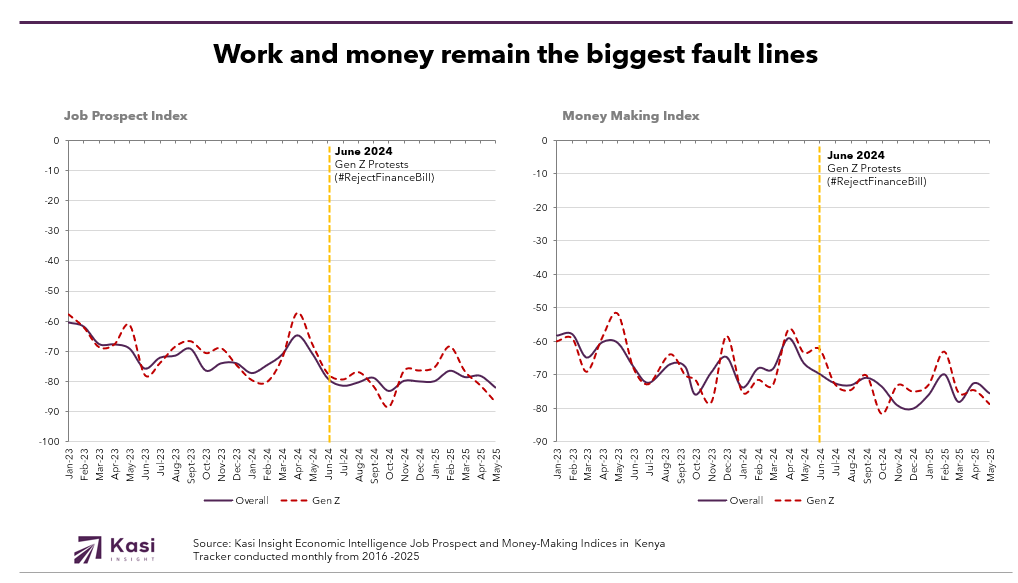
At the national level, job sentiment followed a similar trajectory, falling from –76 to –82, while older groups declined from –78 to –87. Despite generational differences, all groups remained under –65, underscoring the broader stagnation. Income confidence showed the same downward spiral. The Money Making Index for Gen Z dropped from –62 in June 2024 to –79 in May 2025. Even the temporary rise to –57 in April 2025 failed to signal lasting optimism. Instead, it revealed the fragility of progress in a climate where one bad month resets every gain. Across 12 months, Gen Z never crossed –60 and frequently fell below –70, reinforcing the perception that financial struggle is the new normal.
In June 2024, 59% of Gen Z respondents said the country was heading in the wrong direction. That number rose steadily to 79% by December and peaked at 82% in May 2025. At the same time, those who believed the country was on the right track fell from 14% to just 10%. The share of respondents who were unsure or selected “do not know” also declined sharply from 27% to 8%. These changes are not statistical noise. They are clear signals that a growing number of young Kenyans have lost faith in the system.
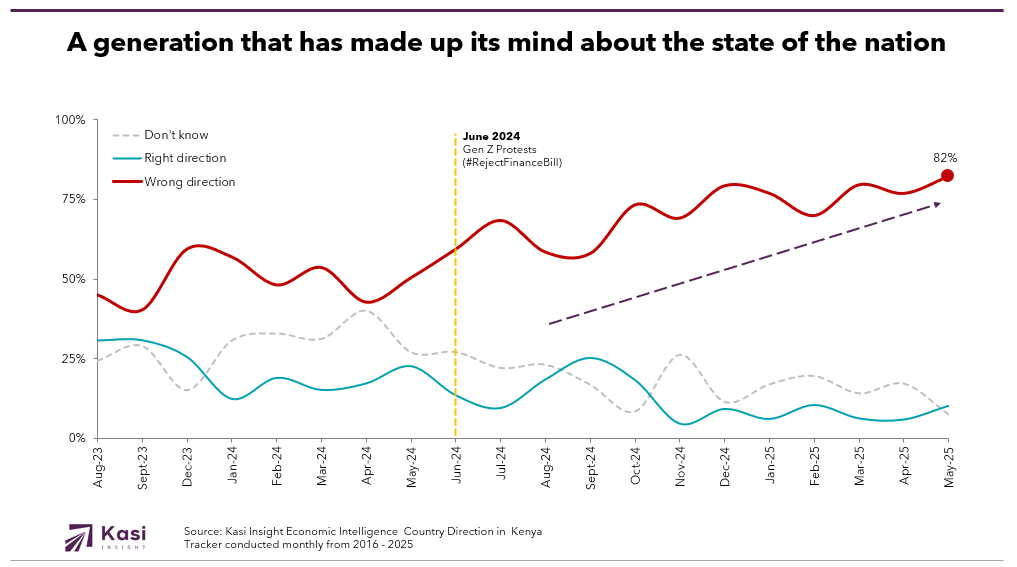
The erosion of uncertainty is especially telling. Gen Z is no longer undecided. They are no longer waiting for improvement. They have reached a settled conclusion that the country is off-course and that current leadership offers no viable path forward. This transformation from frustration to alienation marks a dangerous turning point. It suggests that disillusionment is no longer issue-based. It has become structural. For Gen Z, the disconnect between national policy and personal aspiration has grown so wide that they no longer see themselves reflected in the country’s future.
As the anniversary of #OccupyParliament approaches, new incidents triggered public outrage and reawakened Gen Z’s trauma. On 8 June 2025, 31-year-old blogger Albert Ojwang died in police custody. Officials initially claimed it was suicide, but a 10th June autopsy revealed blunt-force injuries consistent with a fatal beating. His death led to renewed protests in Nairobi and other cities. During one of these protests, 22-year-old Boniface Kariuki was shot at close range after being knocked down by officers. He remains in intensive care. Video footage of the shooting has circulated widely and become a flashpoint for young activists.
Soon after, local media aired clips showing “Team Sakaja,” men armed with sticks seen attacking protestors alongside uniformed police in the Nairobi central business district. While authorities have denied any link, the footage has intensified perceptions of coordinated state violence. For Gen Z, these scenes validate their fears. They see a system that treats protesters as criminals, shields brutality from accountability, and reinforces their marginalization. Viewed against a backdrop of collapsing economic opportunity and stagnant sentiment, these incidents have become more than just triggers. They are evidence of systemic betrayal.
Today, Gen Z are taking to the streets not only to remember, but to demand. This is no longer just about the Finance Bill. It is a movement for justice, inclusion, and systemic reform. A generation that once pleaded to be heard is now asserting its right to shape the nation.
Kasi Insight data underscores the urgency. Gen Z has recorded 12 consecutive months of non-positive sentiment. Their Job Prospects Index has stayed below –75, and the Money Making Index has not risen above –60. Today, 82% believe the country is headed in the wrong direction. These are not passing moods. They are signals of rupture. Gen Z is no longer asking whether the system works. They are preparing to build what it has failed to deliver.
Share on socials using this caption: 📅 One year after #OccupyParliament Kenya’s Gen Z still battles job despair, falling income confidence and brutal policing, so today they march on State House for justice and real change ✊🏾🗣️💔 #GenZProtests #KenyaYouth #JusticeNow
2010 views
Share article
A Strategic Material for Development Sustainable Roads in Africa
Foresight Is No Longer Optional: Why Africa’s Decision Makers Must Move From Insight to Intelligence
Africa’s Data Dilemma: Waiting for the Porsche While Refusing the Bicycle