No growth without confidence: Why African CEOs must lead the consumer recovery

Datastories

Executive summary


Africa’s growth potential remains strong, but a critical driver of economic momentum is missing, consumer confidence. Across the continent, households are under pressure from rising costs, unstable policy environments, and persistent job insecurity. Kasi Insight’s Consumer Confidence Index shows a steep and sustained decline in sentiment, reflecting deep anxiety among consumers. In this environment, businesses cannot grow by waiting for conditions to improve. CEOs must take an active role in rebuilding trust, restoring optimism, and unlocking spending power. This article explains the current crisis, the data behind it, and the specific actions business leaders should take to reignite demand and secure long-term growth.

The confidence crisis is real and deepening

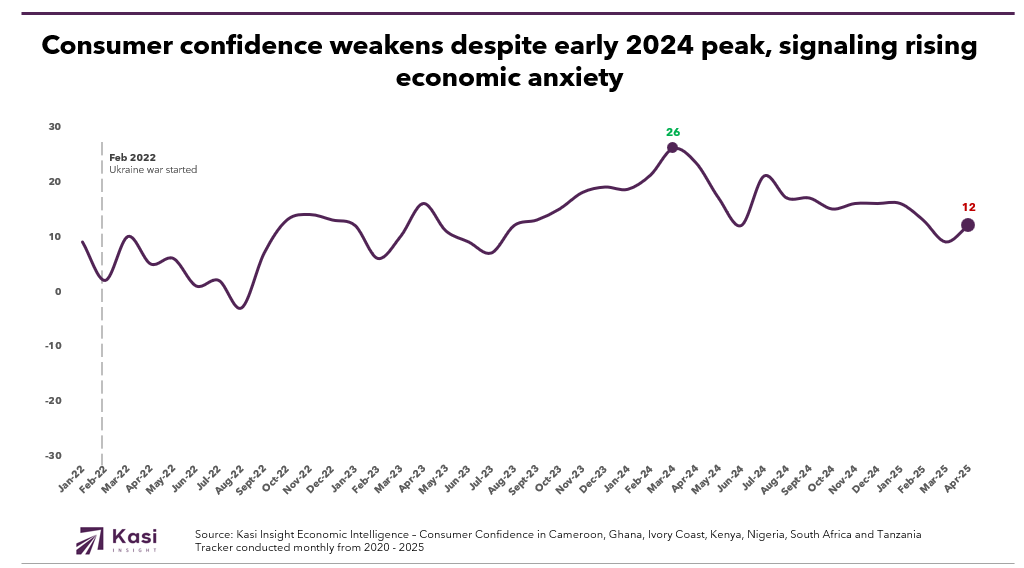
Kasi Insight’s monthly Consumer Confidence Index provides a high-frequency lens into how African consumers are feeling. Between March 2024 and April 2025, the index fell from a high of 26 to just 12, reversing nearly a year’s worth of recovery. This sharp decline highlights the fragile state of consumer sentiment across key markets such as Kenya, Nigeria, Ghana, and South Africa.
CCI-CEO

Several trends are driving the erosion of confidence:

  • The cost of living continues to rise while wages remain stagnant, making it harder for households to meet basic needs.
  • Consumers face policy instability including sudden tax changes, exchange rate volatility, and inconsistent economic direction from governments.
  • Job insecurity remains high, particularly among young people, leading to lower expectations for future income and upward mobility.
  • Trust in institutions is low, and many consumers question whether brands, regulators, and policymakers truly have their interests at heart.

In this environment, consumers are not just spending less. They are postponing investments, trading down, and limiting their engagement with new products and services. Even sectors that have historically shown resilience are starting to feel the effects.

Why it matters to CEOs

Declining sentiment translates directly to business risks and missed opportunities.

  • Revenue exposure: Sectors like retail, telecom, FMCG, banking, and digital services are directly tied to household optimism.
  • Delayed investment: Weak consumer demand undermines long-term planning in infrastructure, logistics, and manufacturing.
  • Stalled innovation: Anxious markets are less responsive to new products, fintech tools, or subscription models.

For CEOs, inaction is not neutral. It compounds the crisis.

What CEOs must do: A confidence recovery playbook

  1. Be a signal of optimism, anchored in realism: Use your visibility to reinforce narratives of resilience. Spotlight youth entrepreneurs, SME recoveries, and inclusive growth models. Trust builds when optimism is backed by transparency.
  2. Build demand from the ground up: Prioritize local sourcing, job creation, and community investment. Consumers reward brands that are part of their solution. Launch initiatives that reduce dependency on imports and build capacity within African supply chains.
  3. Adapt your offerings to strained wallets: Roll out value-based innovations: smaller pack sizes, installment options, free trials, bundled services, and loyalty programs. Make affordability feel empowering, not condescending.
  4. Make CCI a strategic KPI: Track consumer sentiment like you do revenue or churn. Kasi Insight’s CCI offers monthly, market-level data that should guide product launches, pricing decisions, and media messaging. Plan forward, not backward.
  5. Shape the policy environment: Work with governments and regulators to unlock relief mechanisms for consumers targeted tax breaks, digitized subsidy programs, or pricing controls where needed. Advocate for macroeconomic stability, not just sectoral wins.

Conclusion

Africa’s next growth cycle will not be driven by external capital alone. It will be unlocked when everyday consumers regain their sense of possibility and purchasing power. Rebuilding that belief cannot be outsourced to government or left to recover naturally. CEOs must take the lead. Consumer confidence is not a background trend. It is the foundation on which economic growth, innovation, and customer loyalty are built. In a time of uncertainty, leadership must be defined by action that restores trust, affirms value, and invites participation. This is the moment to lead with purpose, invest with insight, and grow with the consumer. Confidence is not a byproduct of growth. It is the catalyst.

Contact our team today to explore how our decision intelligence can empower your decision-making process. Win with confidence with Kasi Insight. https://www.kasiinsight.com

Share on socials using this caption: 📉📊 Consumer confidence in Africa has dropped from 26 to 12 in just over a year, showing rising financial pressure and shrinking optimism💡 CEOs must step up to rebuild trust, create value, and guide recovery through data and action

#KasiInsights #ConsumerConfidence #AfricaEconomy #LeadershipMatters #DataDriven #HouseholdPulse #EconomicRecovery


Recent posts

See all

Vanel Ngansoo, Chartered Professional Engineer, Professional Engineers of Ontario

A Strategic Material for Development Sustainable Roads in Africa

Yannick Lefang, Eng

Foresight Is No Longer Optional: Why Africa’s Decision Makers Must Move From Insight to Intelligence

Yannick Lefang, Eng.

Africa’s Data Dilemma: Waiting for the Porsche While Refusing the Bicycle

Subscribe to our free newsletter