Paul Cheloti Mulongo
February 13, 2025
Share article


Kasi Insight's Retail Demand Index provides a comprehensive measure of consumer demand across various retail categories in Africa, with values ranging from +100 to -100. Alcoholic beverage demand in Kenya remains relatively low, with the index showing only a slight increase from 4.8 in H1 2024 to 5.3 in H2. While overall demand remained stable, there were notable shifts within sub-categories—beer, vodka, champagne, whisky, brandy, and tequila saw gains, whereas RTDs/ciders, wine, liqueurs, and rum declined.
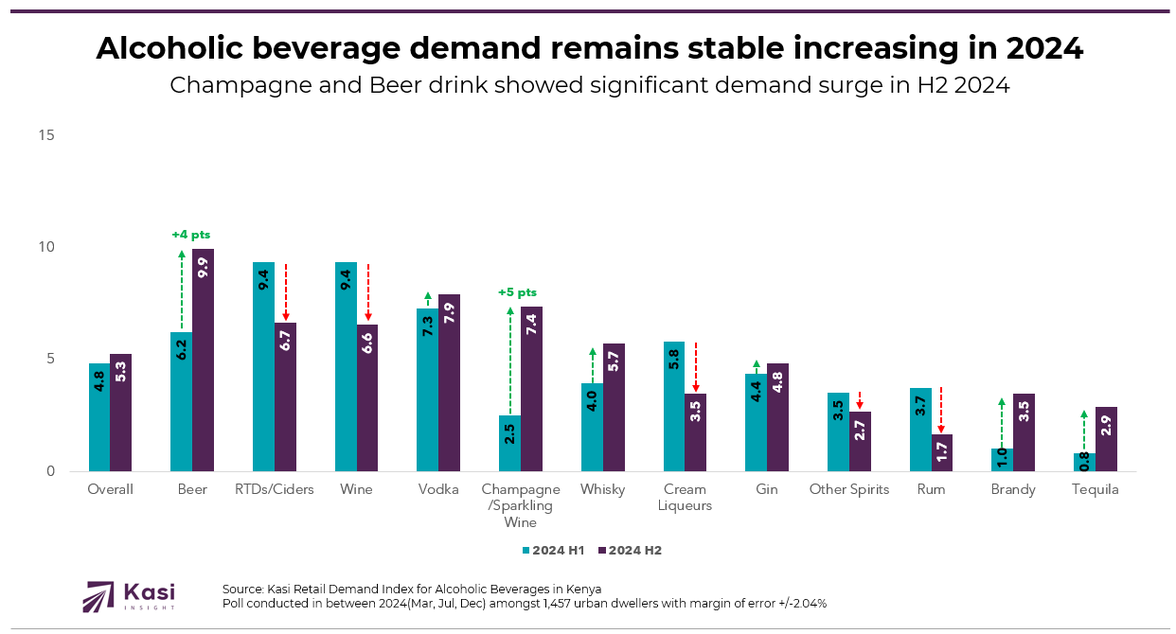
Champagne and sparkling wine recorded the highest surge, jumping from an index of 2.5 in H1 to 7.4 in H2. Beer followed a similar trend, rising from 6.2 to 9.9. In contrast, RTDs/ciders and wine, both strong in H1 at 9.4, fell to 6.7 and 6.6, respectively. Vodka and whisky posted modest gains, increasing from 7.3 to 7.9 and 4.0 to 5.7, respectively. Gin remained relatively stable, moving from 4.4 to 4.8, while cream liqueurs saw a sharp drop from 5.8 to 3.5. Rum recorded the steepest decline, plunging from 3.7 to 1.7.
Demographic trends highlight key shifts in consumer preferences. Beer, which saw the second-highest overall growth after champagne, experienced a notable rise in demand among men, increasing from an index of 5 in H1 to 11 in H2. Among women, beer demand also grew, though more modestly, rising from 7 to 9.
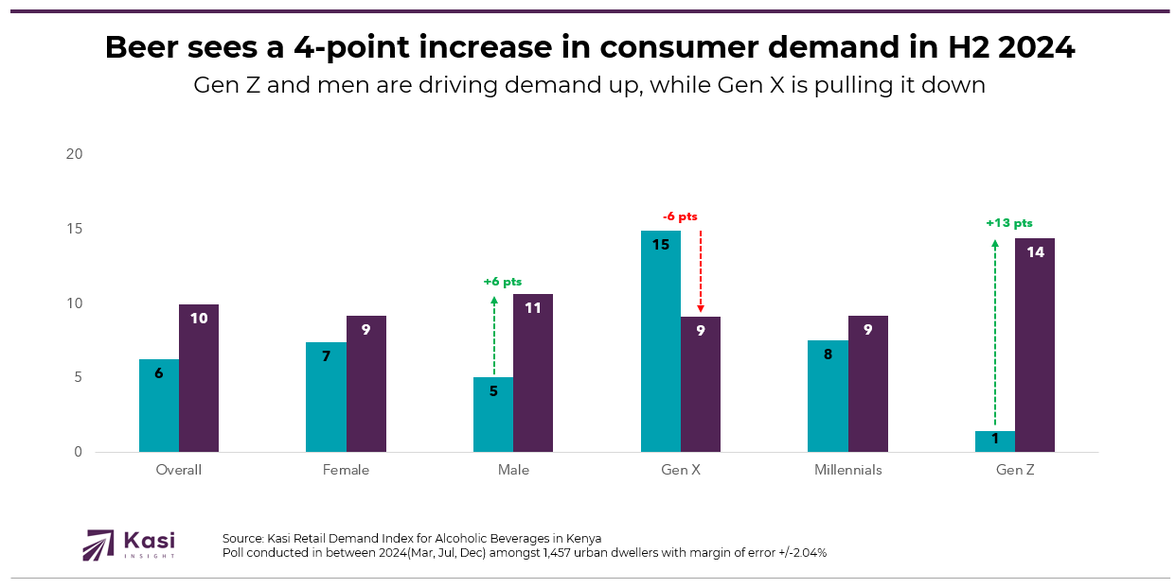
Generationally, Gen Z exhibited the most dramatic shift. In H1, they had the lowest beer demand index at just 1, but by H2, their demand surged to 14—surpassing all other age groups. Millennials remained steady at 9, while Gen X saw a sharp decline from 15 to 9. These trends suggest a growing preference for beer among younger consumers, particularly Gen Z, who are emerging as an increasingly engaged segment.
Kenya’s alcoholic beverage market is undergoing notable shifts, presenting opportunities for brands to adapt and grow. With beer and champagne leading demand growth, brands can refine their production and marketing strategies to align with emerging consumer preferences. Beer demand is rising sharply among Gen Z, making this group a key target for brands looking to expand their market share. To capture their interest, companies should emphasize affordability, social experiences, and digital engagement. Meanwhile, champagne’s surge signals a growing appetite for premium and celebratory drinks, creating space for brands to introduce accessible luxury options or position champagne as a staple for nightlife and social gatherings.
At the same time, declining demand for rum and cream liqueurs highlights the need for strategic repositioning. Brands looking to revitalize these categories may need to focus on premium branding, product innovation, or targeted promotions to rekindle consumer interest. Understanding these evolving trends allows brands to stay ahead of shifting preferences, ensuring they capture emerging demand while strengthening consumer loyalty in Kenya’s dynamic alcoholic beverage market.
Share on socials using this caption: 🍾🍺 Kenya’s alcohol market is evolving! Beer and champagne are surging, fueled by Gen Z and male consumers. Stay ahead with the latest insights! #ConsumerTrends #Kenya #AlcoholDemand #GenZ #Beer #Champagne
1962 views
Share article
Nigeria’s alcoholic beverages market shows resilience in beer but steep H1 declines in premium categories
Fresh staples stay strong as Nigeria’s food market splits between value seekers and quality spenders
Ugandans are loyal to beer but wine captures the biggest spend