Mercy Mutisya
March 5, 2026
Share article



Economic pressure in Ghana is shaping more than spending behavior. It influences how people feel, cope, and function in their daily lives. The latest Kasi Insight health and wellness data shows that shifts in financial outlook are increasingly linked to psychological and emotional wellbeing, revealing a population navigating uncertainty with a mix of strain, adaptation, and cautious optimism. By examining changes in mental health, emotional stability, distress frequency, and financial expectations together, a clearer picture emerges of how economic conditions are being internalized across different segments of society.
Most Ghanaians feel mentally stable, but resilience is strongest among low-income and younger groups
A combined resilience index measuring respondents who report their mental health as improved or unchanged shows that 74% remain psychologically stable, while 71% report stable or improving emotional wellbeing. This indicates that most individuals are maintaining internal balance despite ongoing economic strain. Stability, however, is not evenly distributed. Low-income respondents record the strongest resilience scores, reaching 90% on both indices, while high-income groups show significantly weaker mental health stability.
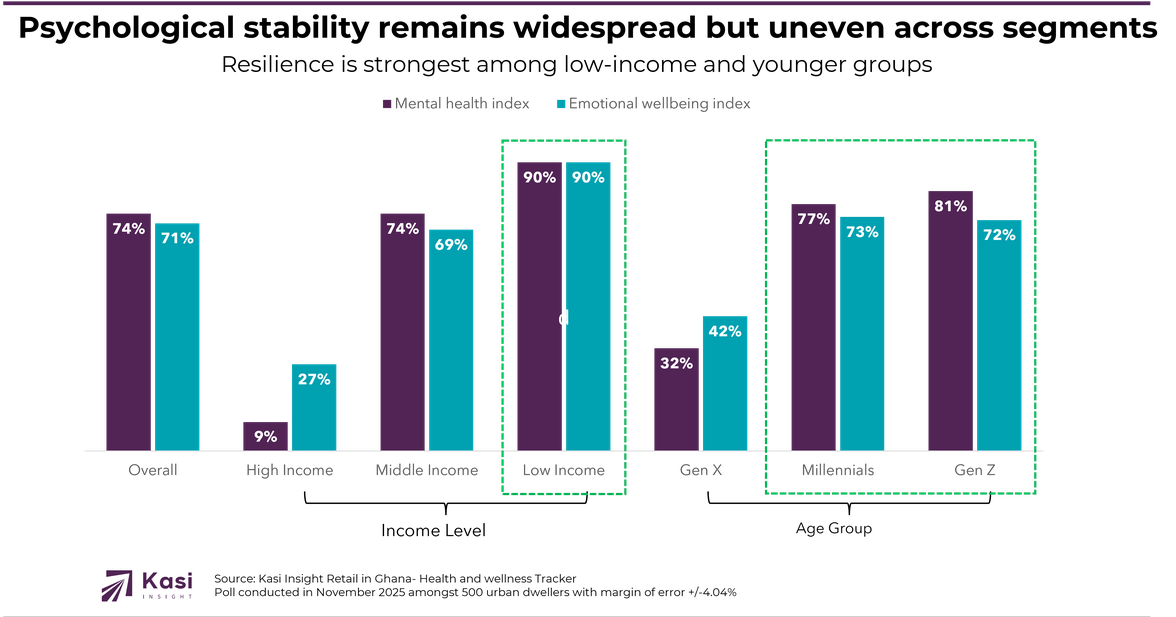
Generational patterns mirror this divide. Gen Z and Millennials demonstrate the highest resilience levels, while Gen X reports markedly lower stability, suggesting mid-life adults may be carrying heavier cumulative pressures tied to financial responsibility, employment demands, and household obligations. These differences show that wellbeing outcomes are shaped less by income level alone and more by how financial realities interact with life stage pressures.
More than half experience frequent stress, with high-income and Gen X groups most affected
Recent emotional experiences tell a more immediate story. 55% of respondents report experiencing distress, signaling that emotional pressure is a common part of daily life even among those who describe their overall wellbeing as stable.
Distress is most concentrated among economically advantaged groups. High-income respondents report the highest levels at 64%, followed by middle-income at 59%, while only 27% of low-income respondents report frequent distress. This pattern suggests that psychological burden may rise alongside financial complexity, expectations, and obligation levels rather than decline with income.
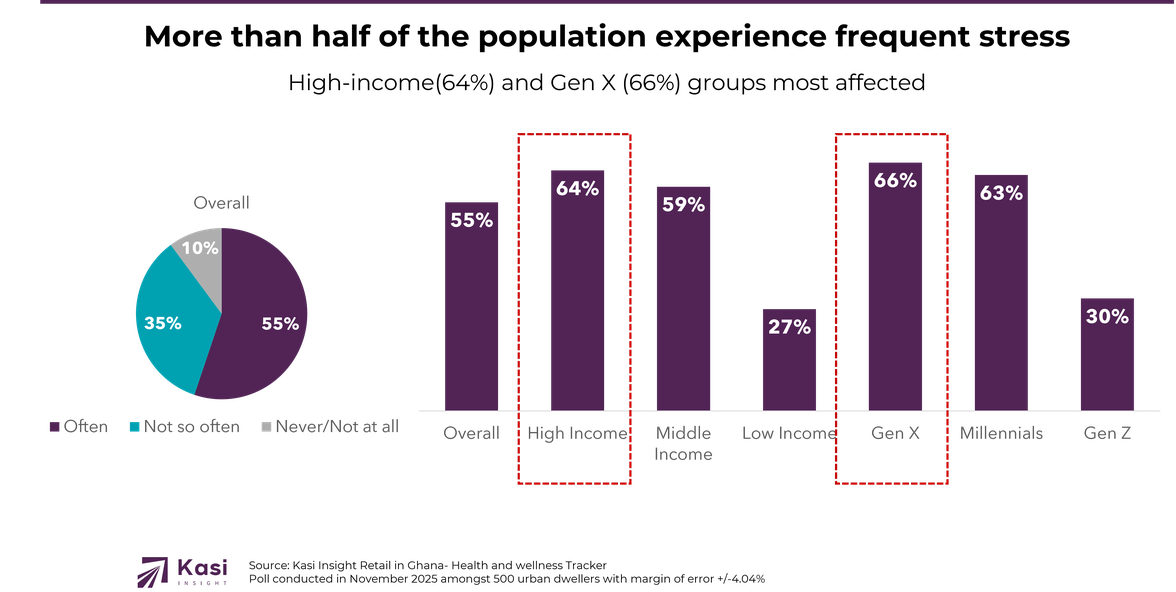
Age differences reinforce this interpretation. Gen X records the highest distress incidence at 66%, followed by Millennials at 63%, while Gen Z reports just 30%. The convergence of higher distress and lower resilience among mid-life adults indicates that financial and social responsibilities are translating directly into emotional load.
Financial confidence is lowest among high earners, explaining why stress concentrates there
Financial expectations help clarify the drivers behind these emotional patterns. 48% believe they will be able to meet their regular expenses over the next six months, a larger share, 56%, expect their income to improve. This gap suggests that many individuals are experiencing present financial strain while relying on anticipated improvement as a coping anchor.
Income segmentation reveals a striking reversal of assumptions. Only 18% of high-income respondents believe they can meet expenses, compared to 46% of middle-income and 73% of low-income respondents. Rather than income alone, financial pressure appears tied to obligation levels, debt exposure, and lifestyle costs. Age patterns confirm this structural dynamic, with Gen X showing the lowest expense confidence, aligning with their higher distress levels.
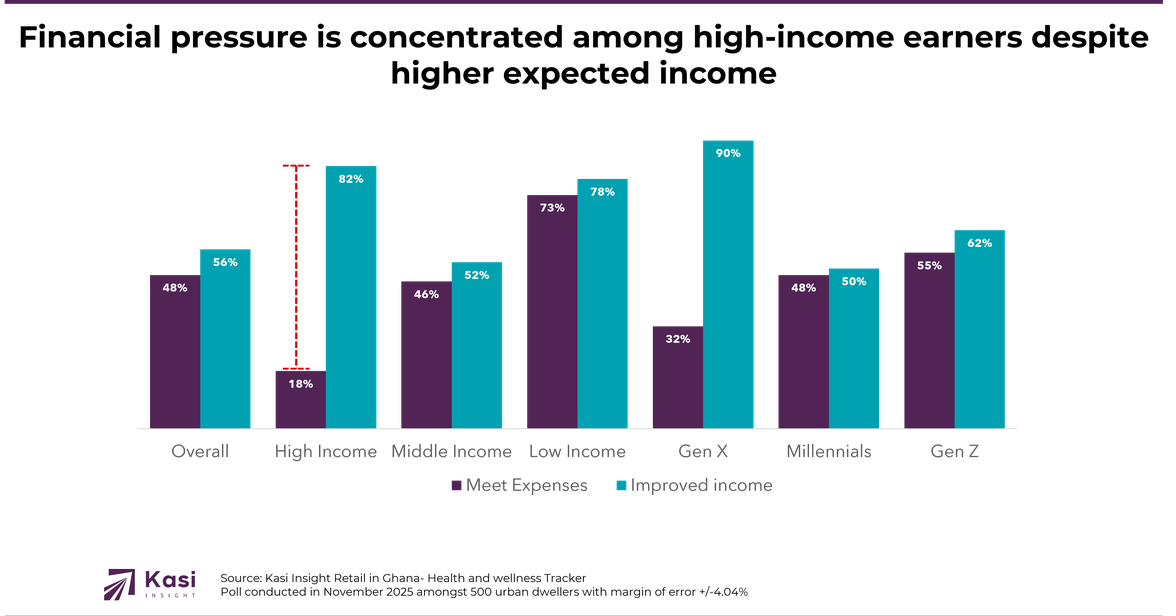
Across all groups, optimism about future earnings remains strong, indicating that while pressure is real, pessimism is not dominant. Many individuals appear to be managing current strain by focusing on expected recovery.
Employers and insurers must address financial stress as a core driver of workforce burnout
The combined evidence points to a structural shift in how economic pressure is affecting Ghana’s workforce. Financial uncertainty is no longer confined to household budgets. It is actively shaping emotional resilience, distress frequency, and psychological stability among working-age populations. Crucially, vulnerability is not concentrated only among traditionally at-risk groups. In several cases, financially secure and mid-career individuals show the strongest signs of strain, indicating that hidden stress may be accumulating within the very segments that organizations rely on most for productivity, leadership, and performance continuity.
This has direct operational implications. When financial pressure translates into emotional load, it can quietly erode focus, decision quality, engagement, and long-term retention. Because these effects develop gradually rather than visibly, they often go undetected until performance declines or burnout surfaces. The data therefore suggests that workforce wellbeing risk is becoming less about income level and more about financial pressure relative to obligations and expectations.
For employers, insurers, and workplace strategists, this signals a need to redesign support systems rather than expand isolated benefits. Integrated models that combine financial guidance, income-smoothing mechanisms, and accessible mental wellbeing support are likely to deliver stronger outcomes than standalone wellness initiatives. Organizations that proactively address financial stress as part of their wellbeing strategy will be better positioned to protect productivity, strengthen workforce stability, and build resilience in an environment where economic pressure remains a defining feature of everyday life.
Contact our team today to explore how nuanced generational insights can help your brand decode the real drivers of resilience and wellbeing across African households, tailoring solutions that support Gen X's heavy load while capturing the optimism of younger cohorts for sustainable loyalty and growth. Win with confidence with Kasi Insight. https://www.kasiinsight.com
Share on socials using this caption: 🌍⚖️ Across Africa's middle-income households, generational divides in resilience tell a powerful story: Gen Z and Millennials show remarkable bounce-back ability, while Gen X, the burdened "Household Anchors"—faces lower stability from juggling finances, family, and mid-life demands. Wellbeing isn't just about income; it's shaped by life stage pressures. Brands that understand these layered realities can design targeted support, turning hidden strain into deeper trust and long-term market leadership.
#AfricaInsights #GenerationalResilience #ConsumerIntelligence #MiddleClassAfrica #WellbeingEconomy
179 views
Share article
The Hidden Cost of “Managing”: Egypt’s Middle Class is Trading Health for Financial Survival
Mpox outbreak in Africa exposes critical inequities in global health
Namibia's Health Landscape: From Varied Health Perceptions to Dominant Concerns