Joy Muindi
February 2, 2024
Share article



The Kasi Retail Demand Index serves as a comprehensive gauge of consumer demand for retail categories across 21 African markets, offering quarterly insights into the nuanced ways in which consumer habits influence category demand. Scored on a scale ranging from +100 to -100, proximity to 100 indicates heightened demand, suggesting a surge in consumer interest, while proximity to -100 signals diminished demand. In the South African context, the index disclosed an uptick of 6 points in beverage demand from 42 in 2022 to 48 in 2023.
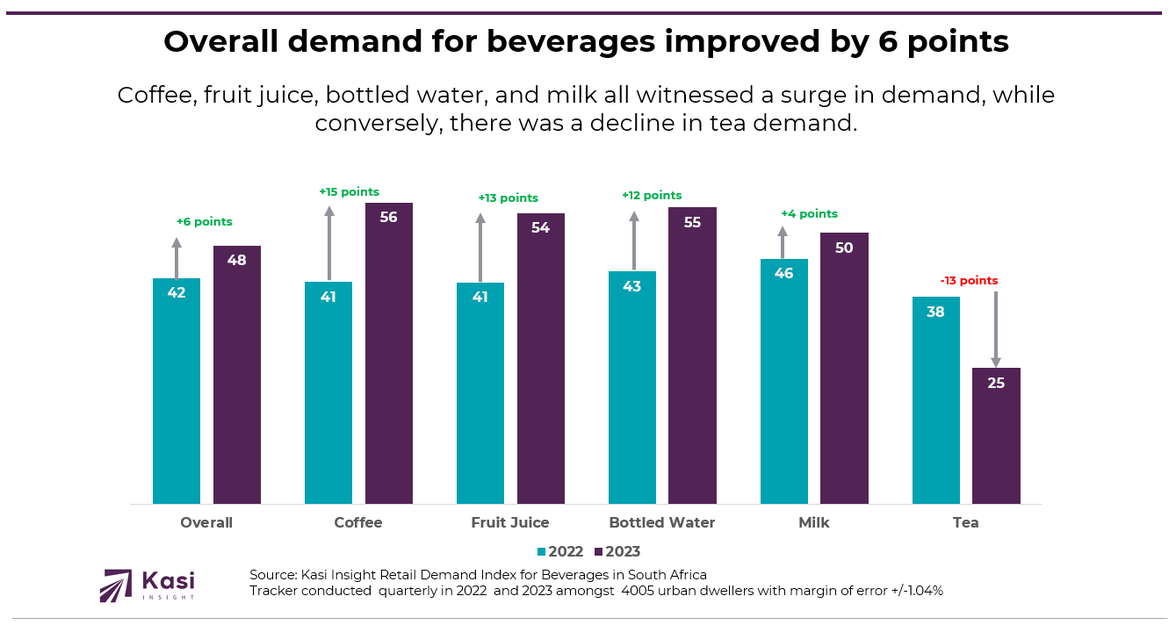
Coffee emerged as a standout category, experiencing a substantial surge with its demand index escalating by an impressive 15 points, soaring from 41 to 56. Similarly, fruit juice and bottled water exhibited robust growth, with demand indices climbing by 13 and 12 points, respectively, indicative of an escalating consumer preference for these beverages. Although milk demand displayed a more moderate change, with a 4-point increase from 46 to 50, the demand for Tea took a notable downturn, witnessing a decline of 13 points from 38 in 2022 to 25 in 2023.
Looking into specific segments it becomes evident that males are the primary drivers behind the surge in coffee demand, exhibiting a substantial 24-point increase. Following closely are Gen Xers, contributing to the trend with a noteworthy 13-point rise. Conversely, females experienced a more modest 3-point increase, while Gen Zers saw a 2-point uptick. Intriguingly, Millennials bucked the trend, registering a 7-point decline in coffee demand during this period.

In contrast, the landscape for tea demand reveals a different narrative, as all segments, excluding Gen Xers, contribute to a decline in overall demand. Millennials observed a notable 36-point decrease, and Gen Zers saw a substantial 30-point decline, females witnessed a significant 24-point downturn, males experienced a more modest 4-point dip. Interestingly, Gen Xers themselves saw a 23-point decrease in tea demand, showcasing a unique pattern amidst the varied dynamics across different demographic segments.
The overall positive shift in the demand index, especially the substantial increase in coffee, fruit juice, and bottled water demand, signals potential growth areas for brands to explore. These trends underscore a changing consumer preference towards specific beverages, providing an opening for strategic product development, marketing, and distribution efforts in these thriving categories.
However, the decline in tea demand, particularly among females, Millennials, and Gen Zers, calls for a nuanced approach. Tea brands may need to reassess their positioning, branding, and marketing strategies to address the changing preferences within these demographics. Innovation, targeted campaigns, and perhaps reimagining the tea experience to align with health or lifestyle trends could be avenues to rejuvenate interest in this category.
The segment-specific insights further highlight the importance of tailored strategies. For coffee, where males and Gen Xers are driving demand, brands can craft marketing campaigns and products that resonate specifically with these demographics. Concurrently, the decline in tea demand among Gen Xers suggests the need for a more targeted approach in this segment.
Share on socials using this caption: 📈 Sipping into the trends of 2023! South Africa's beverage scene is buzzing with a 6-point surge in overall demand. ☕🥤 Explore the highs of coffee and thirst-quenching delights, but why is tea taking a dip? 🤔 #BeverageTrends #SouthAfricaDrinks
2209 views
Share article
Nigeria’s alcoholic beverages market shows resilience in beer but steep H1 declines in premium categories
Fresh staples stay strong as Nigeria’s food market splits between value seekers and quality spenders
Ugandans are loyal to beer but wine captures the biggest spend