Sandra Beldine Otieno, MSc
September 10, 2024
Share article


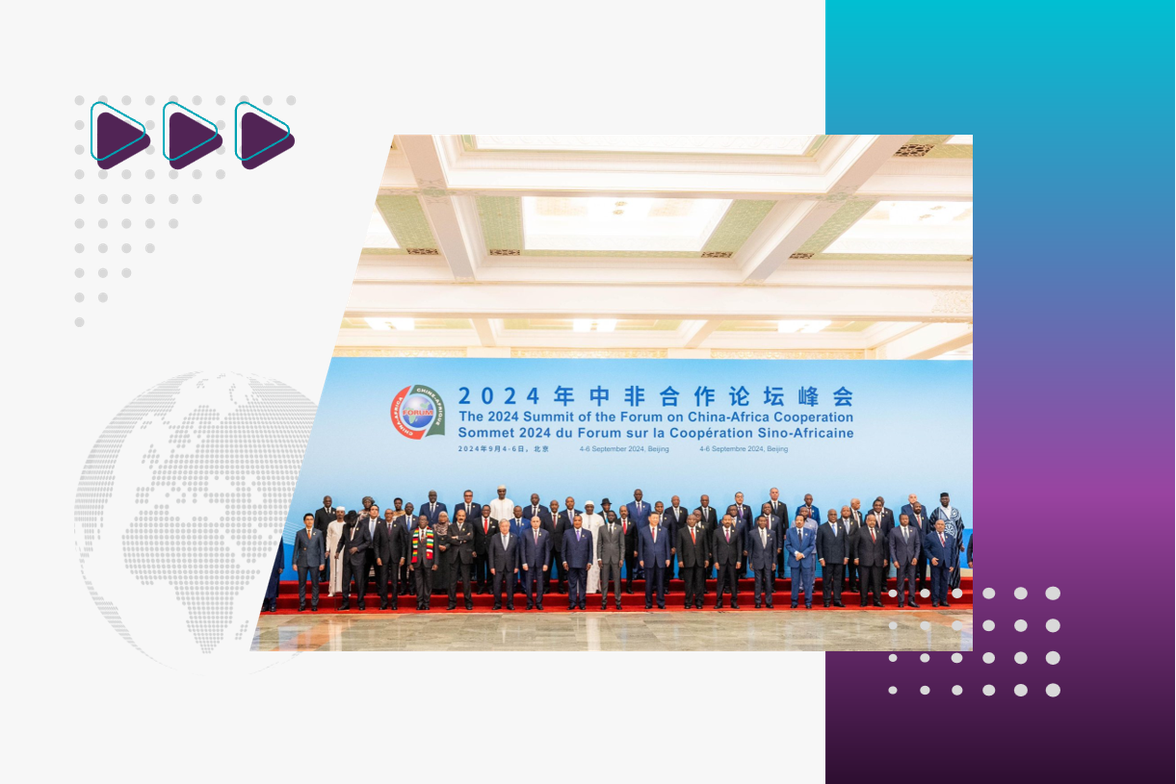
The 2024 Forum on China-Africa Cooperation (FOCAC), held in Beijing from September 4 to 6, stands as a monumental event in international diplomacy, highlighting the evolving relationship between China and the African continent. This year's summit, the largest since FOCAC's inception, drew together 53 African nations in what has been described by China's Ministry of Foreign Affairs as the "largest diplomatic event" in recent years and a "grand reunion of the China-Africa big family." Amidst a complex backdrop of global shifts and competing influences from Western nations, the forum served as a pivotal platform for deepening commitments to mutual modernization and crafting sustainable development strategies.
The summit achieved an unprecedented level of participation, attracting leaders from across Africa's economic spectrum, from powerhouses like Nigeria, South Africa, Egypt, and Kenya to representatives from smaller, emerging economies. This diverse gathering not only demonstrated a continent-wide commitment to strengthening ties with China but also mirrored the strategic shifts occurring worldwide as nations increasingly seek partners that can provide substantial development assistance. The deliberations were designed to shape the trajectory of these burgeoning relationships over the coming years, with all parties keenly anticipating significant reciprocal benefits.
At FOCAC 2024, the discussions were thorough and wide-ranging, covering critical areas such as industrialization, agricultural development, infrastructural enhancement, and security improvements. A notable highlight was China’s renewed financial commitments, with President Xi Jinping pledging over $50 billion for development projects across the continent. Alongside this financial boost, President Xi also promised to create one million new jobs, which aims to directly support Africa’s economic expansion by improving vital infrastructure, such as transportation networks and ports. Additionally, educational initiatives received a significant boost, with new scholarships and training programs aimed at cultivating a skilled workforce for Africa's future. These commitments are designed to provide immediate economic benefits and foster long-term sustainable development across the continent.
Chinese influence in Africa is extensive and multifaceted, with state-owned enterprises heavily invested in key sectors such as infrastructure, energy, and mining. Over 8,000 Chinese companies are operating across the continent, with significant concentrations in South Africa, Nigeria, Zambia, Ethiopia, and Kenya. These companies are not only involved in large-scale infrastructural projects but also span a wide range of industries including energy giants like CNPC and Sinopec, and major players in mining such as CNMC and CSI.
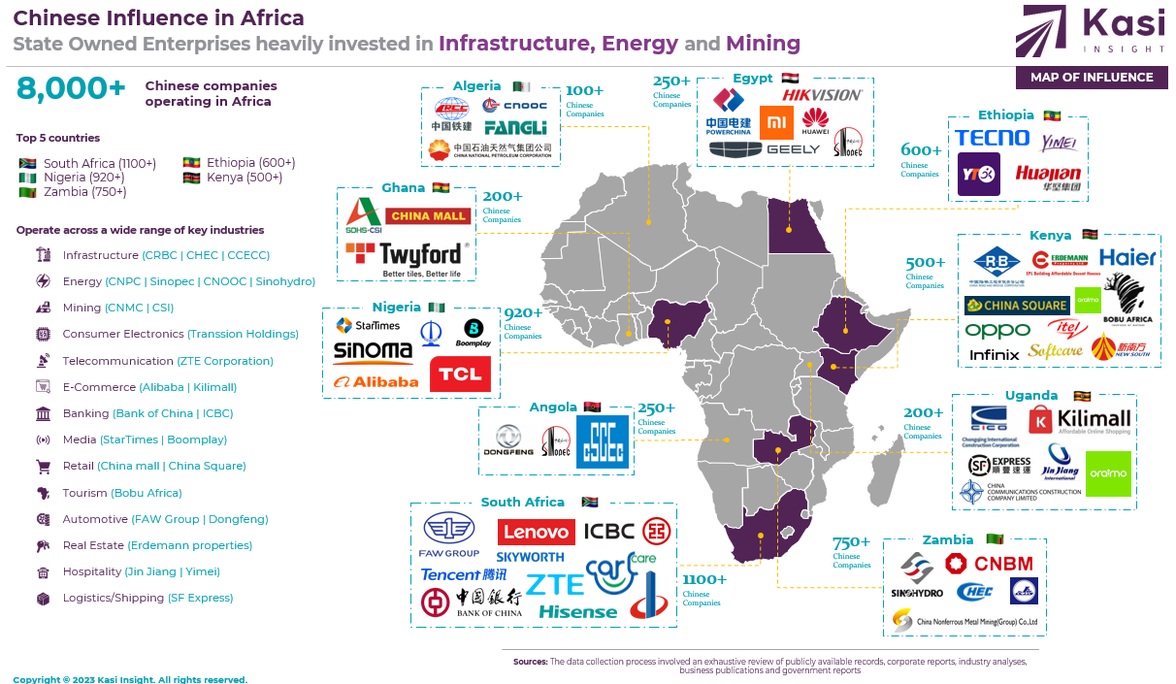
Beyond these core areas, Chinese engagement extends to consumer electronics with companies like Transsion Holdings leading in mobile technology, telecommunications spearheaded by ZTE Corporation, and burgeoning e-commerce platforms such as Alibaba and Kilimall. This extensive presence underscores China’s role as a crucial economic partner, influencing various aspects of African economies from retail and technology with entities like China Mall and Huawei, to automotive and real estate sectors. Through these investments, China is playing a pivotal role in driving development, shaping innovation, and integrating deeply into the economic fabric of Africa, highlighting its strategic approach not only in resource acquisition but also in tapping into the growing markets across the continent.
China's engagement with Africa has evolved significantly, shifting from a primary focus on resource extraction to establishing a comprehensive, strategic partnership. This broader collaboration now encompasses substantial investments in various sectors, significantly through the Belt and Road Initiative, which underscores China's commitment to Africa's infrastructure development across multiple industries including energy, telecommunications, and mining.
This year's summit showcased a strategic pivot towards smaller, more sustainable investments—a response to criticisms regarding debt sustainability and economic dependency from past large-scale infrastructural projects. By focusing on environmentally sustainable projects with strong social impacts, China is refining its development approach in Africa. This strategy aims to align with global sustainability goals, promoting projects that not only spur economic growth but also enhance social welfare within local communities.
This evolution in China's approach marks a shift towards endeavors that support sustainable development and mutual benefit, highlighting a nuanced understanding that seeks to balance economic benefits with social responsibility. Through these initiatives, China is working to position itself as a key partner in Africa's path towards inclusive growth, addressing both local development needs and broader global sustainability objectives.
The strengthening ties between China and Africa pose a formidable challenge to the prevailing Western-led global order. As China deepens its relationships across Africa, it not only expands its geopolitical influence but also showcases an alternative to Western models of development assistance. This evolving partnership is poised to reshape global economic and political landscapes, offering African nations increased leverage in international affairs.
Amid heightened global competition, especially from Western nations seeking influence in Africa, the evolving China-Africa relations place African countries in a strategic position to negotiate more advantageous terms with multiple global partners. This competitive environment bolsters their development paths and enhances their strategic autonomy, allowing them to engage in more balanced and mutually beneficial relationships on the global stage. This shift represents a significant recalibration of international relations, potentially leading to more diversified and equitable global partnerships.
China's financial and developmental commitments are poised to catalyze a transformative impact on African economies, addressing a critical challenge: the widespread lack of employment opportunities, particularly for the continent's burgeoning youth population. Through extensive investments in infrastructure and industrial capacity, coupled with initiatives aimed at widening access to education and healthcare, China is actively contributing to vital sectors that are foundational for stimulating economic growth and enhancing social stability throughout the continent. These initiatives are particularly significant as they promise to create new job opportunities, which are crucial for addressing the employment grievances that are especially prevalent among Africa's young workforce. These initiatives are not only designed to foster short-term economic gains but are also aimed at securing long-term sustainable development.
However, amidst these considerable opportunities, African leaders face the critical task of astutely navigating these partnerships to ensure that they bolster strategic autonomy and align with long-term developmental objectives. There is an increasing consciousness among African policymakers about the need to preserve economic independence and mitigate the risks of becoming overly dependent on external powers. This involves a strategic balancing act: leveraging the benefits of foreign investments while maintaining control over their own economic and political agendas to avoid potential pitfalls that could undermine their sovereignty and economic stability.
The 2024 FOCAC summit has undoubtedly laid a robust foundation for a new era in Africa-China relations, characterized by mutual respect, strategic cooperation, and a shared commitment to sustainable development. As both regions navigate this complex and evolving partnership, the focus will increasingly be on fostering a balanced approach that ensures mutual benefits while safeguarding economic independence and promoting long-term prosperity. The success of this global alliance will hinge on continuous dialogue, adaptive strategies, and a steadfast commitment to achieving common developmental goals in a rapidly changing global context.
Share on socials using this caption: 🌍 FOCAC 2024: China commits $50 billion and 1 million jobs, fueling Africa's future with sustainable investments! A historic summit in Beijing strengthens ties and reshapes global dynamics. 🚀 #ChinaAfrica #SustainableDevelopment #GlobalPartnership
2095 views
Share article
A Strategic Material for Development Sustainable Roads in Africa
Foresight Is No Longer Optional: Why Africa’s Decision Makers Must Move From Insight to Intelligence
Africa’s Data Dilemma: Waiting for the Porsche While Refusing the Bicycle