Sandra Beldine Otieno, MSc
October 25, 2024
Share article


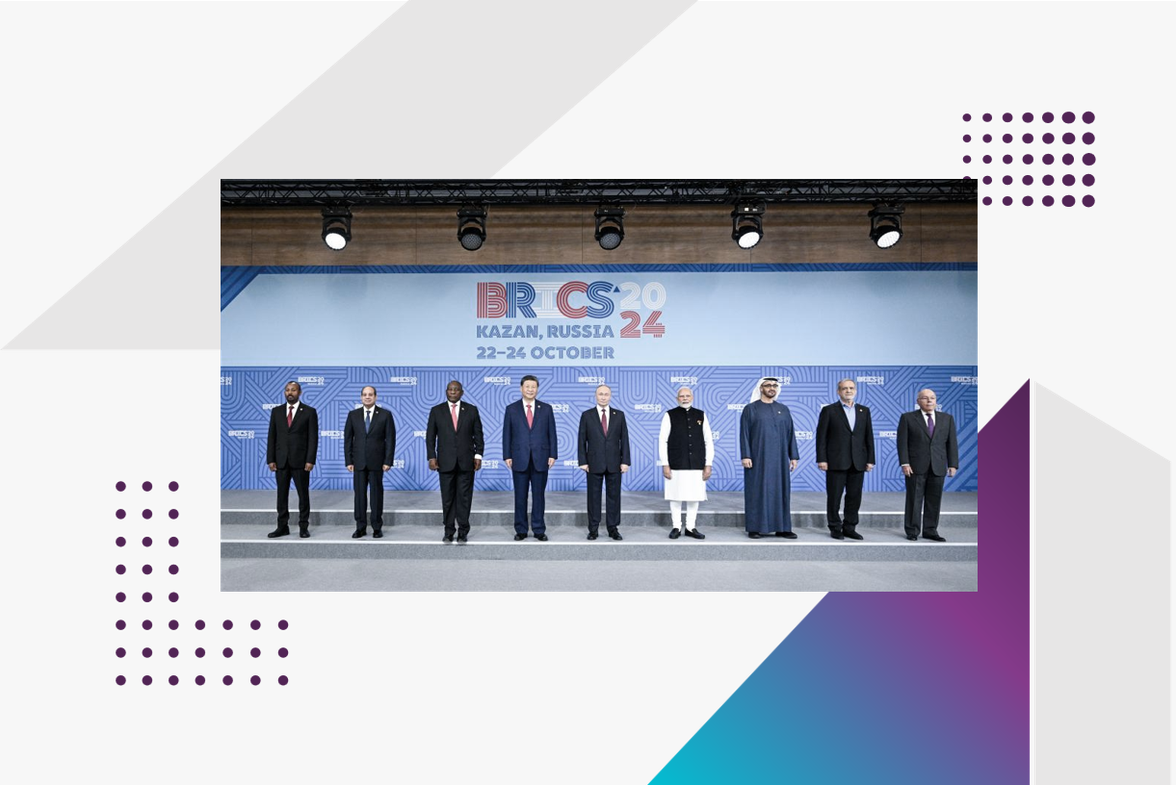
The 16th BRICS Summit, held from October 22 to 24, 2024, in Kazan, Russia, marked a critical juncture for the group. With an expanded membership and crucial discussions about the global economic and political landscape, BRICS has solidified its position as a formidable force in world affairs. However, the summit also exposed internal divisions and external geopolitical complexities, particularly around Russia’s role in global politics and the ongoing conflict in Ukraine.
One of the defining outcomes of the 2024 BRICS Summit was its expanded membership. Egypt, Ethiopia, Iran, and the United Arab Emirates were welcomed as full members, signaling the bloc’s growing geopolitical ambition. With the addition of these nations, BRICS now represents about 45% of the global population and accounts for 28% of global GDP. Beyond these new full members, 13 other countries, including Algeria, Indonesia, Nigeria, and Thailand, were granted partner status, significantly broadening the group’s global footprint.
This expansion not only amplifies BRICS’ influence but also reflects its efforts to provide an alternative platform for countries disillusioned with Western-led institutions like the G7 and IMF. The new members and partners bring diverse political and economic backgrounds, reinforcing BRICS’ position as a platform for the Global South to collectively challenge Western dominance.
Central to the discussions at the 2024 summit was BRICS’ desire to foster economic independence and reform global governance structures. The launch of BRICS Pay, a new payment system designed to reduce reliance on Western financial mechanisms like SWIFT, underscored this ambition. The system aims to facilitate smoother trade and financial transactions between member nations, moving away from the dominance of the U.S. dollar and creating a more self-reliant economic framework within BRICS.
The Kazan Declaration, adopted by the leaders at the summit, reinforced the group’s commitment to multilateralism and called for reforms of international institutions, particularly the United Nations. BRICS leaders emphasized the need for greater representation of developing countries in global governance and supported the full participation of Palestine in the UN. These moves signal BRICS’ ongoing efforts to push for a more equitable global order that better reflects the interests of emerging economies.
While BRICS achieved important milestones in expanding its influence, the summit also revealed internal divisions that could hinder its progress. One of the most significant controversies was Brazil’s veto of Venezuela’s bid for full membership. Venezuelan President Nicolás Maduro, who attended the summit as a guest, expressed outrage, accusing Brazil of adopting exclusionary policies aligned with Western political practices. This incident exposed the political rifts within BRICS, particularly as it seeks to manage the inclusion of new, diverse members while maintaining unity.
Brazil’s decision was influenced by political tensions stemming from Venezuela’s contested presidential elections and the fallout between the two countries' governments. Despite Russia’s support for Venezuela’s inclusion, President Putin was unable to overcome Brazil’s veto, reflecting the complex internal dynamics within BRICS as it continues to grow.
For Russian President Vladimir Putin, hosting the BRICS Summit in Kazan was a major geopolitical win. Isolated by Western sanctions following Russia’s 2022 invasion of Ukraine, Putin used the summit to demonstrate that Russia still has significant international allies willing to engage with it economically and politically. The summit, attended by world leaders from key BRICS nations like China, India, and South Africa, provided a platform for Russia to showcase its resilience in the face of Western efforts to isolate the country.
Russia’s deepening ties with China were a major focus of the summit, as Presidents Putin and Xi Jinping discussed further integrating China’s Belt and Road Initiative with Russia’s Eurasian Economic Union. This growing strategic partnership underscores the importance of BRICS for both countries, as they seek to challenge Western hegemony and promote a multipolar world order.
At the same time, the Ukraine conflict loomed large over the summit. While UN Secretary-General Antonio Guterres called for a “just peace,” the presence of Russia as a key actor in the war complicated the group’s ability to present a unified stance on global security issues. Chinese and Brazilian peace proposals underscored BRICS’ desire to play a diplomatic role in resolving the conflict, but the lack of consensus among members revealed the limits of the group’s influence on global security matters.
In addition to multilateral discussions, the 2024 BRICS Summit was marked by important bilateral meetings that highlighted the group’s role in addressing regional tensions. One of the most significant developments was the meeting between Indian Prime Minister Narendra Modi and Chinese President Xi Jinping, marking the first formal talks between the two leaders in five years. This meeting aimed to resolve a military standoff that had strained relations between India and China since 2020. The thaw in their relationship is crucial for BRICS, as tensions between these two major members threaten the group’s unity.
Meanwhile, Russia and China used the summit to deepen their strategic and economic cooperation, particularly in the areas of infrastructure and energy. By aligning their initiatives—the Belt and Road and the Eurasian Economic Union—both countries are solidifying their roles as leaders within BRICS and further distancing themselves from Western economic systems.
The Kazan summit clearly demonstrated BRICS’ potential to reshape global governance, but it also highlighted the complexities of managing a diverse and expanding membership. While the group’s growth enhances its global influence, it also brings new challenges. The inclusion of countries with varying political systems, economic priorities, and regional concerns has exposed cracks in BRICS’ cohesion, as evidenced by Brazil’s veto of Venezuela’s membership and ongoing geopolitical tensions involving Russia.
At the same time, BRICS’ ambitious goals—such as reducing reliance on the U.S. dollar and pushing for global governance reforms—face significant hurdles. While initiatives like BRICS Pay and the call for UN reform are important steps, the bloc’s ability to implement these ideas remains limited by internal divisions and external pressures.
As BRICS moves forward, its ability to navigate both internal tensions and external geopolitical pressures will be crucial to its success. The bloc’s expanded membership brings both opportunities and challenges. On one hand, it amplifies BRICS’ influence on the global stage, but on the other, it complicates decision-making and highlights the diverse interests of its members.
Looking ahead, BRICS will need to focus on strengthening its economic initiatives and addressing internal political tensions to maintain its unity. The group’s ability to present a cohesive front in the face of global challenges, such as the Ukraine conflict and energy security, will determine its long-term relevance. The Kazan summit highlighted both the promise and the pitfalls of BRICS as a global force, with its future success depending on its capacity to balance expansion with internal cohesion.
While BRICS has made significant strides, its path forward is fraught with complexities that will require careful navigation to achieve its broader goals of reshaping global governance and reducing Western dominance in global affairs.
Share on socials using this caption: 🌍 BRICS expands in 2024! With new members like Egypt, UAE, and Iran, the bloc boosts its global influence 🌐. But can they overcome internal rifts and geopolitical tensions? 🤔 Key discussions on economic independence, Ukraine, and global governance reform at the Kazan summit are shaping a new world order. #BRICS2024 #GlobalPolitics #EmergingEconomies #UkraineConflict #BRICSExpansion
2400 views
Share article
Africa Must Scale Through Shared Ownership. But Are Our Institutions Leading by Example?
The Future of AI in Africa Lies in Smarter Decisions, Not Just Smarter Models
Africa’s Critical Minerals: From Hidden Resource to Economic Catalyst