
Yannick Lefang, Eng
June 25, 2026
For decades, Africa was viewed primarily through the lens of development assistance, humanitarian challenges, and resource extraction. Today, that narrative is increasingly outdated.
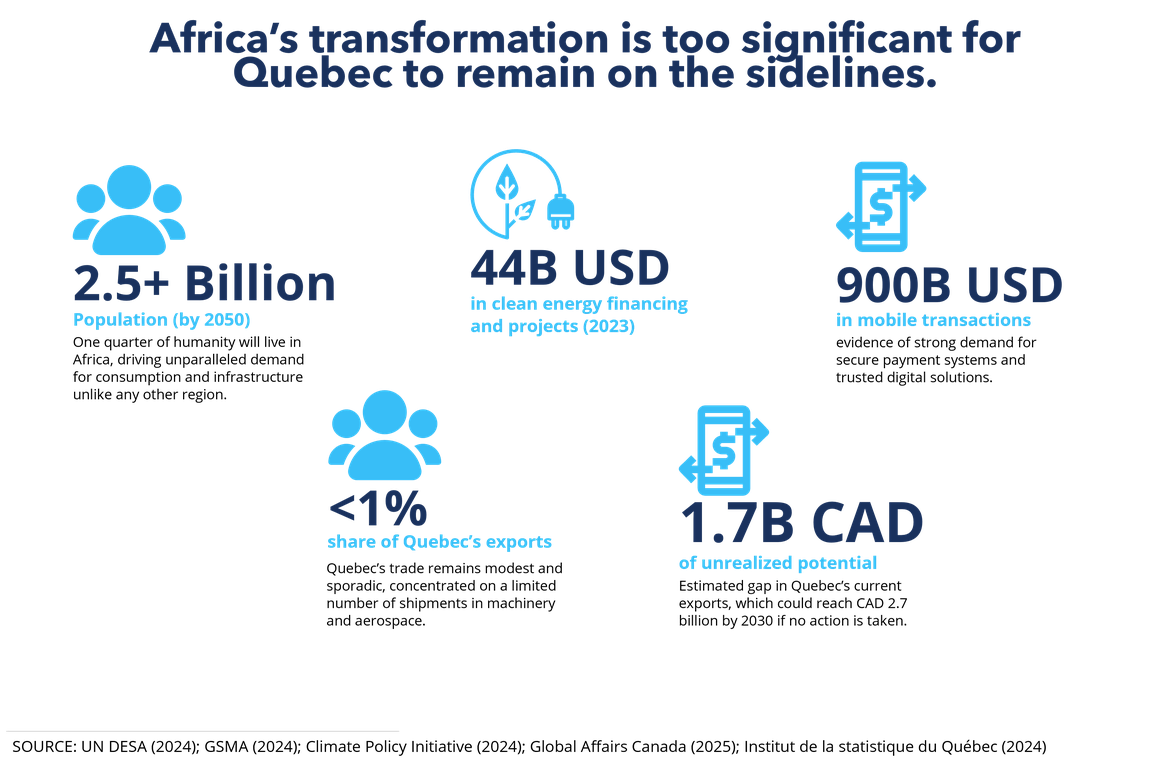
Across the continent, economic growth is being driven by rapid urbanization, digital transformation, renewable energy investment, and the implementation of the African Continental Free Trade Area (AfCFTA), one of the most ambitious economic integration projects in modern history. By 2050, Africa's population is expected to exceed 2.5 billion people, representing one quarter of humanity. At the same time, mobile transaction volumes have surpassed USD 900 billion annually and clean energy investment continues to accelerate.
These developments are not simply indicators of growth; they signal a structural shift in the global economy. Africa is no longer an emerging opportunity on the horizon. It is becoming one of the world's most important growth markets. The question is no longer whether Africa matters economically, but whether Quebec is prepared to participate meaningfully in this transformation.
Quebec possesses many of the capabilities that Africa increasingly needs. From aerospace and mobility solutions to artificial intelligence, agri-tech innovation, renewable energy systems, digital compliance tools, and sustainable mining expertise, the province has developed globally competitive industries that align remarkably well with the continent's development priorities.
Yet despite these advantages, Quebec's commercial footprint across Africa remains relatively modest. Trade activity is concentrated in a small number of countries and product categories, with exports largely focused on machinery, aerospace, vehicles, turbines, and agricultural products. As a result, Quebec remains significantly underrepresented in a region that is becoming increasingly important to global trade and investment flows.
This disconnect is not the result of insufficient expertise. Rather, it reflects a broader challenge around market access, long-term engagement, financing mechanisms, and strategic coordination. While Quebec companies have the technical capabilities to compete, many have yet to establish the partnerships, local presence, and commercial ecosystems required to succeed at scale.
The next phase of Africa's economic growth is being shaped by sectors that are becoming increasingly strategic for governments, investors, and businesses alike. Renewable energy projects are expanding rapidly as countries seek to strengthen energy security and modernize their grids. Fintech ecosystems continue to flourish as digital payments become embedded in everyday commerce. Agri-tech solutions are gaining importance as governments work to improve food security and reduce post-harvest losses. Meanwhile, digital health, smart infrastructure, creative industries, and critical minerals are emerging as major investment priorities across multiple regions.

What makes this moment particularly significant for Quebec is the degree of overlap between these opportunities and its existing areas of expertise. Quebec is already recognized internationally for its strength in clean energy, artificial intelligence, advanced manufacturing, aerospace engineering, and digital innovation. The challenge therefore is not identifying where opportunities exist. The challenge is translating this natural alignment into long-term commercial partnerships and sustained market presence.
Many discussions about Africa continue to focus on perceived risks. Concerns about political uncertainty, regulatory complexity, and market fragmentation often dominate conversations among potential exporters. While these challenges remain relevant, they increasingly overlook a more pressing risk: arriving too late.
Across Africa, procurement systems are becoming more sophisticated, digital regulations are maturing, and regional trade frameworks are creating greater market integration. Companies that establish relationships early are securing reference projects, building trust with local partners, and embedding themselves within emerging value chains. As these ecosystems mature, it becomes increasingly difficult for new entrants to displace established players.
This dynamic is already visible among global competitors. China, India, the United Kingdom, and the United States have expanded their influence through integrated approaches that combine financing, infrastructure development, technology transfer, and long-term partnerships. Their success demonstrates that winning in Africa is no longer simply about selling products. It is about becoming part of a broader economic ecosystem.
For Quebec, the greatest strategic risk may not be entering Africa. It may be waiting until competitors have already secured the relationships, procurement frameworks, and market positions that define future growth.
One of the most important shifts in understanding African markets is moving beyond a country-by-country perspective. Increasingly, economic activity is being organized around regional corridors that connect ports, logistics hubs, urban centers, and trade networks across multiple countries.

The Atlantic corridor stretching from Dakar to Abidjan and Lagos is becoming an increasingly important gateway for West African trade. In East Africa, the Mombasa-Nairobi-Kampala corridor continues to serve as a regional hub for technology, logistics, and financial services. North Africa's Casablanca-Rabat-Tunis corridor is benefiting from strong infrastructure, manufacturing investment, and proximity to European markets. Meanwhile, Southern Africa's Durban-Johannesburg-Lusaka route remains critical for industrial activity and regional trade.
Thinking in terms of corridors rather than individual markets allows exporters to capture regional efficiencies, reduce operational costs, and build credibility across multiple countries simultaneously. For Quebec companies, a corridor-based approach offers a practical pathway to scale while navigating the complexity of a diverse continent.
Among Quebec's most overlooked competitive advantages is its connection to African diaspora communities. While discussions about international trade often focus on capital, infrastructure, and policy, successful market entry frequently depends on something less tangible but equally important: trust.
Diaspora communities possess deep cultural understanding, local market knowledge, professional networks, and relationship capital that can significantly reduce barriers to entry. They can help businesses identify opportunities, navigate complex business environments, establish credibility with local stakeholders, and accelerate commercial partnerships.
At a time when trust has become a critical differentiator in international business, Quebec's African diaspora represents far more than a social or cultural asset. It is a strategic economic advantage capable of strengthening trade relationships and improving market outcomes.
Africa's growth story is entering a new chapter. The continent's future will be shaped not only by economic expansion, but also by its ability to build resilient energy systems, modern digital infrastructure, sustainable supply chains, and globally competitive industries. These are precisely the areas where Quebec has the expertise to contribute.

Success, however, will require a shift in mindset. The most successful organizations will not necessarily be those offering the lowest prices or the largest balance sheets. They will be capable of combining technology, financing, partnerships, local knowledge, and long-term commitment into a coherent value proposition.
For Quebec, the opportunity extends far beyond increasing export volumes. It represents a chance to build enduring economic relationships with some of the world's fastest-growing markets while positioning itself as a trusted partner in Africa's next phase of development.
The opportunity is substantial; the alignment is clear, and the timing is favorable. The remaining question is whether Quebec is prepared to act before the window narrows.
Kasi Insight helps Canadian organizations understand Africa before they invest, enter, partner, or expand. Through proprietary data, local expertise, and continent-wide intelligence, we bridge the information gap between Canada and Africa, enabling smarter decisions and stronger commercial relationships. The opportunity is growing. The time to understand it is now.
This report provides a strategic overview of the evolving trade and investment landscape between Quebec and Africa and highlights where future opportunities are emerging. For organizations seeking a deeper understanding of sector dynamics, regional corridors, market entry considerations, and practical recommendations for engagement, the complete report offers additional analysis and supporting evidence.
📄 Download the full report → https://reports.kasiinsight.com/reportquebec
Kasi Insight is Africa's leading decision intelligence firm specializing in high-frequency consumer and economic data across Africa. Through its proprietary survey infrastructure and analytics platform, Kasi provides real-time insights that help organizations anticipate economic shifts, understand consumer behavior, and make better strategic decisions.
We welcome collaboration with:
Organizations interested in exploring partnerships or accessing Kasi datasets are invited to contact our research team.
📧 yannick@kasiinsight.com
32 views
Africa's Most Valuable World Cup Export Isn't Football. It's Culture.
Beyond Reporting: Introducing Kasi Insight Sustainability Intelligence