Yannick Lefang, Eng.
May 6, 2025
Share article


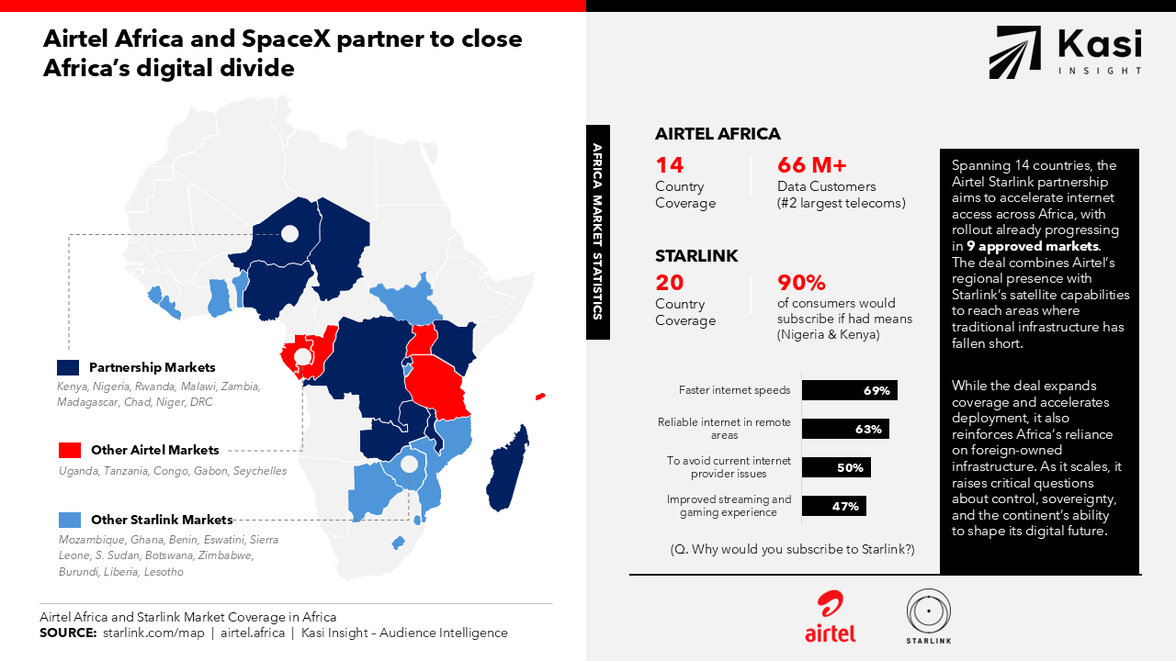
Airtel Africa has signed a landmark agreement with SpaceX to integrate Starlink’s satellite internet services across 14 African countries. The partnership aims to close longstanding connectivity gaps by delivering high-speed, low-latency broadband to areas where traditional infrastructure has remained limited, expensive, or logistically unfeasible.
The rollout will begin in nine countries where regulatory approvals have already been granted. These include Kenya, Nigeria, Madagascar, Chad, Zambia, Malawi, Rwanda, Niger, and the Democratic Republic of Congo. Approvals are still underway in the remaining five markets. Through this collaboration, Airtel plans to strengthen its mobile backhaul network, offer enterprise-grade internet services, and improve digital access for schools, health centers, and rural communities. The initiative reflects Airtel’s growing commitment to digital inclusion and its ambition to lead in underserved regions across the continent.
A recent survey by Kasi Insight confirms that awareness and demand for Starlink’s services are already high in key African markets across Kenya and Nigeria. In Kenya, 75% of respondents reported familiarity with Starlink, and 52% expressed a readiness to subscribe immediately. Nigeria showed similar momentum, with 69% awareness and 48% indicating they would sign up right away.
The main drivers of this interest include the promise of faster internet speeds, cited by 69% of respondents, reliable access in remote areas at 63%, and growing frustration with existing service providers at 50%. Despite this strong demand, affordability remains a major hurdle. In Kenya, 50% of respondents pointed to cost as a barrier, compared to 45% in Nigeria. These findings suggest that while appetite for satellite internet is strong, its widespread adoption will ultimately depend on pricing strategies that reflect local purchasing power.
In Kenya, Safaricom has long dominated the telecommunications sector, commanding a market share of approximately 66% across mobile and broadband services. The company’s leadership is built on extensive investments in 4G, 5G, and fiber networks, along with value-added services like mobile money and home internet bundles. While its urban coverage is strong, Safaricom’s reach in rural and remote counties remains limited due to infrastructure costs and difficult terrain. This has left significant gaps in connectivity across parts of northern Kenya, arid zones, and marginal regions where fiber lines and tower density are low.
Airtel Kenya currently holds around 30% market share and is emerging as a credible challenger. Its partnership with Starlink introduces a new competitive lever, allowing it to bypass traditional infrastructure limitations and deliver reliable satellite-powered internet in regions where existing networks are either inconsistent or unavailable. Starlink, which launched in Kenya in July 2023, has already secured a position among the top ten internet service providers in the country with 8,063 active subscribers and a market share of 0.5% as of June 2024. This rapid uptake underscores growing demand for alternative broadband solutions, particularly in rural and underserved areas. By bundling mobile and satellite connectivity, Airtel can create integrated solutions that appeal to institutions and households beyond the reach of fiber and mobile towers. This approach strengthens Airtel’s presence in rural Kenya and positions it to grow its market share by targeting the very segments where Safaricom’s dominance is weakest.
Nigeria’s internet market is large but uneven, with significant differences in access between urban and rural states. While MTN and Airtel dominate mobile services, fixed broadband is fragmented. Spectranet leads fixed wireless access with around 43% market share, while other players like FiberOne and Tizeti operate primarily in cities. Starlink entered Nigeria in 2023 and by late 2024 had become the second-largest fixed broadband provider with over 65,000 subscribers.
By partnering with Airtel, Starlink gains access to a wide retail network and a trusted local operator. This will allow both companies to scale more rapidly, particularly in states where broadband options are limited, and fiber deployment is slow. Airtel is well positioned to integrate satellite internet into its mobile and enterprise offerings, providing new options for customers across northern and underserved states. The move also increases competitive pressure on MTN, which has begun satellite-to-mobile trials but has yet to reach commercial readiness. Airtel’s rollout could give it an edge in enterprise connectivity and digital public services.
The Airtel Starlink partnership will provide more choice and access to consumers in Africa. The Indian owned telco has been in Africa for 14+ years and is trying to increase its market share and relevance in key markets. For Starlink, the United States owned internet provider, the deal offers much needed scale and local distribution. The jury is still out on whether the partnership will deliver the expected business benefits for both companies. For African consumers, more access to the internet is a good thing, but it also brings concerns around data privacy and how limited household budgets are allocated. In the current global environment, where countries and leaders are putting local industries first, as seen with initiatives like Buy American, African consumers should think carefully about where their money goes and what kind of digital future they are supporting.
For African businesses, this is another reminder that competition from global players is accelerating. To stay relevant, Africa needs to show up and take space, both figuratively and literally. The recent launch of the African Space Agency headquarters in Egypt is an important signal that the continent is starting to think about ownership in areas like satellite technology. The real long-term win for African consumers and businesses will be when an African satellite provider can offer reliable, scalable connectivity on its own terms. For now, the Airtel Starlink deal looks like a shortcut to win big. Whether the bet pays off or backfires is something only time will tell.
Share on socials using this caption: 🚀🌍Airtel Africa x Starlink. Expanding internet access across 14 African countries, but at what cost to ownership and digital sovereignty Is this progress or just a shortcut?
#AirtelAfrica #Starlink #DigitalAfrica #Connectivity #AfricaTech #InternetAccess #TechForGood #SatelliteInternet #DigitalInclusion #FutureOfAfrica #AfricanInnovation
1793 views
Share article
A Strategic Material for Development Sustainable Roads in Africa
Foresight Is No Longer Optional: Why Africa’s Decision Makers Must Move From Insight to Intelligence
Africa’s Data Dilemma: Waiting for the Porsche While Refusing the Bicycle