Sandra Beldine Otieno
May 10, 2024
Share article


The 2024 General Elections in South Africa are set against a backdrop of significant political evolution and mark a crucial juncture, celebrating 30 years of democracy since the apartheid era ended. This year's elections are notably competitive, featuring a diverse array of major parties and independent candidates, which underscores the unpredictability and high stakes of the electoral process. Incumbent President Cyril Ramaphosa of the African National Congress (ANC) is vying for a second and final term amidst formidable opposition. Key challengers include John Steenhuisen of the Democratic Alliance (DA), expected to capture a substantial portion of the vote, and Julius Malema of the Economic Freedom Fighters (EFF), a dynamic former youth leader of the ANC.
Other notable candidates in the race are Jacob Zuma from uMkhonto we Sizwe (MK), Mmusi Maimane leading the One South Africa Movement, and Motsamai John Mathuhle of Hope4SA. The ANC, historically dominant, faces the prospect of losing its majority for the first time, potentially necessitating a coalition to stay in power. This potential shift comes in response to increasing public dissatisfaction with systemic corruption, a perceived disconnect from ordinary citizens' concerns, and inadequate service delivery. The election also introduces a new dynamic with the eligibility of independent candidates, enabled by the 2023 Electoral Amendment Act, reflecting a broader transformation in South Africa’s political landscape where the formation of coalition governments could become a new norm.
The Kasi Index of Consumer Sentiment (ICS) monitors the economic pulse of 21 African nations, making it a premier gauge of consumer confidence on the continent. By probing into the economic realities and prospects concerning purchasing power, personal finances, household earnings, and job prospects, this index provides an insightful snapshot of Africa's economic climate.
In Africa, electoral cycles are critical junctures that significantly impact business landscapes and the broader sentiment of confidence, marking them as events of paramount importance. Notably, consumer attitudes and business outlooks shift in alignment with the electoral atmosphere, reflecting the unique dynamics of each voting season. Moving beyond traditional methods of predicting electoral outcomes, the application of consumer sentiment data has emerged as a potent tool for forecasting election results in nations such as Kenya, Ghana, Nigeria and recently Senegal, demonstrating its effectiveness on multiple occasions.
This approach centers on analyzing variations in consumer sentiment in the year preceding elections, with particular attention to the average sentiment and its fluctuations during this period. Such analysis helps delineate between scenarios of political change—marked by the defeat of incumbents—and continuity, where the status quo prevails.
Over the past two years, South Africa's consumer sentiment has experienced dramatic swings, ranging from deep pessimism to notable optimism. The journey began with a low sentiment score in early 2022, plunging to a dramatic low of -87 in August, indicating intense consumer distress under tough economic conditions. However, the end of 2022 saw a significant improvement, with sentiment rising to +18 in December, suggesting a recovery in consumer confidence.
Throughout 2023, this upward trend generally persisted, with some fluctuations. The sentiment peaked impressively at +50 in November, indicating a robust resurgence in positive consumer outlook. This positive trend extended into 2024, where sentiment scores soared to +70 by March, showcasing sustained optimism among consumers. The stark volatility observed—from severe lows to highs—highlights the impact of economic and socio-political factors on consumer confidence.
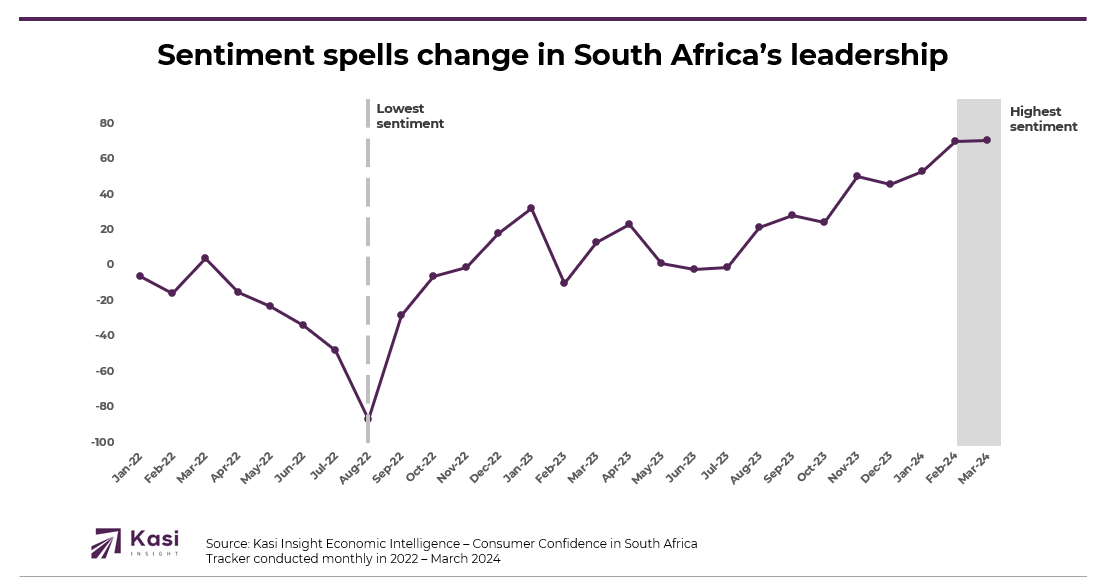
As South Africa approaches its general elections in two weeks, these shifts in consumer sentiment, rather than signaling support, might not necessarily favor the ruling party, African National Congress (ANC). Utilizing the Kasi ICS methodology to analyze the sentiment trends leading up to the election reveals an average index of 6 with a volatility rate of 134%, indicating a strong potential for a change in leadership.
In the dynamic interplay of economic sentiment and democratic processes, South Africa stands at a pivotal crossroads as it approaches the 2024 General Elections. These elections are not merely political contests but a referendum on the ruling African National Congress (ANC)'s governance amid fluctuating consumer confidence. The Kasi Index of Consumer Sentiment (ICS) has captured significant swings—from deep lows to recent highs—mirroring public response to economic and socio-political challenges.
The ANC faces the possibility of losing its majority for the first time, driven by public discontent with systemic corruption and inadequate service delivery. These sentiments, exacerbated by economic difficulties, are crucial in shaping voter behavior. As the election nears, analysis using the Kasi ICS suggests a strong potential for change in leadership, given its track record of predicting electoral outcomes in other African nations.
With an average sentiment index of 6 and a volatility rate of 134%, the data points to a restless public mood, indicating that economic conditions are likely to influence the upcoming electoral decisions significantly. This election could mark a transformative moment in South Africa's political landscape, reflecting the profound impact that economic factors have on governance and public trust.
Share on socials using this caption: 📉🗳️ With the 2024 elections on the horizon, South Africa's volatile consumer sentiment could signal a major political upheaval. Will the ANC maintain its grip? Check out our latest insights! #Election2024 #SouthAfrica #ChangeIsComing
2346 views
Share article
Trust Is Becoming Economic Infrastructure
Consumer confidence loses momentum in October
Confidence plateaus in September as caution defines household behavior