Paul Cheloti Mulongo
July 10, 2025
Share article



Kasi Insight's Banking Brand Intelligence tracker conducted annually, explores which banks consumers recognize, currently use, might consider in the future, and would recommend to others. It investigates what drives consumers to choose specific financial services and what fosters long-term loyalty.
The latest findings from April 2025 highlight how competitive the banking landscape has become. No single institution holds universal appeal across all consumer segments. When respondents were asked which banks they would most likely consider if opening a new account, Absa Bank emerged at the top with 29%. Standard Chartered followed closely at 27%, and Equity Bank secured 24%. The competition remains intense. UBA and Ecobank both earned strong consideration from 23% of respondents. Stanbic Bank and Centenary Bank also maintained solid positions, each attracting 21%.
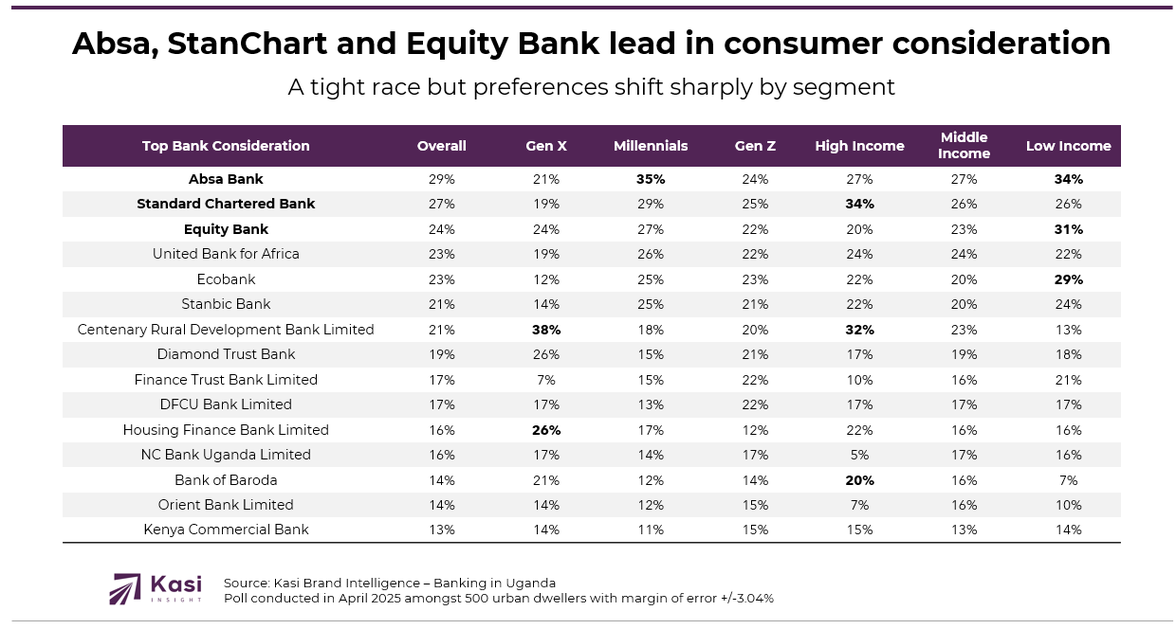
A closer look at the data reveals segmented preferences that call for tailored strategies. Absa Bank leads among Millennials at 35% and appeals to low-income earners at 34%, reflecting strong digital and retail reach. Standard Chartered performs best with high-income consumers, with 34% citing strong consideration, likely due to premium services and brand trust. Equity Bank maintains broad appeal, topping low-income segments at 31%. Centenary Bank stands out among Gen X with 38% consideration and attracts 32% of high-income customers, benefiting from its rural-urban network and community-focused service.
Beyond brand recognition, the data reveals what truly shapes consumer banking decisions. Customer service ranks as the most important factor overall, followed by ease of use and the ability to access all services on a single platform. This pattern highlights a strong shift toward expectations for seamless, digital-first experiences that make banking more intuitive and convenient.
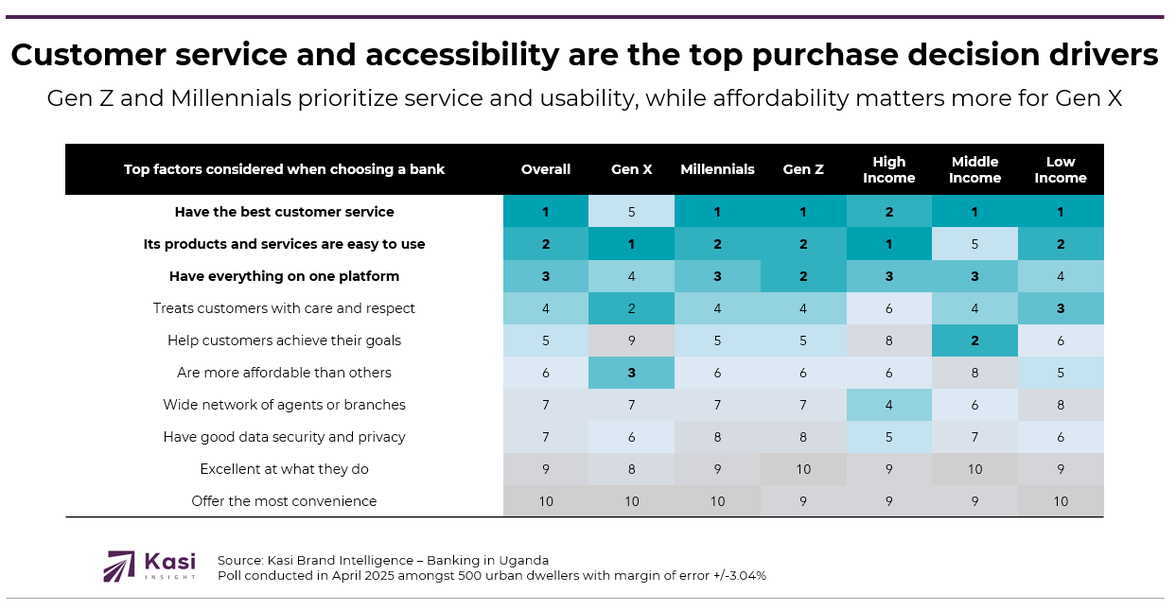
Generational and income differences further illustrate how preferences vary. Gen X place ease of use as their top priority and affordability as third in importance. High-income consumers value digital usability above all and rank a broad agent or branch network in fourth place. Middle-income groups stand out by ranking help with achieving personal goals as their second most important factor, showing a clear demand for advisory and empowerment-oriented services that extend beyond basic transactions.
The narrow gaps between leading brands and the strong performance of niche players show that even small strategic shifts can unlock significant growth. A generic, one-size-fits-all approach is no longer effective. Banks need to tailor their offerings and communication to the specific expectations of each segment. For high-income customers, this means delivering premium, integrated platforms that combine digital tools with accessible physical touchpoints. In contrast, lower-income consumers place more value on fair pricing, courteous service, and straightforward processes that make banking less intimidating and more transparent.
For younger segments such as Millennials and Gen Z, who consistently rank service and usability as top priorities, intuitive apps, fast onboarding, and responsive support are essential. Providing tools that help customers achieve their personal financial goals, which rank fifth overall in importance, also creates powerful opportunities to build loyalty that goes beyond transactions. Banks that reshape their value proposition around these expectations will be better positioned to drive customer acquisition and deepen long-term relationships.
Share on socials using this caption: Ugandan consumers are raising the bar for banks. 💡 It’s no longer just about trust: service, simplicity, and smart digital experiences are driving loyalty. Discover how leading brands are adapting to these shifting expectations and what it takes to stand out in a crowded market. #BankingTrends #CustomerExperience #Uganda
974 views
Share article
Uganda Banking Sector 2025: Growth with Discipline, What Marketing Signals Reveal About Balance Sheets
Kenya Banking Sector 2025: Reading the Balance Sheet Through Marketing Signals
How Consumer Sentiment Predicts South Africa’s Credit Cycles