Yannick Lefang, Eng
February 9, 2026
Share article



This signal is derived from Kasi’s high-frequency Trust & Economic Sentiment dataset, combining indicators of employment outlook, household financial resilience, consumption intent, institutional trust, brand trust, and trust-related behaviors. The dataset captures both current state (levels of pressure and trust) and direction of change (trust momentum versus one year ago), allowing trust to be read as a leading indicator, not a lagging perception metric. By integrating economic stress markers (job availability, expense coverage, meals per day) with trust attitudes and behavioral outcomes (recommendation, churn), the dataset surfaces how trust functions under real economic constraint rather than in abstract conditions.
The data emits a clear and converging signal: as economic pressure intensifies, trust is being re-priced as infrastructure rather than sentiment. With 82% of respondents reporting that finding a job has become more difficult and only 17% believing it is a good time to make large purchases, households are operating with limited financial and emotional slack. This is reinforced by the fact that just 42% are confident they can meet regular expenses in the coming six months, while a significant 38% remain uncertain. Food consumption patterns deepen this signal, with 52% of low-income households eating only two meals per day, indicating that economic pressure is not temporary but structural. In signal terms, this environment amplifies demand for actors that reduce uncertainty in everyday life.
A second signal emerges in how trust itself is being redefined. Trust is no longer anchored in values or long-term reputation, but in observable behavior. The strongest associations with trust—honesty even when it is hard (30%), consistency and reliability (22%), and truth without concealment (15%)—indicate a recalibration toward predictability and transparency. Among Gen Z, honesty rises to 35%, while low-income households disproportionately emphasize doing what is promised (22%), signaling lower tolerance for ambiguity or failure. This shift points to the rise of performance-based trust, where every interaction becomes a trust-building or trust-eroding event.
The third signal is behavioral and commercial. With 71% of respondents stating that trust is “very important” in deciding which organizations to support or buy from, trust is functioning as a primary decision filter, particularly in constrained environments. This elevates trust from a branding consideration to a leading indicator of demand, retention, and advocacy.
At the institutional level, the signal shows trust migration rather than uniform decline. Trust in public institutions has collapsed, with net trust changes of –85 for national government and police, while trust in financial institutions (+78 net trust), businesses (+74), and notably media (+80) remains high. Media is also one of the few institutions showing positive trust momentum (+7), signaling a broader shift toward information and service ecosystems as anchors of credibility. This migration creates a vacuum traditionally filled by the state, increasingly occupied by private actors that deliver tangible value.
Within this reallocation, telcos emit a strong but conditional signal. At 71% trust, telcos rank third among company types, just behind banks (78%) and mobile money providers (73%), and ahead of global tech, e-commerce, and utilities. This positioning signals that telcos have already crossed into the category of trusted institutions, but are now benchmarked against financial infrastructure, not consumer brands. Expectations around transparency, fairness, and responsiveness are therefore rising sharply.
The drivers of trust and distrust further reinforce this signal. Trust is built through open communication (55%), effective delivery (47%), respect for rights (43%), and consistency (42%), while distrust is overwhelmingly driven by perceived dishonesty or corruption (72%), broken promises (48%), and leaders perceived as not caring about ordinary people (46%). These patterns act as early-warning signals of churn, supported by the finding that 27.6% of respondents have stopped using a brand due to loss of trust. Importantly, trust loss is often silent, surfacing only after revenue or usage declines.
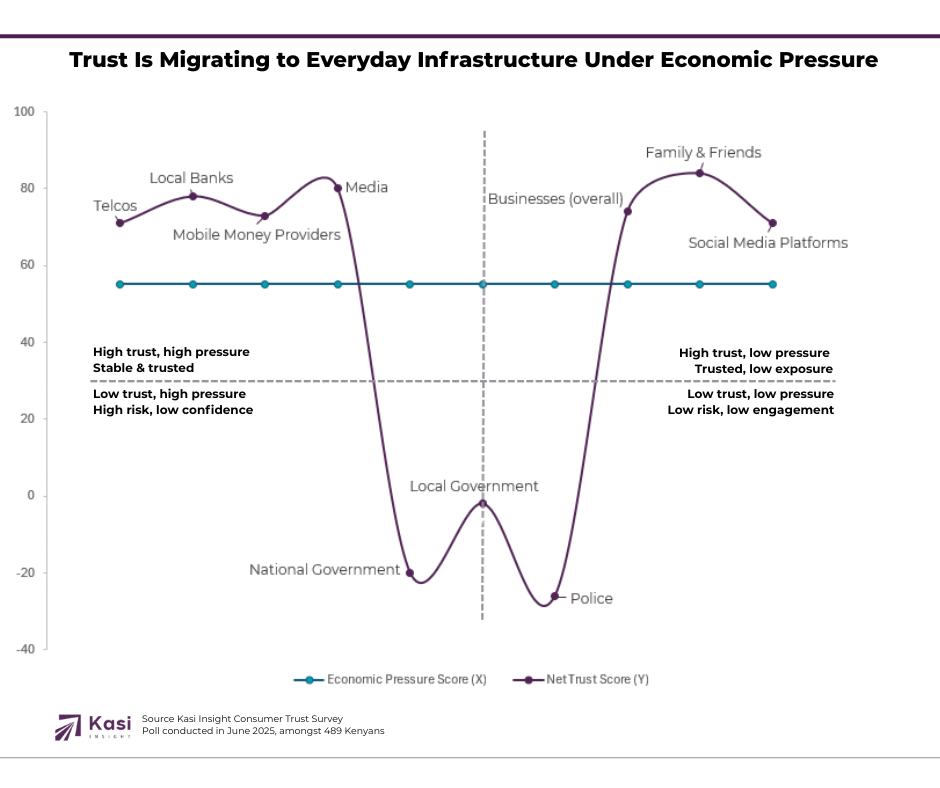
Trust is transitioning from a reputational metric to economic infrastructure, particularly in high-pressure environments. Telcos that consistently reduce uncertainty, through predictable pricing, transparent communication, reliable service, and fast resolution when failures occur, will increasingly be treated as stabilizing institutions in people’s lives. Those that introduce opacity, inconsistency, or perceived unfairness risk being cognitively grouped with the least trusted public institutions, regardless of brand strength.
For telco leaders, this signal demands a shift from measuring trust to engineering trust. Trust should be treated as a core operational KPI, monitored alongside network uptime, ARPU, churn, and NPS. Pricing changes, outages, policy updates, and customer care interactions should be assessed not only for efficiency or cost impact, but for their trust impact under economic stress. Telcos that act early; by institutionalizing transparency, simplifying customer journeys, and closing the gap between promise and delivery, will convert trust into resilience and long-term growth. Those that delay risk discovering trust erosion only after customers have already disengaged.
If trust is becoming economic infrastructure, the question is no longer whether to measure it, but how to engineer it before it breaks.
Contact the Kasi Insight team to explore how our Trust & Economic Sentiment intelligence can help you identify early risk, design for resilience, and turn trust into a commercial advantage.
Win with confidence. → https://www.kasiinsight.com
Share on socials with this caption:
🏗️📊 Trust is no longer a feeling, it’s infrastructure.
As economic pressure rises, consumers are rewarding brands that reduce uncertainty through honesty, consistency, and delivery. In Africa, trust is now a leading indicator of demand, loyalty, and growth.
#TrustEconomy #EconomicInfrastructure #AfricaInsights #ResilientBrands #KasiInsight
377 views
Share article
Consumer confidence loses momentum in October
Confidence plateaus in September as caution defines household behavior
Restless sentiment, divided opposition, and the path to continuity in Cameroon