Sandra Beldine Otieno
March 21, 2024
Share article


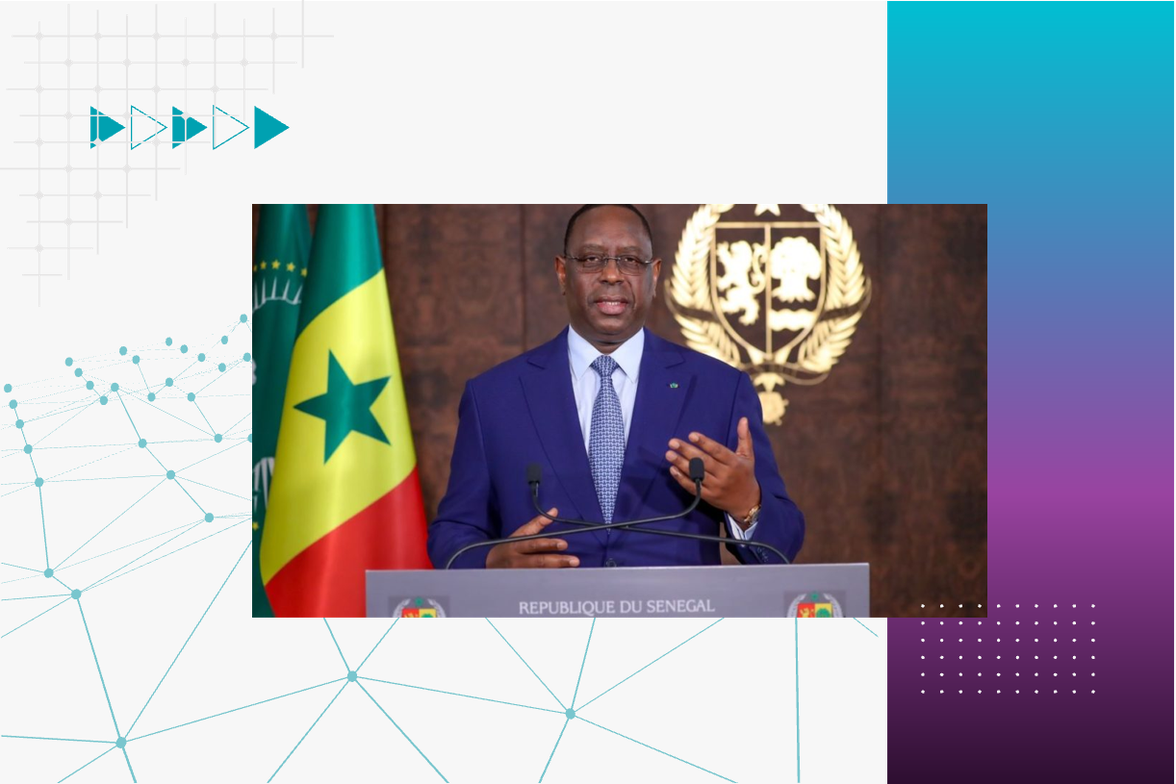
In a remarkable testament to Senegal's democratic spirit, the Constitutional Council has decisively acted to uphold the integrity of the upcoming presidential election, setting a new date for March 24, 2024, despite initial attempts to delay. This move came in response to an unexpected decree by President Macky Sall, which sought to postpone the election over a dispute regarding candidate eligibility—a decision that sparked a national debate and led to the National Assembly proposing a delay. However, the Council's intervention ensures that the electoral process moves forward without further hindrance, marking a pivotal moment in Senegal's political narrative.
As the nation anticipates this electoral event, the spotlight turns to the candidates stepping forward to shape Senegal's future. Prime Minister Amadou Ba, President Macky Sall's chosen successor, leads the race as the flagbearer of the ruling Benno Bokk Yakaar (BBY) coalition. Joining him in the contest are notable figures such as Khalifa Ababacar Sall, the former Mayor of Dakar known for his tumultuous political journey; Idrissa Seck, a seasoned politician and the 2019 presidential runner-up; opposition leader Bassirou Diomaye Faye; and Anta Babacar Ngom, a female entrepreneurial newcomer eager to infuse politics with new ideas.
The Kasi Index of Consumer Sentiment (ICS) monitors the economic pulse of 20 African nations, making it a premier gauge of consumer confidence on the continent. By probing into the economic realities and prospects concerning purchasing power, personal finances, household earnings, and job prospects, this index provides an insightful snapshot of Africa's economic climate.
In Africa, electoral cycles are critical junctures that significantly impact business landscapes and the broader sentiment of confidence, marking them as events of paramount importance. Notably, consumer attitudes and business outlooks shift in alignment with the electoral atmosphere, reflecting the unique dynamics of each voting season. Moving beyond traditional methods of predicting electoral outcomes, the application of consumer sentiment data has emerged as a potent tool for forecasting election results in nations such as Kenya, Ghana, and Nigeria, demonstrating its effectiveness on multiple occasions.
This approach centers on analyzing variations in consumer sentiment in the year preceding elections, with particular attention to the average sentiment and its fluctuations during this period. Such analysis helps delineate between scenarios of political change—marked by the defeat of incumbents—and continuity, where the status quo prevails.
Over the last two years, Senegal’s consumer sentiment has shown a dynamic range, oscillating between optimism and deep pessimism. In the early months of 2022, the sentiment fluctuated, peaking at a positive +6 in April and May, before experiencing a sharp downturn to -13 by September, indicating a substantial fall in consumer confidence. The trend continued into 2023, predominantly in the negative realm, with a dramatic drop to -29 in May, highlighting a critical decline in consumer sentiment. It was only in the final quarter of 2023 that sentiment began to improve, eventually stabilizing at +4 by December.
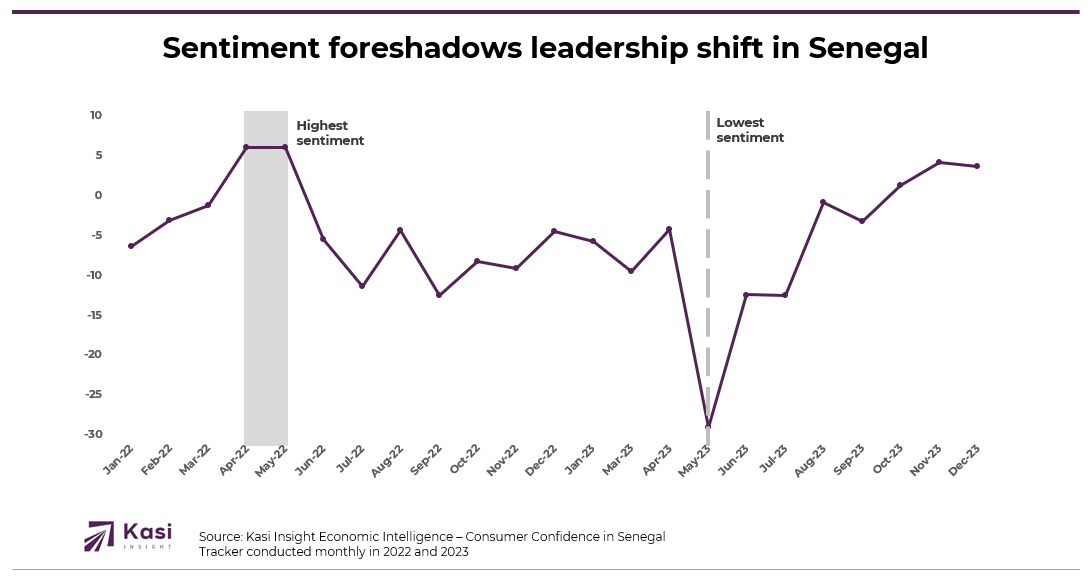
This persistent negative trajectory, especially the pronounced decline in May 2023, suggests underlying economic or socio-political challenges significantly influencing the public’s economic outlook. As Senegal heads towards its presidential election on March 24, 2023, these sentiment shifts present a formidable hurdle for the ruling party. Utilizing the Kasi ICS methodology to analyze the sentiment trends leading up to the election reveals an average index of -6 with a volatility rate of 110%, indicating a strong potential for a change in leadership.
In the intricate dance of democracy and economic sentiment, Senegal stands at a pivotal juncture. The Constitutional Council’s firm stance to keep the democratic process on its intended path, despite initial delays, underscores a steadfast commitment to constitutional principles. This decision not only reaffirms the importance of adhering to scheduled electoral timelines but also sets a precedent for the resolution of future electoral disputes.
The ruling party BBY is faced with the challenge of navigating through a period marked by significant shifts in consumer sentiment, confronting an election that is as much a referendum on its leadership as it is a test of the nation’s democratic resilience. The oscillation in consumer confidence, with its drastic lows and modest highs, reflects the broader uncertainties that have gripped the nation, underscoring the profound impact of economic conditions on political fortunes.
The Kasi ICS’s insights into consumer sentiment across Africa, and particularly in Senegal, offer a lens through which to view the upcoming election. The index’s predictive success in other African nations suggests that consumer sentiment could be a harbinger of political change, a notion that seems particularly pertinent given the current climate in Senegal. With an average sentiment index leaning towards the negative and volatility indicating a restive public mood, the stage is set for a potentially transformative electoral outcome.
Share on socials using this caption: 📉🗳️ As Senegal counts down to its presidential election, the nation's economic pulse beats with anticipation and concern. With consumer confidence taking a rollercoaster ride in recent years, all eyes are on how this sentiment will sway the scales for the ruling coalition. Amidst constitutional calls to action, will the tide turn in Senegal's political landscape? Stay tuned as we witness history in the making. #SenegalElection2024 #ConsumerSentiment #PoliticalChange
2275 views
Share article
Trust Is Becoming Economic Infrastructure
Consumer confidence loses momentum in October
Confidence plateaus in September as caution defines household behavior