Sandra Beldine Otieno, MSc
September 30, 2025
Share article


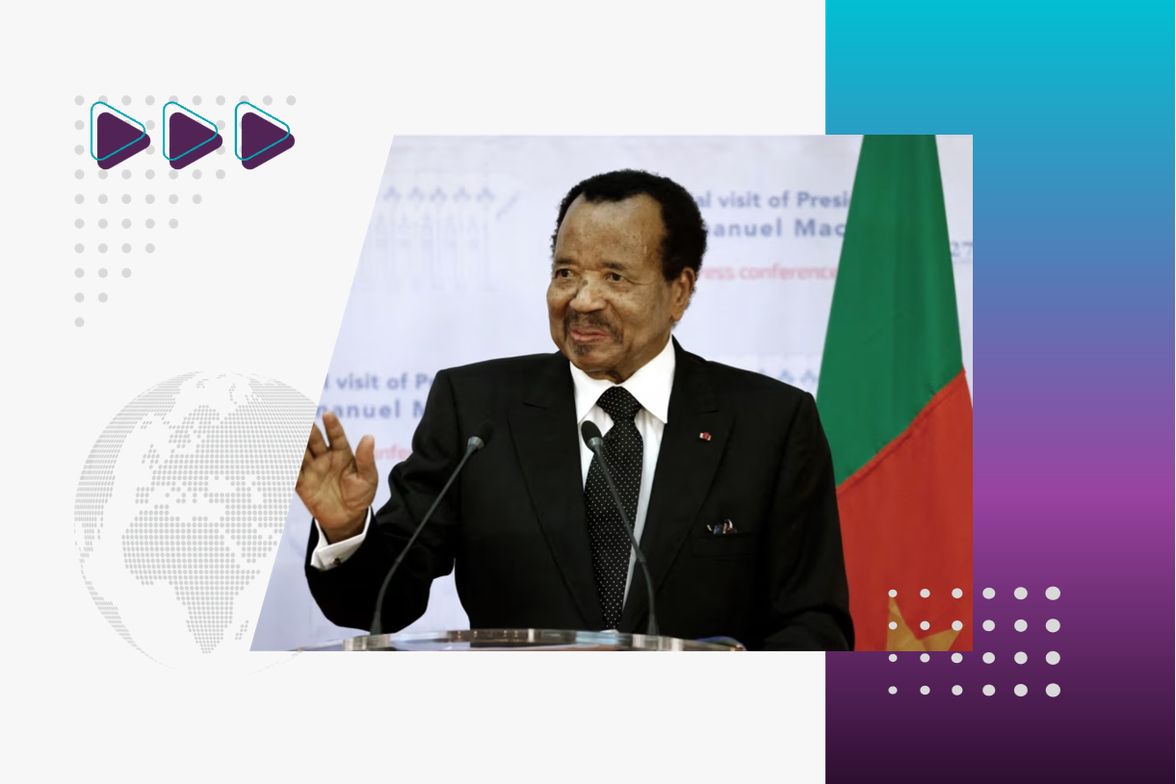
Cameroon will hold its presidential election on October 12, 2025, marking a critical moment for the country’s political trajectory. Twelve candidates are on the ballot, reflecting a mix of established politicians and reform-minded challengers. The vote comes at a time when citizens are demanding solutions to economic hardship, insecurity in parts of the country, and a sense of political renewal.
The race features long-time incumbent Paul Biya, who has been in power for more than four decades, alongside prominent figures such as Issa Tchiroma Bakary of the Front for the National Salvation of Cameroon, Bello Bouba Maigari of the National Union for Democracy and Progress, Cabral Libii of the Cameroon Party for National Reconciliation, Hermine Patricia Tomaïno Ndam Njoya of the Cameroon Democratic Union, Joshua Osih of the Social Democratic Front, and Akere Muna of the Univers party. While Biya’s candidacy symbolizes continuity, others are positioning themselves as alternatives with promises of generational change, economic reform, and stronger democratic institutions.
The absence of Maurice Kamto, who was barred from contesting despite being seen as a leading opposition voice, has reshaped the dynamics of the election. With a fragmented opposition and widespread voter concerns over living standards and governance, the outcome will be closely watched both domestically and internationally as Cameroonians decide between continuity and the prospect of a new political direction.
The Kasi Index of Consumer Sentiment (ICS) has emerged as one of the most reliable predictors of electoral outcomes across Africa. Tracking the economic pulse in various countries, the index provides a clear picture of consumer confidence by probing into purchasing power, personal finances, household earnings, and job prospects. This forward-looking perspective makes it a premier tool for understanding how economic perceptions shape political realities.
Electoral cycles are critical junctures that often reshape both business and consumer confidence. The ICS has demonstrated its accuracy by successfully anticipating election outcomes in Kenya, Nigeria, Senegal, and South Africa, with Ghana’s second election cycle being the most recent case. In each of these contexts, shifts in consumer sentiment during the year leading up to elections mirrored the eventual result, signaling either political change with the defeat of incumbents or continuity when the status quo prevailed.
This predictive strength stems from a focus on both the average level of consumer sentiment and its volatility in the run-up to the polls. By closely examining these dynamics, the ICS distinguishes between electorates leaning toward change and those favoring continuity, offering businesses, policymakers, and observers an evidence-based window into Africa’s democratic and economic transitions.
Over the past three years, Cameroon’s consumer sentiment has recorded significant fluctuations, as measured by the Kasi Index of Consumer Sentiment (ICS). The trend began in early 2023 at -6, reflecting a pessimistic public mood amid mounting economic and social challenges. Sentiment briefly recovered into positive territory by February (+4) before dipping again in March (-3) and June (-4). July marked a low point at -13, underscoring widespread distress, but by December 2023 sentiment had rebounded to +11, suggesting cautious improvement heading into the new year.
The year 2024 brought both recovery and volatility. Sentiment opened at zero in January, fell back to -4 in February, and then improved through the spring with scores between +3 and +4. September marked a sharp peak at +15, the highest in the series, reflecting renewed optimism before moderating to +9 in October and stabilizing at +11 in November. However, sentiment softened again in December (+4), pointing to persistent uncertainty around governance, unemployment, and economic stability.
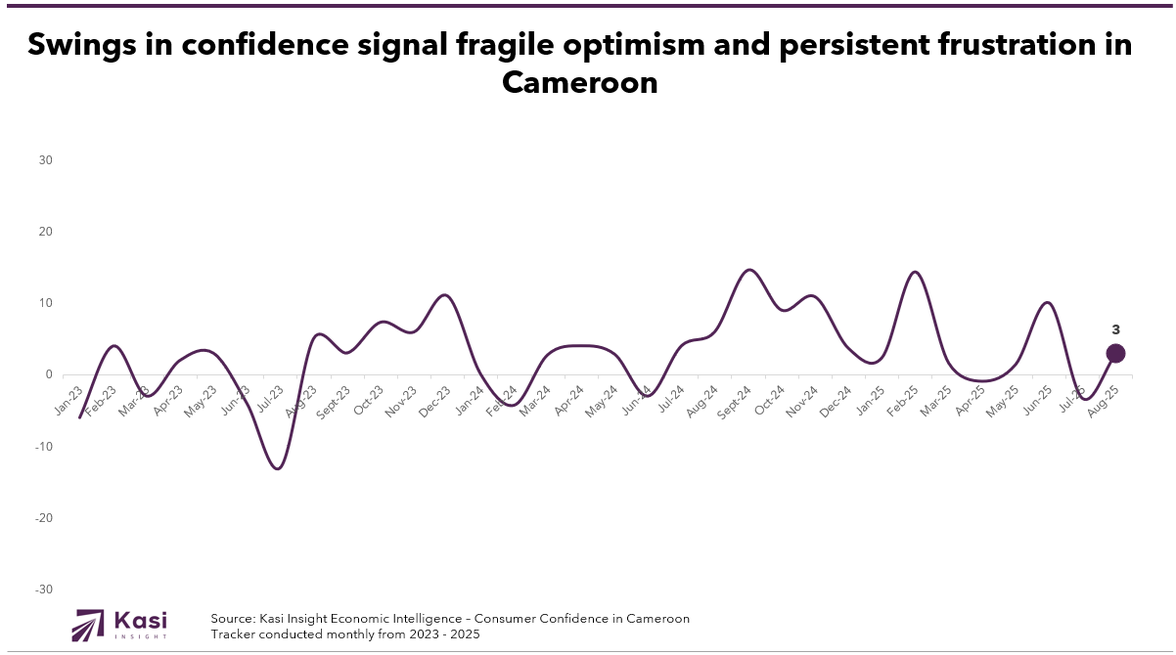
In 2025, trends remained unsettled. The year began with subdued confidence (+2 in January), followed by a surge in February (+14), then sharp reversals with scores of +2 in March and -1 in April. Modest gains in May (+1) were followed by renewed optimism in June (+10), only to dip once more in July (-3) before recovering slightly in August (+3). With an average sentiment score of 6 and a volatility rate of 106%, sentiment reflects a restless population caught between fragile optimism and deep frustration.
The presidential election takes place amid sharp swings in consumer sentiment that underline a restless yet divided electorate. The ICS data highlights the intensity of public frustration over unemployment, rising living costs, and insecurity in conflict-affected regions. These conditions have fueled demand for political renewal, but the opposition remains fragmented following the exclusion of Maurice Kamto, who was widely viewed as the strongest challenger to the ruling CPDM.
The outcome points clearly to continuity. Despite the presence of reform-minded candidates such as Cabral Libii of the PCRN, Joshua Osih of the SDF, Hermine Patricia Ndam Njoya of the UDC, and Akere Muna of Univers, none command the unified support required to dislodge Paul Biya’s CPDM. With more than four decades in power, Biya enters the election as the dominant figure, and the ICS data suggests that while Cameroonians are unsettled and eager for change, the lack of a consolidated opposition indicates the CPDM will probably retain power in the upcoming election.
Share on socials using this caption: 🇨🇲 Cameroon heads to the polls in October as citizens call for 💼 jobs, 📈 stability and 🛡️ security, yet the Kasi ICS shows a restless electorate where hope and frustration collide, with continuity still likely to outweigh change.
#CameroonElections2025 #AfricaDecides #KasiICS #ContinuityVsChange
1736 views
Share article
Trust Is Becoming Economic Infrastructure
Consumer confidence loses momentum in October
Confidence plateaus in September as caution defines household behavior