Segun Sunmonu
September 4, 2024
Share article



Kasi Insight's Cost of Living Tracker offers critical insights into the shifting economic dynamics across Africa. Conducted quarterly in 20 African markets, this tracker provides an in-depth analysis of consumer behavior, spending trends, and perceptions of price changes in both essential and non-essential goods and services. In South Africa, significant shifts in consumer perceptions of price fluctuations have been observed across key sectors such as Food & Beverages, Utilities, Household Furniture & Appliances, Alcoholic Beverages, Housing/Rent, Transportation, Clothing & Shoes, Education, Recreation, and Communication. As of early 2023, a substantial portion of South Africans reported sharp price hikes, with 65% perceiving increases in Food & Beverages, 78% noting higher Utility costs, and 75% experiencing rising Housing/Rent expenses.
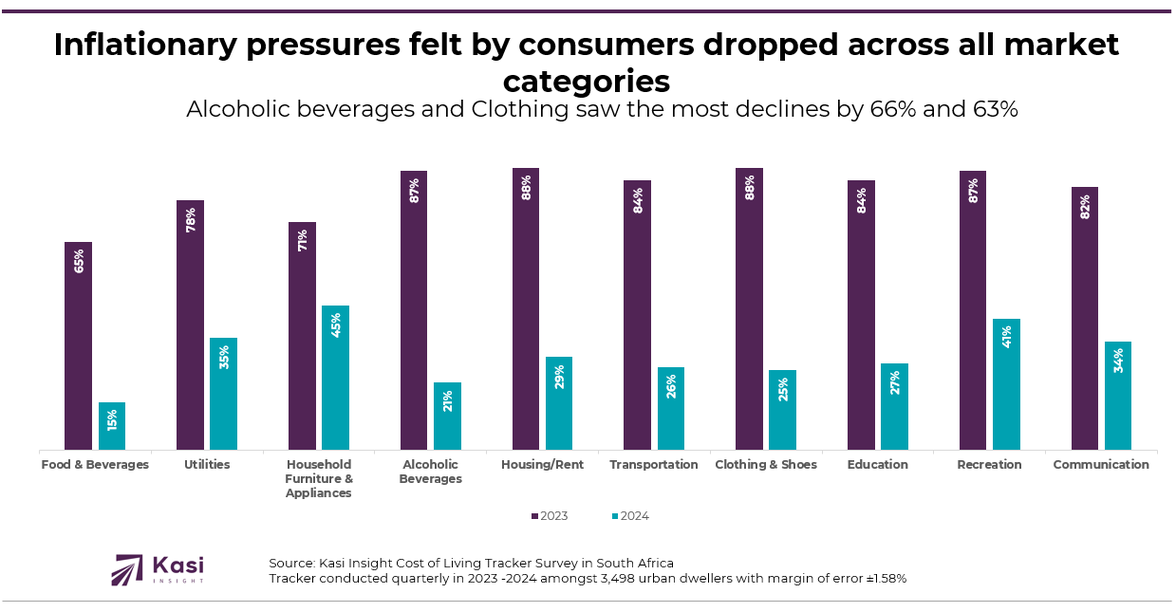
By mid-2024, consumer perceptions had shifted dramatically across several key sectors. In the Food & Beverages category, the percentage of consumers reporting price hikes plummeted from 65% to just 15%, with 70% now believing that prices had stabilized. A similar trend emerged in the Utilities sector, where reports of price increases fell sharply from 78% to 31%, and 35% of consumers even observed price decreases. This pattern of stabilization and reduction extended to other segments as well. In Household Furniture & Appliances, the percentage reporting price hikes dropped from 71% to 17%, while in Alcoholic Beverages, it declined from 87% to 31%. Transportation saw a significant decline in perceived price increases, dropping from 84% to 27%, and Clothing & Shoes followed suit, with reports of rising prices falling from 69% to 26%. The Education and Communication sectors also witnessed fewer reports of price hikes, as more consumers noticed stable or declining prices.
South Africans are primarily responding to inflation by making lifestyle changes, with both men and women across all generations ranking this as their top strategy for coping with rising costs. These lifestyle adjustments include measures such as sharing transportation and cutting back on non-essential spending. Generation X, Millennials, and Gen Z are equally invested in these changes, showing that the impact of inflation is prompting wide-ranging shifts in consumer behavior. The second tactic involves changing purchasing habits, such as buying less expensive goods or reducing spending on take-out food. Women, Millennials, and Gen Z are particularly proactive in seeking cheaper alternatives or switching to budget-friendly brands. Using community services, such as feeding programs, ranks third overall, with men relying on these services more frequently than women. This approach is equally popular among both high- and middle-income earners.
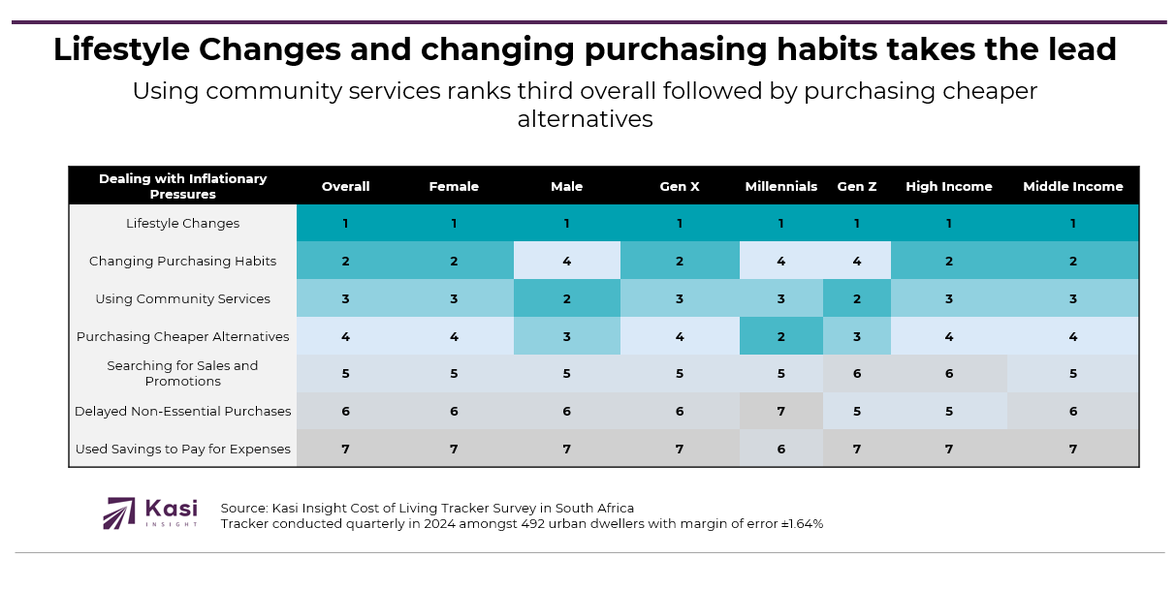
Purchasing cheaper alternatives comes in fourth place, driven largely by younger consumers who are more open to switching to lower-priced brands. Searching for sales and promotions ranks fifth for most groups, though Gen Z slightly prefers delaying non-essential purchases, ranking this strategy fifth for their demographic. Lastly, using savings to cover expenses is the least favored approach for all groups, highlighting a general reluctance to tap into savings, with high-income earners being a bit more likely to resort to this strategy.
As we approach Q4, brands operating in South Africa must recalibrate their strategies to address shifting consumer behaviors amid easing inflationary pressures. Kasi Insight's data reveals that price stabilization across key sectors has led consumers to adopt a more cautious, value-driven approach to spending. Offering budget-friendly products and services, along with discounts and promotions, will be essential in capturing cost-sensitive consumers, particularly Generation X, Millennials, and Gen Z. Loyalty programs that deliver tangible benefits will further solidify customer retention in an increasingly competitive market.
For younger generations, especially Millennials and Gen Z, brands must enhance their digital marketing efforts, utilizing social media and influencer partnerships to engage this highly active demographic. These consumers are not only seeking cheaper alternatives but are also more receptive to personalized, value-focused messaging. In addition, with lifestyle changes and community reliance becoming common strategies for managing costs, brands that show transparency in pricing and actively participate in community support initiatives will build trust and foster deeper connections with consumers, making them well-positioned for success in the final quarter.
Share on socials using this caption: ✨ Good news for South Africans! 📉 Inflation is easing, with prices stabilizing across key sectors. 🛒 Consumers are adapting by making smart lifestyle changes and adjusting their spending habits. 🚗🍽️ #CostOfLiving #SouthAfrica #InflationRelief #KasiInsight
2961 views
Share article
Trust Is Becoming Economic Infrastructure
Consumer confidence loses momentum in October
Confidence plateaus in September as caution defines household behavior