Sandra Beldine Otieno, MSc
May 26, 2025
Share article



Kasi Insight’s Human Connection Survey provides a deep understanding of how relationships evolve, from where people meet to their beliefs about love, communication, financial responsibilities, gender roles, conflict resolution, and perceptions of gender-based violence. In Tanzania, the survey reveals that love and companionship remain central, but how individuals experience change and manage tension is strongly influenced by how much they earn and how old they are.
When asked whether their relationship roles had changed compared to a year ago, most Tanzanian respondents said yes. A total of 84% reported some degree of change, with 44% saying roles had changed significantly and 40% saying somewhat. Only 16% said their roles had stayed the same. These results suggest that relationship responsibilities are increasingly fluid, shaped by changing expectations, evolving social norms, and day-to-day pressures. For most, fixed roles no longer reflect their current experience.
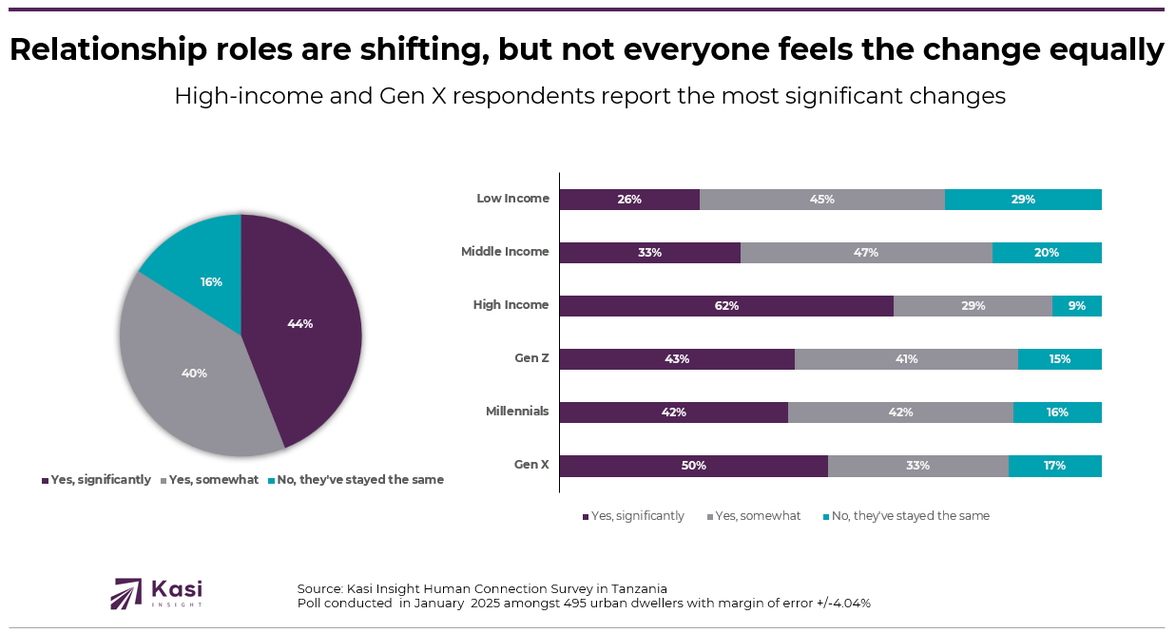
Change is not felt equally across groups. Gen X reported the highest rate of significant change at 50%, followed by 43% of Gen Z and 42% of Millennials. Income reveals sharper contrasts. Among high-income individuals, 62% said their roles had changed significantly, compared to 33% of middle-income and just 26% of low-income respondents. Meanwhile, 29% of low-income individuals said their roles had not changed at all, pointing to how financial constraints may reinforce more traditional or rigid household structures.
When it comes to resolving conflict, apologizing and forgiving is the most common method across all groups, ranking first overall and topping the list across income and age segments. This underscores a widespread cultural emphasis on emotional repair and reconciliation. Calm and open communication follows closely, particularly among Gen Z, middle-income, and low-income individuals. Active listening ranks third, especially among Millennials and Gen X, reflecting a broad preference for dialogue and mutual understanding. Together, these top strategies suggest that Tanzanians tend to favor emotionally engaged, conversation-driven approaches to resolving conflict.
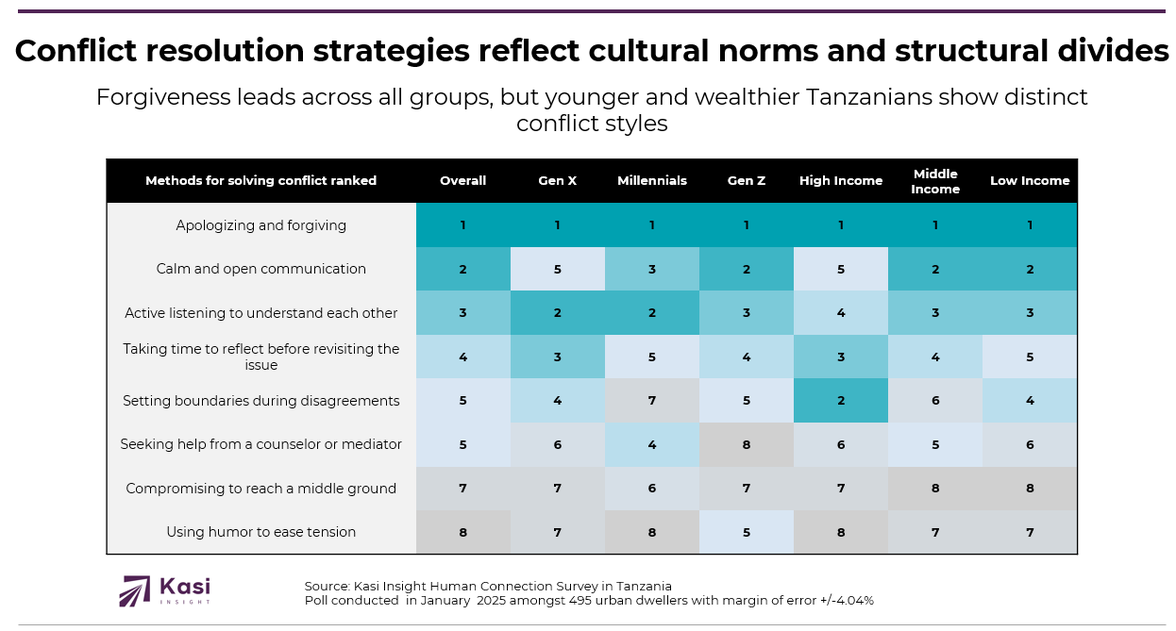
Still, notable differences emerge across groups. Gen Z places higher value on humor, ranking it fifth more than any other generation, pointing to a shift toward lightness and emotional openness. Millennials are the most likely to seek professional help, ranking counseling or mediation fourth, well ahead of Gen Z who rank it last. Among high-income individuals, structured approaches like setting boundaries and reflection rank second and third, suggesting a more formalized way of managing tension. Meanwhile, middle- and low-income groups rely more on interpersonal strategies like listening and calm conversation, highlighting the role of accessibility and relational habits in shaping how conflict is handled.
These findings make it clear that strengthening relationships in Tanzania requires tailored approaches. Individuals in different income brackets experience distinct emotional pressures and rely on different tools to navigate them. For low-income groups, interventions should reinforce emotional intelligence and low-cost techniques such as compromise and humor. Middle-income individuals could benefit from more structured communication training and emotional regulation support. High-income earners may need advanced coaching to manage role transitions, boundary setting, and emotional independence.
Generational differences also matter. Gen Z’s openness to dialogue and humor provides a strong foundation for early preventive education. Millennials’ receptiveness to counseling signals readiness for deeper therapeutic engagement. Gen X may benefit most from programs that acknowledge their reflective style while encouraging openness and trust. Relationship interventions that are grounded in context, experience, and emotional style will be far more effective than one-size-fits-all solutions.
Share on socials using this caption: 💬❤️ Relationship roles are shifting in Tanzania and how people resolve conflict depends on both income and age. From Gen Z’s openness to high earners’ structure, emotional connection is being redefined. #TanzaniaRelationships #HumanConnection #EmotionalHealth #KasiInsight #ConflictResolution #GenerationalShift
1251 views
Share article
The Future of AI in Africa Lies in Smarter Decisions, Not Just Smarter Models
Africa’s Critical Minerals: From Hidden Resource to Economic Catalyst
Perceptions of climate inaction persist among Ghanaian consumers, driven by income disparities