Segun Sunmonu
June 9, 2025
Share article


Kasi Insight’s Sustainability Tracker, a tracker that assesses public views on climate change and environmental responsibility across Africa, reveals a prevailing sense of dissatisfaction among Ghanaians regarding corporate climate efforts. As of February 2025, two-thirds (66%) of respondents believe businesses in their region are making only limited efforts to address climate change, while just 3% perceive strong action. A further 21% recognize moderate efforts, and 10% feel businesses are not addressing climate concerns at all, signaling a need for more visible and impactful sustainability initiatives from the private sector.
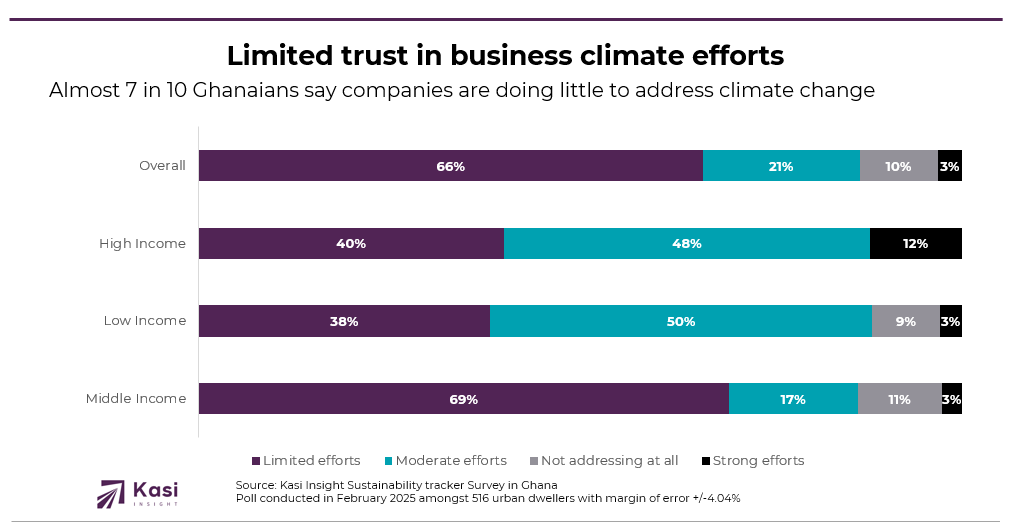
When broken down by income, the data uncovered notable differences in perception. Middle-income respondents stand out as the most critical, with 69% stating businesses are making only limited efforts and just 3% acknowledging strong efforts, mirroring the national average. Meanwhile, high- and low-income groups share a similar split, with around 88% of each group believing businesses are either making limited or moderate efforts. Interestingly, high-income respondents are slightly more likely to see strong efforts (12%) compared to just 3% among low-income individuals.
Moreso, offering sustainable products and services emerged as the most widely expected climate action from businesses in Ghana, cited by 55% of respondents. This expectation was consistently high across generations, 56% of Millennials, 54% of Gen X, and 51% of Gen Z, highlighting a unified demand for greener product options. Gender differences were also minimal, with 58% of males and 50% of females selecting this option.
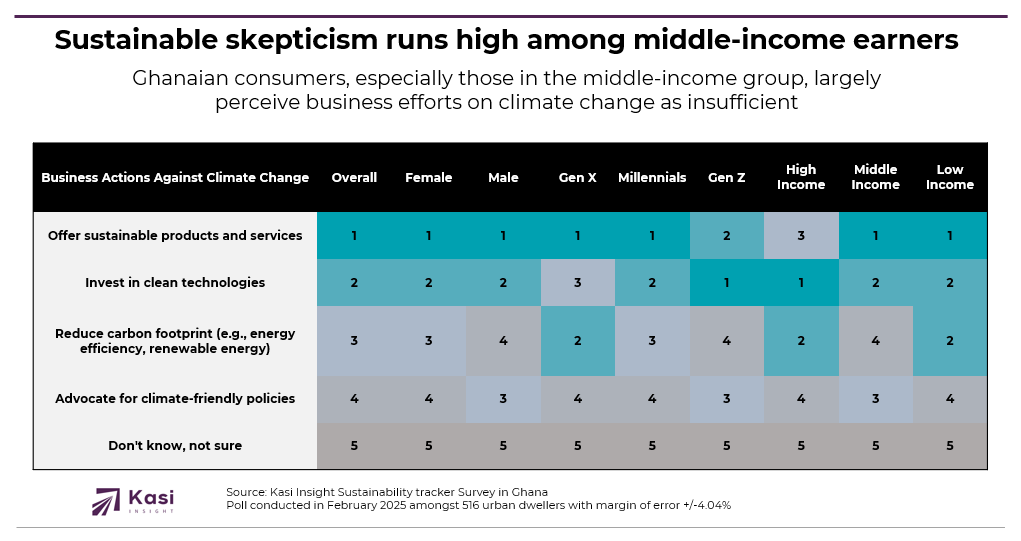
However, investment in clean technologies stood out among Gen Z (56%) and high-income individuals (60%), showing a clear appetite for long-term innovation-driven solutions among younger and wealthier groups. Meanwhile, low-income respondents demonstrated the most intense expectations across the board, topping the list for sustainable products (71%), clean tech investment (68%), and even carbon footprint reduction (68%). Advocacy for climate-friendly policies resonated most with Gen Z (49%) and low-income groups (53%), underlining a growing call for systemic change among those most likely to be affected by climate risks.
To effectively address climate concerns and align with public sentiment in Ghana, businesses must adopt an inclusive and action-oriented sustainability approach. The data reveals a strong desire across all segments, particularly among low- and middle-income groups, for companies to prioritize sustainable products and services. While this is the most expected action, it is only the starting point. Businesses must ensure that their offerings are not only labeled as “green” but are also accessible, affordable, and visibly impactful within local communities. The middle-income group shows a higher level of skepticism, with 70% perceiving corporate efforts as limited. This signals a pressing need for businesses to communicate their climate strategies clearly and demonstrate measurable progress on the ground.
Beyond product offerings, deeper interventions such as investment in clean technologies and reducing carbon footprints are gaining traction, especially among Gen Z, high-income, and low-income respondents. These segments are increasingly aware of the systemic nature of climate change and expect companies to lead beyond the shelves through innovation, advocacy, and energy efficiency. Low-income consumers voiced strong expectations across all action types, suggesting that climate vulnerability may be shaping a sharper awareness of what needs to be done. Businesses that integrate community-based solutions, invest in long-term environmental infrastructure, and advocate for supportive policies will be better positioned to gain public trust and differentiate themselves in a market where climate action is no longer optional, it’s expected.
Share on socials using this caption: 📊 Uncovering Ghana’s Climate Expectations! From sustainable products to clean tech, see how different income groups are shaping the future of business-led climate action. 🌱🏙️ #SustainabilityInGhana #GreenExpectations #ClimateActionNow
1497 views
Share article
The Future of AI in Africa Lies in Smarter Decisions, Not Just Smarter Models
Africa’s Critical Minerals: From Hidden Resource to Economic Catalyst
Eco-friendly packaging and natural ingredients drive Ghanaian purchases, despite limited support for corporate sustainability practices