Sandra Beldine Otieno
December 15, 2023
Share article



In November, consumer confidence maintained its upward trajectory, registering an improvement of three points. This positive trend was propelled by a concurrent three-point increase in both the indices measuring current conditions and future expectations.
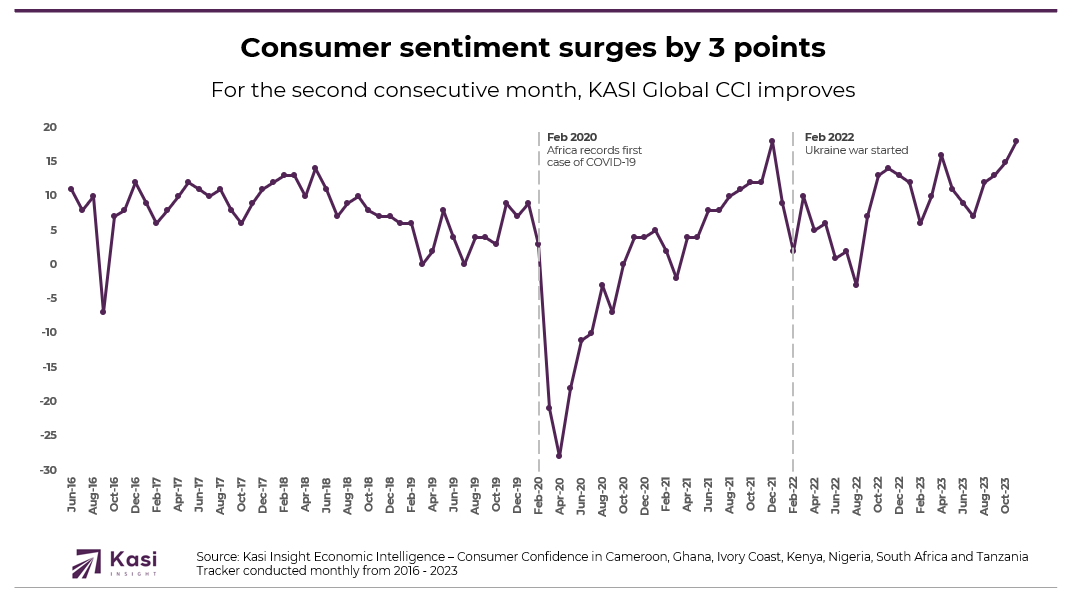
In November, African nations showcased remarkable resilience in the face of escalating living costs, as evidenced by the improved household indices compared to October. The general country economic conditions index and the general city economic conditions index both posted positive gains, rising by 1 and 3 points, respectively. These indices serve as barometers for the collective perception of economic well-being at both the national and city levels.
The personal finance index surged impressively by 9 points, signaling a significant upswing in individuals' confidence regarding their own financial situations. This suggests a growing optimism about personal financial stability. Concurrently, the household spending index maintained a robust position at 18 points for the third consecutive month, underscoring a sustained level of confidence in household expenditure patterns.
The household income index demonstrated a commendable improvement, marking a 4-point increase and indicating positive developments in the overall income levels of households. The five-point increase in discretionary spending reflected a favorable shift in consumers' willingness to allocate funds to non-essential purchases, emphasizing a buoyant consumer sentiment. However, amidst these positive trends, the job prospect index experienced a slight dip of one point, suggesting a nuanced sentiment regarding employment opportunities.
Varied consumer sentiment trends emerged in the observed nations. Tanzania saw a significant 12-point surge, highlighting a substantial uptick in consumer confidence, while Ivory Coast registered a 6-point decline, signaling a decrease in confidence.
In Tanzania, consumer sentiment experienced an upswing, marked by a 12-point surge. This positive shift can be attributed to a significant 22-point increase in the country economic conditions index and a robust 16-point rise in the index of future expectations. The buoyancy in consumer confidence is closely tied to the favorable economic climate of Tanzania in 2023, with the International Monetary Fund (IMF) forecasting a robust GDP growth of 5.2%. This economic optimism is likely instilling confidence among consumers, particularly regarding job security and income prospects, showcasing the intricate connection between macroeconomic factors and individual sentiment in shaping economic perceptions.
In Ivory Coast, consumer sentiment encountered a setback with a 6-point decline, attributed in part to an 11-point decrease in the index of country economic conditions and a 9-point drop in the index of city economic conditions. This decline in consumer confidence appears to be intricately linked to the recent movement in the Consumer Price Index (CPI) for Ivory Coast, which rose to 122.90 points in November from 122.70 points in October 2023. The CPI for Ivory Coast has exhibited a fluctuating pattern, averaging 105.24 points from 2011 to 2023 and reaching an all-time high of 123.00 points in September 2023. The dynamics of the CPI likely played a role in shaping the overall consumer sentiment, as changes in economic conditions and pricing levels can significantly influence the perceptions and confidence of consumers.
As the year draws to a close, the economic landscape in African nations offers distinct opportunities for both value and premium brands. The increased consumer confidence in personal finance signals a growing demand for value brands, known for their cost-effective solutions. The consistent positive trends in household spending patterns underscore a continued preference for budget-friendly options, creating a favorable environment for value brands to thrive. Furthermore, the positive shift in household income opens avenues for these brands to capture a larger market share, capitalizing on consumers' increased disposable income without compromising their budget-conscious inclinations.
Concurrently, premium brands find their own strategic openings. The heightened consumer confidence provides an opportunity for these brands to attract discerning consumers willing to invest in higher-quality and exclusive products. While value brands dominate certain segments, premium brands can carve out a distinctive market by catering to consumers who prioritize superior quality and are willing to pay a premium for exclusive experiences. The positive trajectory in household income further fortifies the position of premium brands, allowing them to target consumers seeking luxury and elevated lifestyles. With discretionary spending on the rise, premium brands can position themselves as exclusive choices, appealing to consumers seeking a touch of sophistication and luxury in their non-essential purchases.
Share on socials using this caption: November vibes: Africa's consumer confidence on the rise with a 3-point boost! 📈💪 Household indices are shining. 🏡💰 Positive trends abound but stay tuned for the social sentiment rollercoaster across nations! 🌍✨ #NovemberTrends #FinancialConfidence #PositiveVibes
2048 views
Share article
Trust Is Becoming Economic Infrastructure
Consumer confidence loses momentum in October
Confidence plateaus in September as caution defines household behavior