Segun Sunmonu
June 4, 2025
Share article


Kasi Insight’s Media Tracker, which monitors trusted sources of information monthly, shows that Nigerian consumers are increasingly leaning toward digital platforms for product and brand discovery. Data collected between January 2024 and the close of Q1 2025 reveals a sustained preference for digital media over traditional formats, driven by shifting habits across age and income groups.
Throughout the 14-month period, digital channels consistently earned higher levels of consumer trust. Trust in digital media peaked at 66% in February 2025, the highest during the observed period. Traditional media, in contrast, reached its lowest point at 34% during the same month.
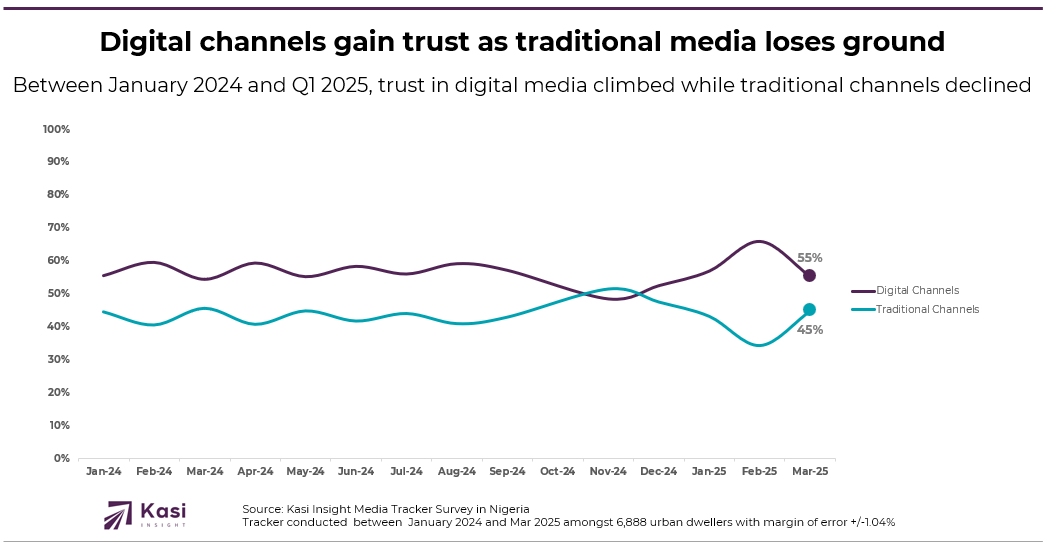
While digital trust briefly dropped to 49% in November 2024, this was the only month it fell below the halfway mark, and it quickly recovered. Traditional media recorded a brief rebound in November 2024 at 52% and December at 48%, but this momentum was not maintained. On average, digital media attracted 56% of consumer trust compared to 44% for traditional channels, indicating a structural shift in how Nigerians engage with and evaluate media content.
As of the close of Q1 2025, TV and online sources were the top two channels used by Nigerian consumers to discover new products and brands, each cited by 52% of respondents. TV retained broad appeal, especially among male audiences at 54% and low-income households at 77%, reinforcing its status as a trusted and familiar medium. Online platforms also held strong influence, particularly among Gen Z at 62% and middle-income earners at 55%, signaling a high level of digital engagement among younger and urban populations.
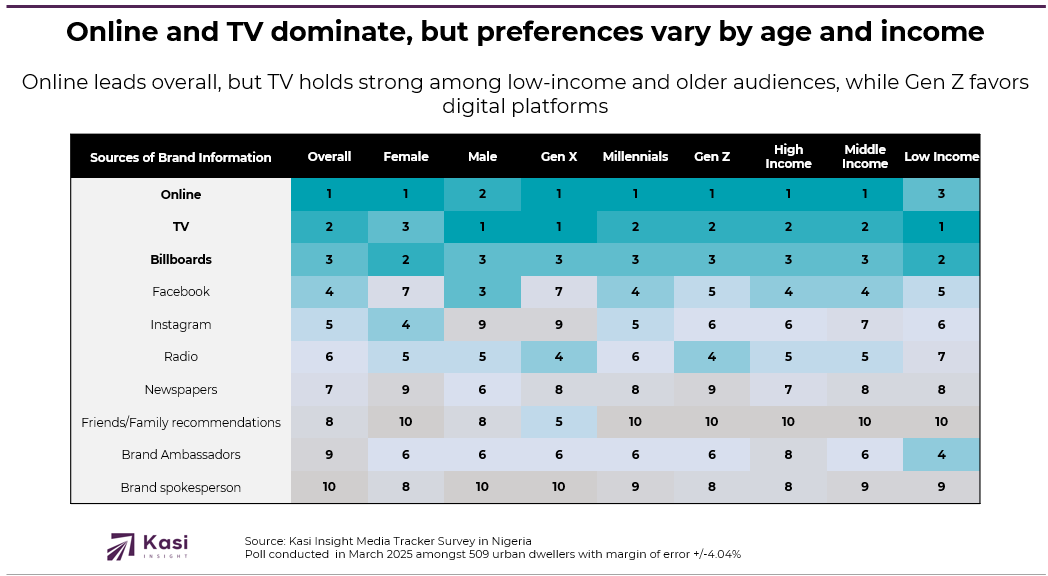
Billboards followed at 42%, performing well among Gen Z and female respondents, both at 51%. Facebook was cited by 36% of consumers overall and was especially popular among Millennials at 39% and low-income groups at 43%. These numbers highlight Facebook’s continued relevance as a cost-effective and widely accessible channel. Meanwhile, newspapers and radio maintained modest but stable engagement, while Instagram at 34% and TikTok at 23% drew attention primarily from younger and lower-income audiences. This reveals a layered media ecosystem in Nigeria, where both traditional and digital formats play meaningful roles in shaping consumer awareness.
Nigeria’s media landscape is becoming more segmented, with generational and income-based preferences shaping how people consume information. To stay relevant and competitive, brands must move beyond uniform campaigns and adopt tailored media strategies grounded in audience-specific behaviors and trust patterns. Gen Z and Millennials prefer digital-first channels such as Instagram, TikTok, YouTube, and online news platforms. These consumers value interactivity, personalization, and on-demand access. In contrast, Gen X and low-income consumers continue to rely on traditional media such as TV, radio, and billboards, which they perceive as credible and accessible.
Digital platforms provide brands with powerful targeting capabilities and real-time performance tracking, making them ideal for engaging younger and tech-savvy audiences. Traditional media remains effective for large-scale awareness, emotional storytelling, and campaigns requiring broad reach across regions and age groups. A hybrid approach that combines the precision of digital media with the reach and familiarity of traditional formats will be essential. Brands that map media preferences to demographic profiles such as age, gender, and income will be better positioned to deliver relevant messages, strengthen consumer trust, and drive higher engagement. In an increasingly competitive environment, sustained brand growth will depend on relevance, reach, and resonance.
Share on socials using this caption: 📊 Nigeria's media habits are shifting fast—digital trust now leads at 56% while TV and billboards still hold power across key segments. Smart brands are blending reach with relevance to stay ahead 🚀 #NigeriaMediaTrends #DigitalShift #KasiInsight #ConsumerIntelligence
1130 views
Share article
Ivorians blend digital and traditional media for accurate, trusted information
Kenyans blend traditional and digital media for holiday purchase decisions
South Africans turn to social media and authentic reviews for holiday shopping decisions