Sandra Beldine Otieno
April 18, 2024
Share article



In March, consumer confidence saw a further boost, climbing by five points and continuing the growth from the previous month. This rise, the highest level the index has achieved since its inception in 2016, was driven by a six-point increase in the index of current conditions and a four-point improvement in the index of future expectations, reflecting a more optimistic outlook among households.
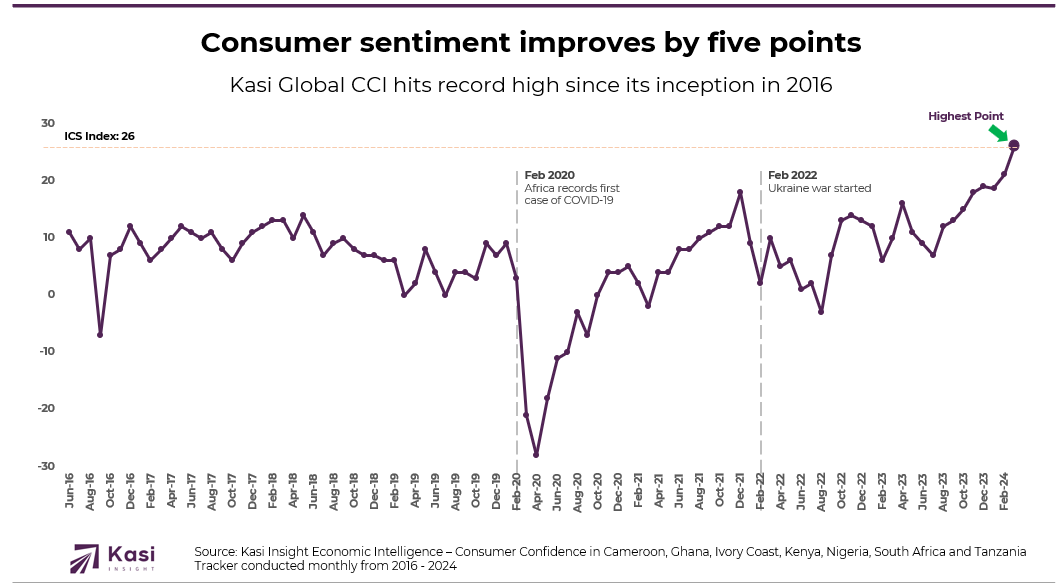
In March, Africa saw a significant positive shift in consumer sentiment, with all household indices showing improvements for the first time, suggesting a robust rebound in the face of persistent economic challenges. This broad enhancement across various financial indicators marks a pivotal change, indicating a gradual alleviation of pressures on household budgets, which had been intensified by economic fluctuations.
The personal finance index surged by 8 points, signaling a substantial improvement in consumers' financial health. This notable rise suggests that despite ongoing economic pressures, individuals are finding their financial footing, reflecting increased stability. Meanwhile, the household spending index, which tracks consumer expenditure, recorded a modest increase of 1 point. Although slight, this change indicates a careful but positive shift in spending behaviors.
Furthermore, the household income index rose by 5 points, illustrating an encouraging upturn in earnings among households. This uplift supports the increase in consumer spending and contributes to broader economic stability. Discretionary spending also saw a significant boost, with an 11-point jump. This dramatic rise highlights a renewed willingness among consumers to spend on non-essential items, suggesting greater financial freedom and optimism. The job prospects index increased by 2 points, providing a positive outlook on employment opportunities, and reflecting an improving labor market. Additionally, both the general country and city economic conditions indices improved, by 4 and 3 points respectively, indicating growing optimism about the overall economic situation.
In Ivory Coast, consumer confidence surged impressively, marked by an eight-point increase in overall sentiment, reflecting a robust enhancement in the economic outlook among Ivorians. This surge was significantly supported by a dramatic rise in the personal finance index, which soared by 26 points, and the country economic conditions index, which increased by 22 points. The primary catalyst for this uplift was an improvement in the country's credit rating by Moody’s Investors Service, which upgraded Ivory Coast to Ba2. This upgrade recognizes the economy's resilience, growing private sector investments, and diversification, alongside robust growth prospects and enhanced competitiveness. Moody’s also lauded the government's fiscal consolidation efforts and effective debt management, supported by its current program with the International Monetary Fund. These factors, combined with the successful issuance of its first dollar bond in nearly seven years, have significantly bolstered financial optimism and contributed to the remarkable rise in consumer confidence.
In contrast, Kenya witnessed a modest 2-point decline in consumer confidence, signaling a deterioration in economic sentiment. This decline was highlighted by a 7-point reduction in both the city economic conditions and household income indices, along with a 6-point drop in general country conditions, illustrating widespread economic difficulties. According to the Kenya National Bureau of Statistics, this downturn was largely driven by a significant inflation increase, which reached 5.7% year-on-year. The inflation spike primarily stemmed from sharp price hikes in critical sectors: Transport surged by 9.7%, Housing, Water, Electricity, Gas, and other fuels by 8.0%, and Food and Non-Alcoholic Beverages by 5.8%. These sectors, which account for over 57% of the weights across 13 broad categories, significantly escalated the overall cost of living, thereby undermining consumer confidence.
The recent rise in consumer sentiment across Africa, reaching a record high, presents a significant opportunity for brands operating within the region. As consumer confidence climbs to its highest level since 2016, there is a clear window for brands to capitalize on this growing optimism. By introducing new products or services, expanding distribution, and crafting targeted marketing campaigns, brands can attract an increasingly confident consumer base.
The considerable increase in discretionary spending indicates that consumers are now more willing to invest in non-essential and premium items, suggesting that brands could benefit from diversifying their product lines to include luxury or higher-end options. However, given the mixed performance in consumer sentiment across different countries brands need to customize their strategies to suit regional nuances. This might involve adapting marketing messages to resonate with local economic sentiments and consumer expectations. Furthermore, enhancing the consumer experience is essential. This could mean investing in customer service training, improving after-sales support, or leveraging technology to offer more personalized shopping experiences. As the economic outlook brightens and consumer spending power increases, there is also a pressing need for brands to bolster their online presence and e-commerce capabilities to tap into the expanding digital marketplace.
Share on socials using this caption: 📈 Breaking New Ground! In March, Africa's consumer confidence soared to its highest level since 2016, showcasing a powerful rebound across all financial indicators. Optimism is blooming continent-wide! 🌍💪 #ConsumerConfidence #EconomicGrowth #AfricaRising
2210 views
Share article
Trust Is Becoming Economic Infrastructure
Consumer confidence loses momentum in October
Confidence plateaus in September as caution defines household behavior