Sandra Beldine Otieno, MSc
December 20, 2024
Share article



Kenya’s formal workforce has long been the backbone of the country’s tax system, consistently contributing more than their share to government revenues. Despite making up just 15% of the national labor force, these workers shoulder an outsized share of taxes, particularly through Pay As You Earn (PAYE). Recent discussions of possible PAYE rate reductions have sparked cautious optimism, but they also raise deeper questions about fairness and sustainability in Kenya’s tax policies.
The 2023/2024 fiscal year demonstrated just how heavily Kenya’s salaried employees are taxed. Of the KSh 2.407 trillion collected by the Kenya Revenue Authority (KRA), PAYE alone accounted for KSh 543.186 billion, representing 22.56 percent of total revenue. The system relies heavily on formal employees, leaving other segments of the economy relatively untouched. For many workers, the introduction of statutory deductions like the Housing Levy (1.5 percent) and the Social Health Insurance Fund (2.75 percent) has only added to this financial strain.
While the government recently announced exemptions on certain statutory deductions from PAYE calculations, such as pension contributions and mortgage interest, the relief may not be enough to offset the cumulative financial pressures facing workers. For employees earning higher salaries, these benefits may barely register, further reinforcing perceptions of inequity in the tax system.
Compounding this issue is the fact that formal employees often face indirect taxes such as VAT and excise duty, which disproportionately affect those who cannot claim credits or deductions. Meanwhile, the informal sector and corporate tax loopholes remain less scrutinized, leaving the tax burden heavily skewed toward salaried workers.
Kasi Insight’s Index of Consumer Sentiment highlights the growing discontent among both salaried and non-salaried workers, providing a nuanced picture of Kenya’s economic challenges. Over the past two years, consumer sentiment among these groups has fluctuated in response to key policy changes, reflecting the real impact of government actions on everyday financial well-being.
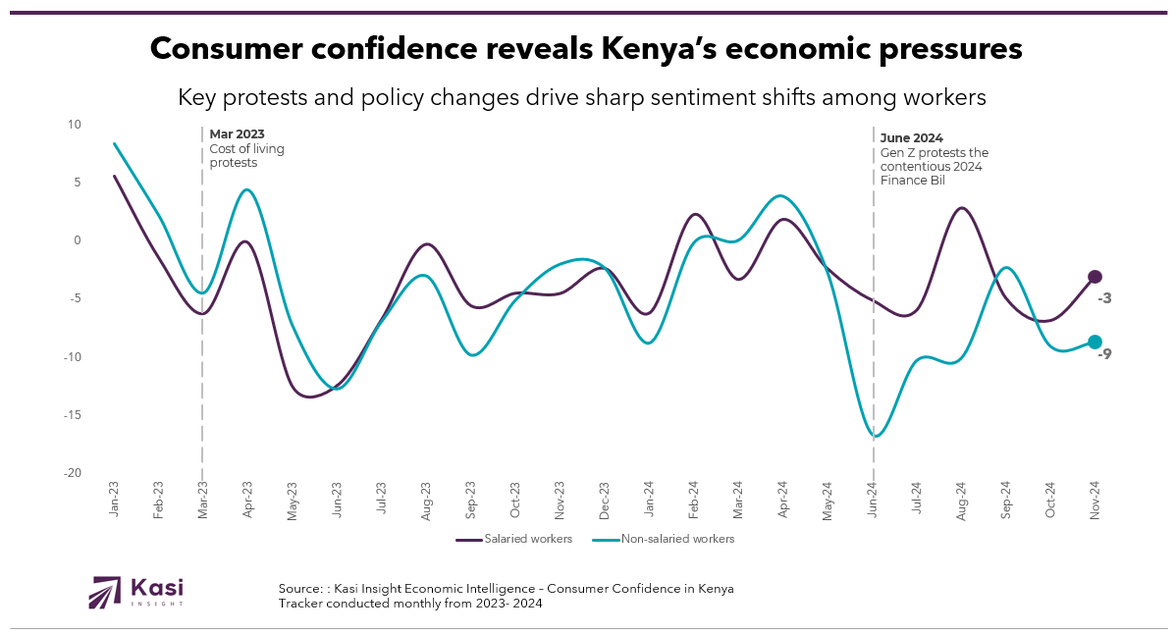
For salaried workers, the index has repeatedly shown negative scores, particularly in periods when new tax policies took effect. The sharpest declines in sentiment were recorded in May and June 2023, when statutory deductions such as the Housing Levy were introduced, dropping the index to -12 for salaried employees. Even when sentiment improved slightly in February 2024, it remained fragile and failed to sustain positive momentum.
Non-salaried workers, while less directly affected by statutory deductions, have also struggled under the weight of broader economic slowdowns. The index revealed a sharp dip to -17 in June 2024, a reflection of dwindling informal sector earnings as domestic VAT collections and trade activity fell. Unlike salaried workers, whose frustrations stem from over-taxation, non-salaried workers face uncertainty due to declining opportunities and unstable incomes.
Despite these differences, the data underscores a shared sense of economic distress. Both groups reported temporary improvements in sentiment—such as in early 2024—but these recoveries were short-lived, suggesting deeper systemic challenges that remain unresolved.
The government’s tax strategy, including the Tax Laws (Amendment) Bill 2024, has sparked debate over its long-term implications for Kenya’s economy. By targeting an additional KSh 174.6 billion through measures like VAT rationalization, the government hopes to address revenue shortfalls. However, critics argue that these policies could stifle economic activity rather than stimulate growth.
The heavy reliance on salaried workers is indicative of a tax system that prioritizes convenience over equity. Expanding the tax base to include under-taxed sectors, such as the informal economy and certain corporate activities, is a necessary step toward relieving the pressure on formal employees. Moreover, improving tax efficiency and addressing loopholes would help ensure that all segments of the economy contribute fairly.
Kenya must also address inefficiencies in public service delivery. For many taxpayers, dissatisfaction stems from the perception that their contributions do not translate into tangible benefits. Better healthcare, infrastructure, and education systems could help rebuild trust and support a more cooperative approach to taxation.
Kasi Insight’s data paints a vivid picture of the struggles faced by both salaried and non-salaried workers, offering valuable insights for policymakers. The persistent negativity in consumer sentiment underscores the urgent need for meaningful reforms that prioritize fairness and sustainability.
For salaried employees, the focus should be on reducing their tax burden while ensuring that statutory contributions fund impactful programs. For non-salaried workers, economic policies should aim to stabilize incomes and foster opportunities in the informal sector. Across both groups, restoring confidence will require a combination of structural reforms and visible improvements in government accountability.
Kenya’s tax system must evolve to reflect the realities of its diverse economy. Overburdening formal workers is neither sustainable nor equitable, and neglecting the informal sector undermines the country’s economic potential. By addressing these imbalances, the government can foster a more inclusive and resilient economic environment, restoring faith in the nation’s fiscal policies.
Share on socials using this caption: 💼 Kenya’s salaried workers are carrying the weight! 💰📊 Despite being just 15% of the workforce, they contribute a massive 22.56% of tax revenue through PAYE. 💔 With rising taxes and shrinking incomes, discontent is growing.📢 What’s your take on this? #KenyaTaxBurden #SalariedStruggles #PAYEPressure #KenyaEconomy #TaxTalk #ConsumerVoices #EconomicRealities
1964 views
Share article
Kenya fuel prices surge by 13%, triggering a predicted period of subdued consumer sentiment.
Uganda Banking Sector 2025: Growth with Discipline, What Marketing Signals Reveal About Balance Sheets
Kenya Banking Sector 2025: Reading the Balance Sheet Through Marketing Signals