Maps & Infographics
July 18, 2025
Share


Tariffs are a tax on imports, designed to raise the cost of foreign goods, protect domestic industries, and shift trade flows. For example, if Libya exports $1,000 worth of goods to the U.S. at a 30% tariff, the U.S. importer pays an extra $300 in duties. This cost often kills the deal or pushes buyers toward local suppliers.
On April 2, 2025, the Trump administration announced a universal 10% tariff on all imports, effective April 5. Crucially, this was not bound by World Trade Organization (WTO) rules and superseded all existing trade agreements or unilateral preferences, including the African Growth and Opportunity Act (AGOA) and the Caribbean Basin Initiative. AGOA, which had granted 31 African countries duty-free access to the U.S. market, remains legally in place until September 2025, but under the new rules, its benefits are functionally void.
Following sharp global backlash, the tariffs were paused for 90 days. On July 31, 2025, President Trump signed a revised order that entrenched the new regime:
This is more than a rate hike; it is a reset. By explicitly overriding agreements like AGOA, the new tariffs strip away decades of negotiated market access. This move pushed the average U.S. tariff from 2.5% in 2024 to an estimated 22% in 2025 - the steepest level in over a century, recalling the Smoot–Hawley Tariff Act of 1930.
The African countries most affected include:
Washington frames the tariffs as “levelling the playing field,” pointing to the fact that over 150 countries were charging higher tariffs on American goods than the U.S. was on theirs. The U.S. average tariff was just 1.5%, which was notably lower than the global median of 2.6%, which is 73% higher. This imbalance was seen as putting U.S. exporters at a significant disadvantage.
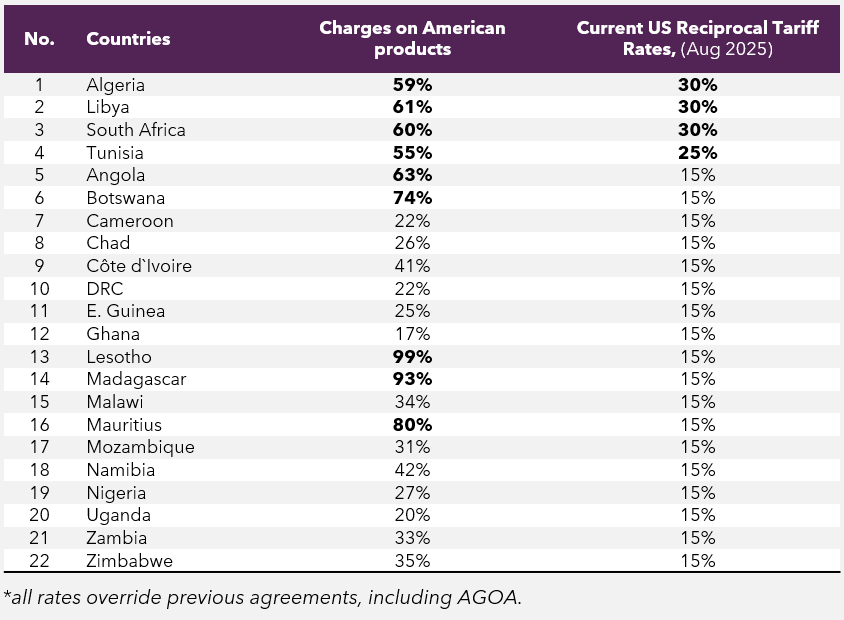
To illustrate this point with a concrete example, U.S. goods faced an average tariff of 60% when entering South Africa, while South African exports to the U.S. had previously faced a tariff of only about 2.5% in 2024. Under the new order, that tariff has increased to 30%.
The Trump administration claims other nations, including African partners, have consistently rejected reciprocal zero-tariff offers, thus entrenching a one-sided trade relationship that the U.S. is now taking unilateral action to correct.
Short-term disruption | African exporters to the U.S. will see profit margins squeezed. Apparel from Lesotho and Madagascar, cocoa products from Ghana, and auto components from South Africa will all become less competitive overnight.
Forced diversification | With U.S. market access effectively downgraded, African economies will need to accelerate trade within Africa under the African Continental Free Trade Area (AfCFTA). Diversification into Asian, Middle Eastern, and European markets could also help reduce U.S. dependency. For instance:
Strategic opportunities and risks | African nations could leverage this disruption to renegotiate terms with both the U.S. and other major economies. However, smaller economies heavily dependent on the U.S. market face heightened vulnerability, risking revenue loss, job cuts, and slower growth in export-oriented industries.
The Bigger Picture | These tariffs represent not just a trade dispute but a reconfiguration of global supply chains. For Africa, the choice is between passively absorbing the shock or actively using it as a pivot point to deepen regional integration, build industrial capacity, and engage in more balanced trade negotiations.