Maps & Infographics
March 5, 2026
Share


The story of Africa’s sovereign credit landscape in 2026 is defined by a sharp divide between a few "investment-grade" successes and a vast majority of nations struggling under the weight of external risk perceptions. Despite the continent's immense potential, its financial health is still primarily judged by international agencies (S&P, Moody’s, and Fitch) who often view African stability through a lens of high risk. This "outsider" perspective creates a significant barrier to entry for many nations; currently, only 32 of Africa’s 54 countries hold a formal credit rating from these major global players, leaving approximately 41% of the continent unrated and largely invisible to traditional global capital markets.
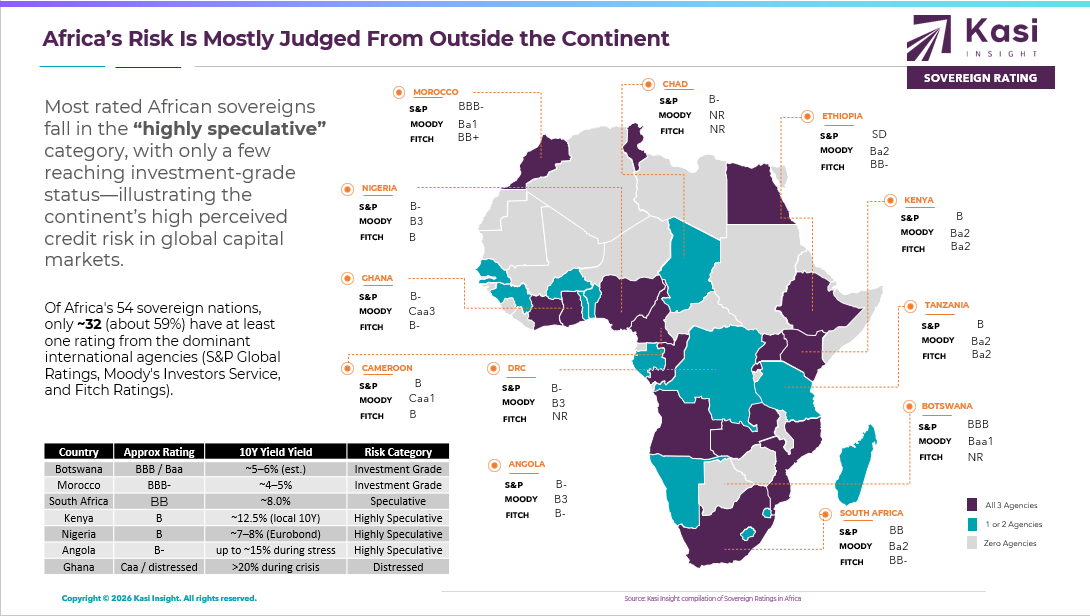
For the nations that are rated, the economic reality is a tale of two extremes. At the top of the pyramid, countries like Botswana and Morocco have successfully attained investment-grade status, with ratings in the BBB to Baa range. This allows them to borrow at relatively low yields of 4% to 6%, acting as safe harbors for global capital. In contrast, economic heavyweights like South Africa have slipped into the "speculative" category with a BB rating, seeing their borrowing costs rise toward 8.0% as they navigate shifting economic headwinds.
Moving further down the rating scale, the financial burden becomes increasingly heavy for nations categorized as "highly speculative". In Kenya and Nigeria, the cost of debt is a major hurdle, with yields ranging from 7% to over 12.5%. This disparity means that for every dollar borrowed to fund essential development, these nations pay significantly more in interest than their investment-grade peers. The most extreme cases, such as Angola and Ghana, illustrate the "distressed" phase of this cycle; in these instances, yields can spike above 20% during times of crisis, effectively locking these countries out of sustainable global markets.
Ultimately, the data suggests that Africa’s path to prosperity is hindered by a credit gap that punishes nations for their "speculative" labels. As long as the continent’s risk is judged predominantly from the outside, the majority of African sovereigns will continue to face a steep uphill battle in securing fair and affordable financing for their long-term development.