Sandra Beldine Otieno, MSc
July 21, 2025
Share article



In June, consumer confidence in Africa rose by 5 points, continuing the upward trend observed over the past two months. The gain reflected stronger household conditions, led by sharp increases in discretionary spending and perceptions of current economic realities. Despite a slight decline in job optimism and weaker national outlooks, the trend points to improved resilience and growing short-term confidence across most markets.
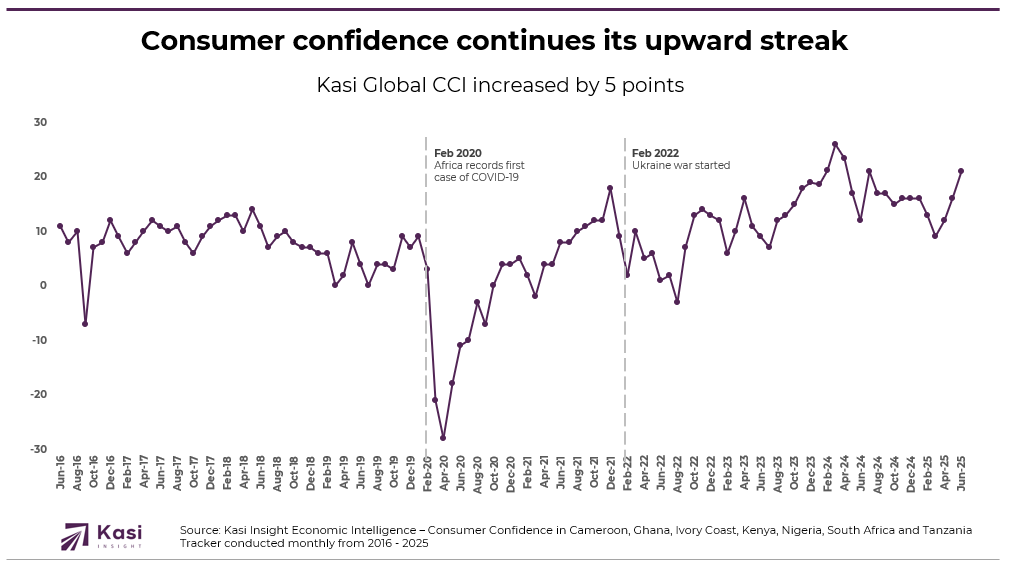
Household indicators reflected a deeper and more confident rebound in consumer sentiment, continuing the positive momentum seen in the previous two months. The household income index rose by 5 points, pointing to further improvements in earnings and income reliability. While the personal finance index remained steady at 40 points, this stability suggests households are sustaining their financial footing after recent gains. Together, these results signal a strengthening sense of financial control at the household level.
This growing confidence translated into more assertive spending behavior. The discretionary spending index surged by 15 points, its strongest gain this year, highlighting increased comfort with non-essential purchases. The household spending index also rose by 8 points, suggesting a broader recovery in day-to-day consumption. These gains indicate that many consumers are moving beyond caution and re-engaging with the economy more actively.
Labor market sentiment was more subdued. The job prospects index declined by 2 points, suggesting lingering concerns about employment opportunities. Broader economic perceptions remained mixed. The general city economic conditions index increased by 5 points, indicating continued optimism at the local level. In contrast, the general country economic conditions index fell by 3 points, reflecting persistent uncertainty around the national outlook. This split reinforces the idea that while urban households are regaining momentum, national sentiment remains tempered by structural and political concerns.
In June, consumer confidence in Africa continued to rise, supported by stronger household conditions and a clearer sense of financial control. The household income index rose by 5 points, and discretionary spending saw its largest gain this year with a 15-point increase. Even though the personal finance index remained steady at 40 points, this stability reflects sustained improvements in how households manage their budgets. Household spending also rose by 8 points, showing renewed engagement in everyday consumption. Together, these gains point to growing resilience in the short term.
This renewed confidence is beginning to shift consumer behavior, but it remains grounded. While households are more willing to spend, they are still highly intentional. Needs continue to take priority over wants, and value is being defined not only by price, but also by relevance, reliability, and accessibility. Job sentiment declined slightly, with a 2-point drop in the job prospects index, and broader economic perceptions remain mixed. Urban optimism is improving, as seen in the 5-point rise in city-level sentiment, but uncertainty at the national level persists, with the country-level index falling by 3 points.
For brands, the signal is clear. Consumers are gradually recovering, but they are not taking risks. This is a time to reinforce core value and show up with practical solutions. Products that offer flexible pack sizes, simple pricing, and everyday utility will resonate most. Messaging should be honest and grounded in the real decisions consumers face each day. A disconnected or aspirational tone risks missing the moment.
Market variation also matters more than ever. Sentiment improved in Cameroon, Ghana, Ivory Coast, Nigeria, South Africa, and Tanzania, giving brands room to cautiously reintroduce innovation and experience-led engagement. Kenya was the only country where confidence declined, highlighting the need for consistency, trust, and value reassurance in more vulnerable markets. Success now depends on listening closely, adapting by market, and aligning brand behavior with the shifting expectations of the African consumer.
Share on socials using this caption: 📈💡 In June, consumer confidence in Africa rose by 5 points, marking a third straight month of growth. Income and spending surged, but job concerns and national outlooks remind brands that value still matters most. #AfricaInsights #ConsumerConfidence #SmartMarketing #ValueLedBrands
1463 views
Share article
Trust Is Becoming Economic Infrastructure
Consumer confidence loses momentum in October
Confidence plateaus in September as caution defines household behavior