Claudine Linda Wa Nciko
February 24, 2025
Share article


Inflation is pushing South Africans to rethink their spending habits, but the impact is uneven across demographics. Kasi Insight’s Cost of Living Tracker, conducted quarterly across 20 African markets, shows that while many consumers are adjusting, younger generations and middle-income earners are feeling the financial strain more acutely, while high-income earners are making strategic shifts despite having more financial flexibility.
Financial stress is becoming more evident, with 18% of South Africans reporting that inflation has made their days “quite stressful,” while the majority—80%—describe themselves as neutral, meaning they are neither highly stressed nor unaffected. Gen Z is feeling the most pressure, with 26% experiencing financial stress, followed by Gen X at 14%.
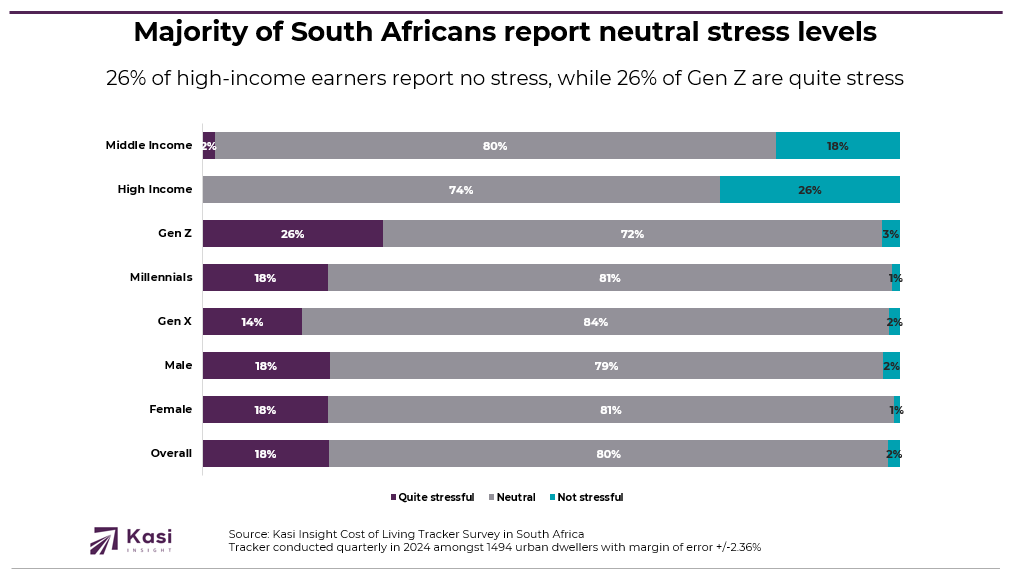
High-income earners, however, appear more insulated, with 18% saying they feel no stress at all—a stark contrast to middle-income groups, which are experiencing more financial strain. This suggest that while inflation is affecting spending behaviors across the board, its emotional and financial toll is greatest on younger and middle-income consumers.
With inflation straining household budgets, South Africans are prioritizing essentials and reducing spending on non-essentials. The biggest cutback is in beauty and personal care, with 50% of consumers spending less on beauty products and procedures. Food choices are also shifting—35% are opting for cheaper local organic foods, while 28% have abandoned specialized diets such as Keto, Vegan, or Gluten-Free.
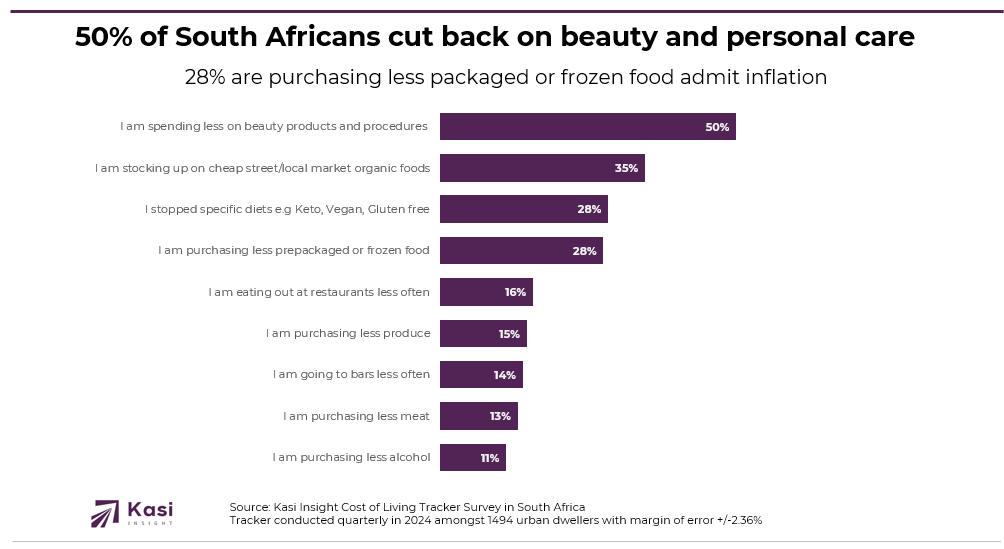
Inflation is also reshaping grocery and dining habits. 28% of consumers are purchasing less packaged or frozen food, while 16% are eating out at restaurants less often. Fresh produce consumption is also declining, with 15% purchasing less produce and 13% buying less meat. Additionally, nightlife and alcohol consumption are taking a hit—14% of consumers are visiting bars less frequently, and 11% are purchasing less alcohol. These behaviors highlight a clear shift toward practical, cost-effective choices, as consumers prioritize affordability while cutting back on discretionary spending in response to rising cost.
As consumers rethink their spending, brands must adapt to these changing behaviors by offering cost-effective yet high-quality solutions. With inflation influencing spending across sectors, companies in beauty, food, and hospitality need to adjust their strategies. Beauty brands can introduce long-lasting, multi-use products that provide greater value, while food retailers should focus on bulk discounts, affordable organic options, and versatile meal solutions. Hospitality and entertainment brands may need to explore budget-friendly experiences and promotions to maintain customer engagement despite reduced discretionary spending.
By emphasizing affordability without sacrificing quality, brands can build stronger relationships with consumers navigating inflationary pressures. Empathy-driven messaging that acknowledges financial constraints while providing practical solutions will be crucial in maintaining trust and consumer loyalty during these uncertain economic times. As South Africans continue adjusting their financial habits in 2024, businesses that align with these shifts will be better positioned to thrive in an evolving economic landscape.
Share on socials using this caption:💸 Inflation is reshaping spending in South Africa! 🇿🇦 Consumers are cutting back on beauty, dining, and entertainment while prioritizing affordability. How can brands stay relevant? ✅ Adapt, offer value, and build trust! 🛍️ #CostOfLiving #SmartSpending #ConsumerTrends #SouthAfrica
2088 views
Share article
Trust Is Becoming Economic Infrastructure
Consumer confidence loses momentum in October
Confidence plateaus in September as caution defines household behavior