Joy Muindi
March 25, 2025
Share article



Kasi Insight’s Cost of Living Tracker reveals that inflation continues to weigh heavily on consumers in Ivory Coast. With prices rising across key categories such as food, education, and transport, more consumers are feeling financially stretched, and stress levels are climbing across income groups and age segments.
By December, 77% of consumers reported that food prices had increased, up from 60% in March. This makes food the most significant contributor to inflation-related stress. Education costs also remain high, with 55% of consumers still reporting price increases at the end of the year. Transport has seen only minor improvement, with 56% of consumers citing price increases in December compared to 61% in March. These three essentials: food, education, and transport continue to strain household budgets the most.
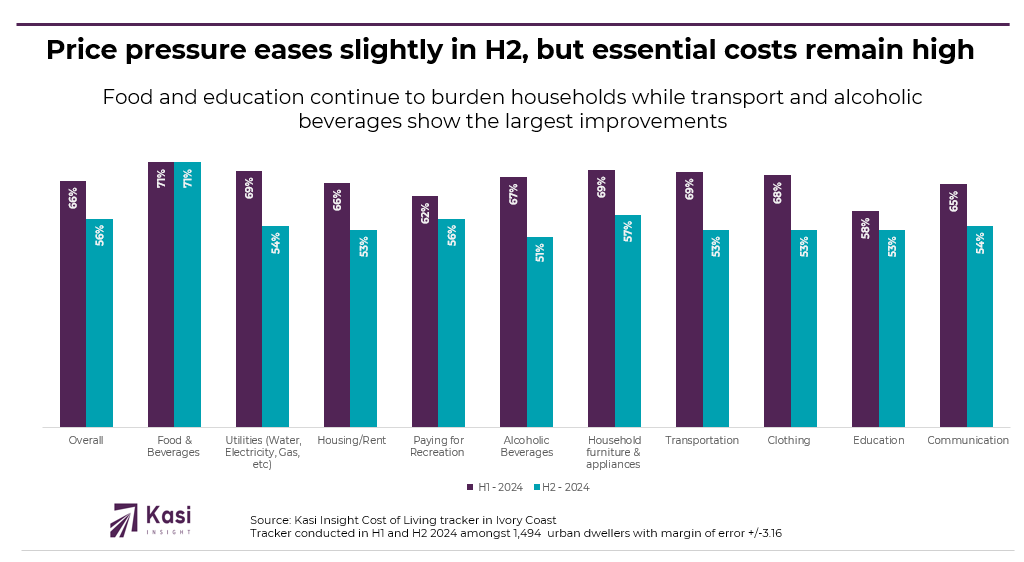
Other categories have started to stabilize. Reports of utility price increases dropped from 63% to 54%, and 20% of consumers noticed a price decline, compared to just 9% in March. Communication followed a similar trend, with the share of consumers reporting price increases falling from 62% to 52%. Alcohol, clothing, and household goods also saw a slight easing of pressure, though concerns around affordability persist. Consumers are feeling the pressure most in areas they cannot avoid. Even where prices are stabilizing, cautious spending behavior continues.
Overall, 40% of consumers in Ivory Coast describe most of their recent days as quite stressful due to rising prices and financial issues. High-income earners are the most affected, with 52% reporting high stress and only 19% saying their days are not stressful.
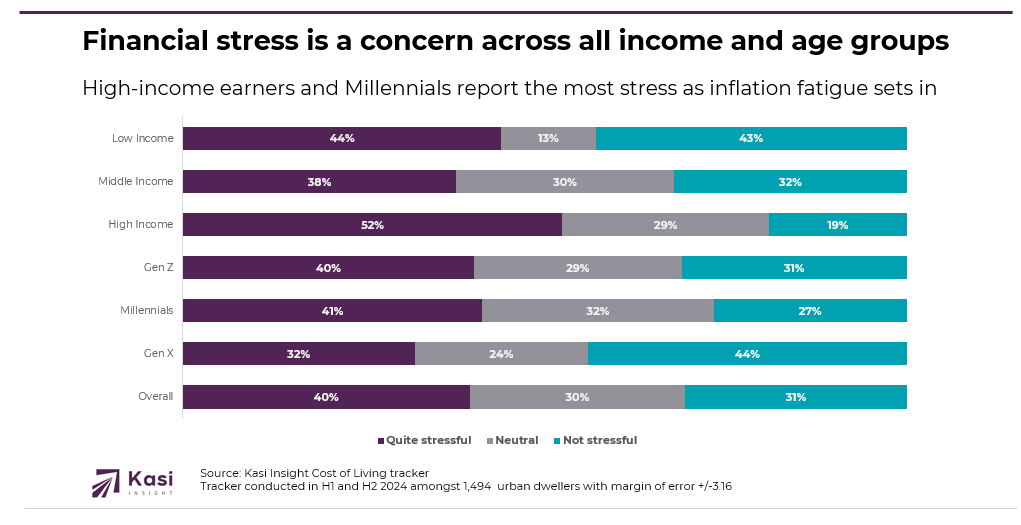
Among age groups, 41% of Millennials say their lives feel quite stressful, followed by 40% of Gen Z. Gen X appears to be coping better, with 44% saying they are not stressed and only 32% reporting high stress.
Low-income earners show a split pattern. While 44% say they are quite stressed, 43% also report not being stressed at all. Only 13% describe their situation as neutral, indicating a polarizing experience where people are either managing or feeling overwhelmed. This shows that financial stress is not limited to any one demographic. Even groups traditionally seen as more financially secure are now experiencing strain.
With financial stress spreading across income brackets and generations, brands must adopt a customer-first mindset. In high-pressure categories like food, education, and transport, affordability must be central, via price adjustments, installment plans, or value bundles.
In improving sectors such as utilities, communication, and clothing, there’s room to rebuild engagement through loyalty programs, flexible payment options, and promotional campaigns. As some price sensitivity eases, the opportunity lies in communicating savings clearly and offering consumers a sense of regained control.
Empathetic, transparent, and practical messaging will resonate most. From Gen Z to high-income earners, consumers are not just looking for products, they’re looking for brands that understand their realities.
Share on socials using this caption: 📈 Prices for essentials like food, education, and transport remain high in Ivory Coast, leaving 40% of consumers feeling quite stressed. 😓 Millennials (41%) and high-income earners (52%) are the most affected. 📉 While some relief is seen in utilities and communication, brands must respond with empathy 💬, flexible pricing 💸, and clear value ✅. #CostOfLiving #ConsumerStress
1896 views
Share article
Uganda’s retail sector shows early 2025 fatigue as consumers cut back on essentials but remain engaged in wellness and lifestyle choices
Kenyan consumers are shifting from survival to intentional living reshaping value wellness and brand responsibility
Cameroonians appetite for staples and fresh produce grows while demand for proteins dips