Mercy Cyrus
May 7, 2025
Share article


Kasi Insight’s Sustainability Tracker examines the shifting landscape of environmental awareness across Africa, focusing on how climate change is experienced and how it shapes everyday decisions and public engagement. In Tanzania, the data highlights a clear gender distinction in how men and women take personal responsibility for climate action.
Women are more likely to adopt lifestyle-based responses. The findings show that 45% of women have reduced their meat consumption, compared to 38% of men. Similarly, 30% of women choose sustainable products, while only 20% of men report doing the same. Women also show greater involvement in climate-related activism, with 42% participating in relevant activities compared to 39% of men.
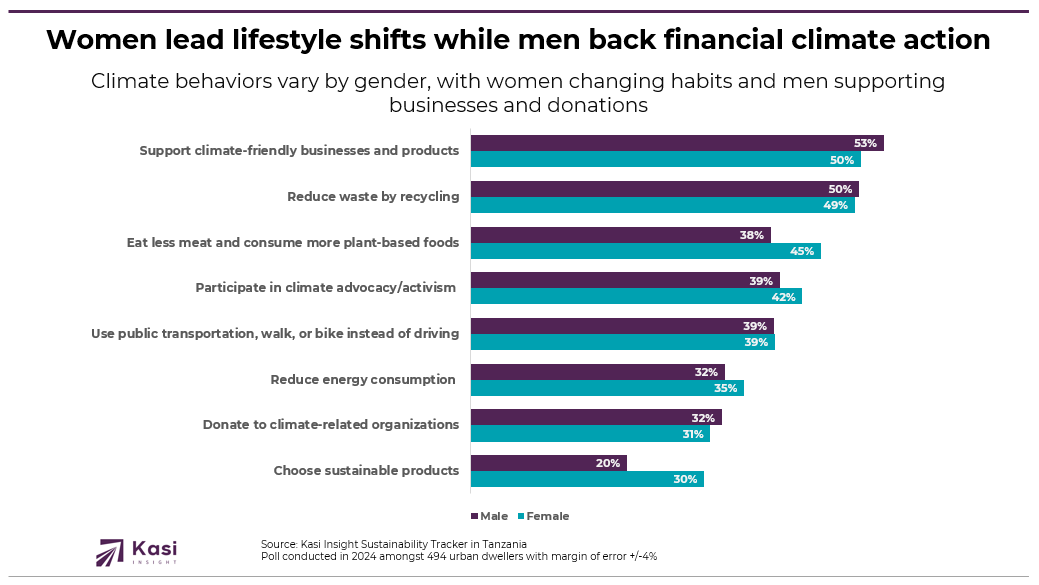
Men, meanwhile, show stronger alignment with market-based approaches. About 53% support environmentally responsible businesses, slightly more than the 50% of women who do so. Additionally, 32% of men report donating to environmental organizations, compared to 31% of women. These trends suggest that while women focus more on daily behavioral changes, men tend to engage through financial and institutional channels.
Support for government-led climate action is widespread in Tanzania, with both men and women calling for stronger public engagement and supportive policies. Overall, 58% of respondents want the government to prioritize climate education, while 57% support financial incentives that encourage sustainable practices. Women show a stronger preference for practical, community-focused solutions. Specifically, 60% of women back financial incentives compared to 54% of men, and 45% favor increased investment in renewable energy, compared to just 37% of men. These preferences suggest that women are more aligned with initiatives that directly affect households and local environments.
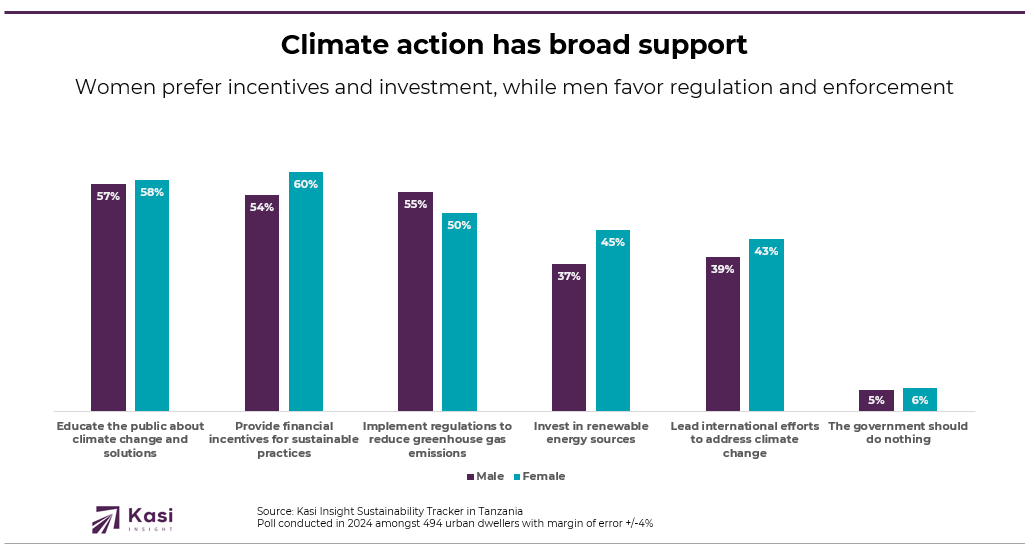
Men, in contrast, are more likely to support regulatory and globally focused interventions. About 55% of men endorse stricter emissions rules, and 39% support a stronger role for Tanzania in international climate leadership. These views are slightly more prominent than among women and point to a broader, more policy-driven approach to climate action. While the gap is not dramatic, it reflects different perspectives shaped by roles, experiences, and perceived influence. Women tend to favor immediate, actionable solutions that improve everyday life, whereas men place greater emphasis on structural change and global engagement.
Gender influences both how citizens act on climate change and what they expect from their government. Women are more likely to engage in everyday sustainable behaviors—like consuming more plant-based foods and choosing sustainable products and show greater support for incentive-based solutions like financial support and investment in renewable energy. Men, by contrast, lean slightly more toward structural and policy-driven responses, such as enforcing regulations and leading global climate initiatives. This divide signals that men and women are not just different in practice, but also in their vision of how climate challenges should be addressed.
For policymakers, this underscores the value of gender-responsive climate strategies. Community programs that tap into women’s strengths such as running household-focused sustainability initiatives or promoting local green entrepreneurship can yield quick, scalable grassroots results. Meanwhile, efforts to build male engagement through policy dialogues, regulatory reforms, and visible leadership roles in climate efforts can deepen systemic buy-in. By aligning strategies with gender-specific behaviors and expectations, the government can turn public concern into real, measurable impact empowering citizens not just as beneficiaries, but as key drivers of climate resilience.
Share on socials using this caption: Gender shapes how 🇹🇿 Tanzanians experience 🌡️ climate change and what they expect from solutions. Women are embracing 🌱 lifestyle shifts while men focus on 🏛️ policy and global leadership. Real impact starts with gender-responsive strategies. #ClimateAction #Tanzania #GenderAndClimate #Sustainability #GreenAfrica #ClimateSolutions
1503 views
Share article
The Future of AI in Africa Lies in Smarter Decisions, Not Just Smarter Models
Africa’s Critical Minerals: From Hidden Resource to Economic Catalyst
Perceptions of climate inaction persist among Ghanaian consumers, driven by income disparities