Segun Sunmonu
March 24, 2025
Share article


The rising cost of living has become a defining issue for Ghanaians, influencing financial behavior and altering daily decisions. According to Kasi Insight’s 2024 Cost of Living Tracker, consumers are taking bold steps to adapt. Many are cutting back on discretionary spending, leaning on personal savings, and seeking out community support as inflation continues to bite. Financial resilience is now a central theme across households.
In 2024, concern over the rising cost of living increased from 44% in March to 51% in December. Gen Z (67%) and Gen X (62%) are the most affected, underscoring a generational urgency for affordable solutions. At the same time, concern about government corruption jumped from 37% to 48%, with Gen X (69%) and Gen Z (60%) pushing for more transparency and accountability from both public institutions and brands.
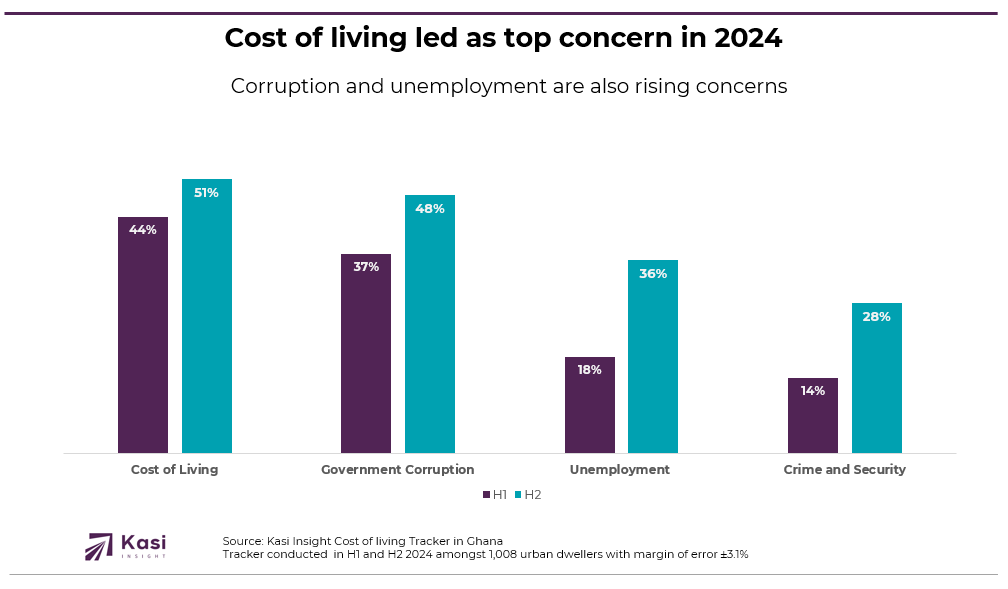
Unemployment also surged as a key worry, rising from 18% in March to 36% in December. Gen Z again felt the impact most sharply, with 52% citing joblessness as a top concern. This signals opportunities for brands to introduce value-driven products, income-support programs, or skills development initiatives. Meanwhile, crime and security fears grew among Gen Z (35%) and Gen X (32%), while Millennials (24%) were the most vocal about ongoing supply chain issues.
As costs continue to rise, consumers are becoming more strategic with their finances. By December, 72% had cut back on discretionary spending, up from 62% in March. More Ghanaians also turned to personal savings, with 50% relying on this by December, compared to 36% earlier in the year. Community support is becoming more critical as well, with usage of community services rising from 36% in March to 51% in December. These behaviors are especially common among lower-income households.
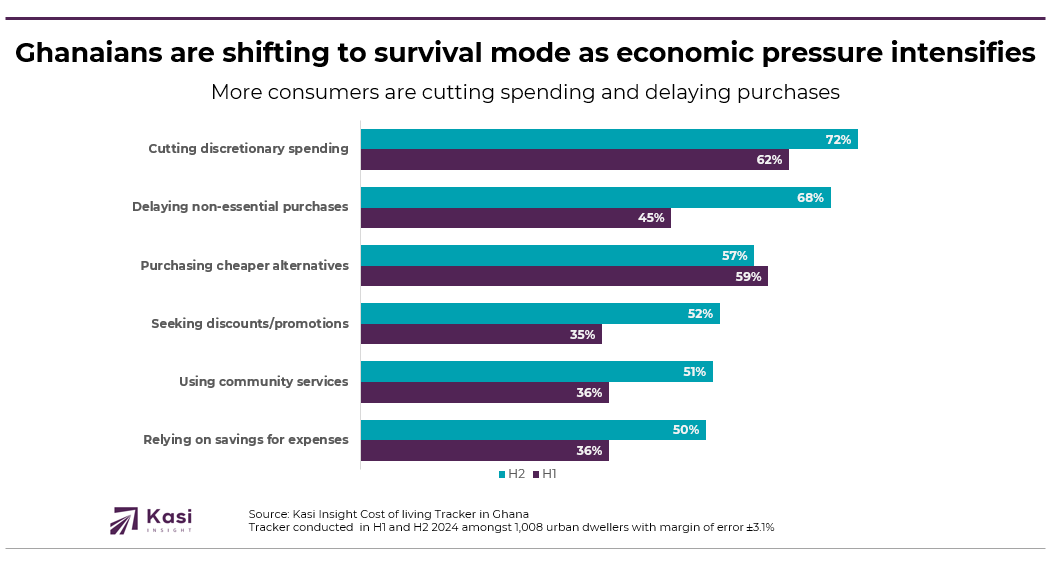
Discount-hunting is on the rise, with 52% of consumers actively looking for deals by December, up from 35% in March. Postponing non-essential purchases has also become a widespread coping strategy. By year-end, 68% were delaying such purchases, compared to 45% in March. Gen Z and Millennials are leading this shift. Gen Z’s delayed purchases rose from 33% to 80%, while 79% of Millennials increasingly turned to cheaper alternatives.
With consumer priorities shifting, brands must rethink their approach to remain relevant in Ghana’s evolving economic environment. Affordability is now a core expectation. Offering budget-friendly product lines, installment payments, and bulk-buying incentives can help brands connect with cost-conscious shoppers. Community-driven solutions such as group buying or partnerships with cooperatives can further enhance relevance.
Messaging that highlights value, savings, and reliability will resonate with Millennials and Gen Z. Gen X, who are particularly sensitive to issues of corruption, will respond to brands that lead with ethics and transparency. Safety-focused offerings also have added appeal, especially given the rise in concern around crime. By tailoring solutions and communications to the specific needs of each demographic, brands can foster trust, build long-term loyalty, and remain resilient amid economic uncertainty.
Share on socials using this caption: 📉💰 Cost of living shifts in Ghana! Consumers are cutting spending, hunting for discounts & leaning on community support. Brands, it's time to focus on affordability & value-driven solutions! 🚀 #GhanaEconomy #CostOfLiving #ConsumerTrends #SmartSpending
1733 views
Share article
Trust Is Becoming Economic Infrastructure
Consumer confidence loses momentum in October
Confidence plateaus in September as caution defines household behavior