Sandra Beldine Otieno, MSc
November 29, 2024
Share article


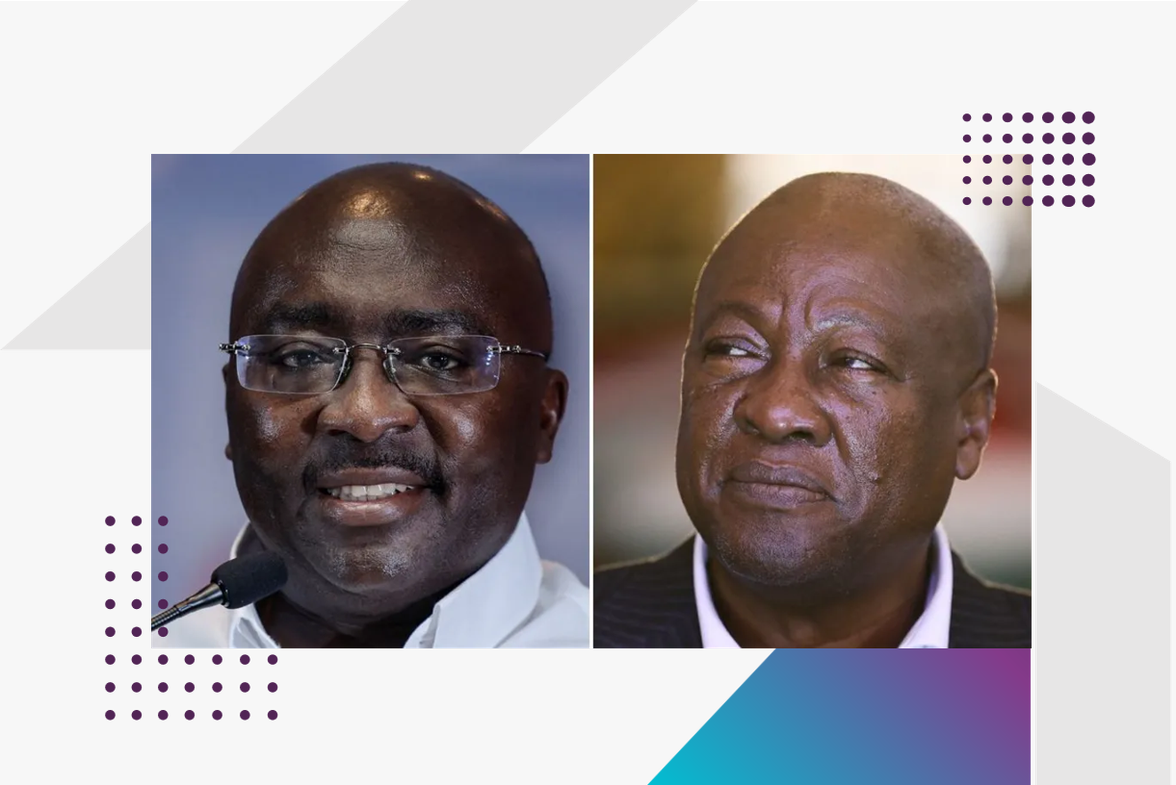
Ghana is just one week away from its General Election, scheduled for December 7, 2024, marking a critical juncture in the nation’s democratic history. This ninth general election since the reintroduction of multiparty democracy in the early 1990s comes as President Nana Akufo-Addo concludes his second and final term. The outcome of this election will shape Ghana’s trajectory amidst mounting economic and social challenges.
The presidential race is largely a contest between Mahamudu Bawumia of the ruling New Patriotic Party (NPP), who currently serves as Vice President, and John Dramani Mahama of the opposition National Democratic Congress (NDC), a former President seeking a political comeback. While 12 candidates are on the ballot, these two dominate the race, extending a decades-long tradition of two-party political dominance. Independent candidates such as Alan John Kwadwo Kyerematen, a former trade minister, and Nana Kwame Bediako, an entrepreneur with a focus on infrastructure, add nuance but are unlikely to upset the established dynamic.
Nearly 18.8 million registered voters are faced with a critical decision: continuity under the NPP or a shift to the NDC’s leadership. With the economy at the forefront of public concerns, including rising living costs, unemployment, and environmental challenges, this election is seen as a referendum on governance, economic stewardship, and the country’s future direction. Ghana’s well-earned reputation for peaceful power transitions now faces the test of intense public scrutiny and rising expectations.
The Kasi Index of Consumer Sentiment (ICS) monitors the economic pulse of 21 African nations, making it a premier gauge of consumer confidence on the continent. By probing into the economic realities and prospects concerning purchasing power, personal finances, household earnings, and job prospects, this index provides an insightful snapshot of Africa's economic climate.
Electoral cycles are vital junctures that often reshape business and consumer confidence. Across Africa, shifts in consumer sentiment during election years frequently signal political change or continuity, reflecting the broader public mood. The ICS has successfully predicted election outcomes in nations such as Kenya, Nigeria, Ghana previously, Senegal and most recently South Africa, reinforcing its reputation as a reliable tool for understanding electoral dynamics
This approach centers on analyzing variations in consumer sentiment in the year preceding elections, with particular attention to the average sentiment and its fluctuations during this period. Such analysis helps delineate between scenarios of political change—marked by the defeat of incumbents—and continuity, where the status quo prevails.
Over the past three years, Ghana’s consumer sentiment has shown notable fluctuations, as captured by the Kasi Index of Consumer Sentiment (ICS). The trend began in early 2022, with sentiment starting near zero before dipping to -8 in March, reflecting economic distress as inflation and rising living costs took their toll. By mid-2022, sentiment climbed steadily, reaching +13 by December, signaling cautious optimism as some stability returned.
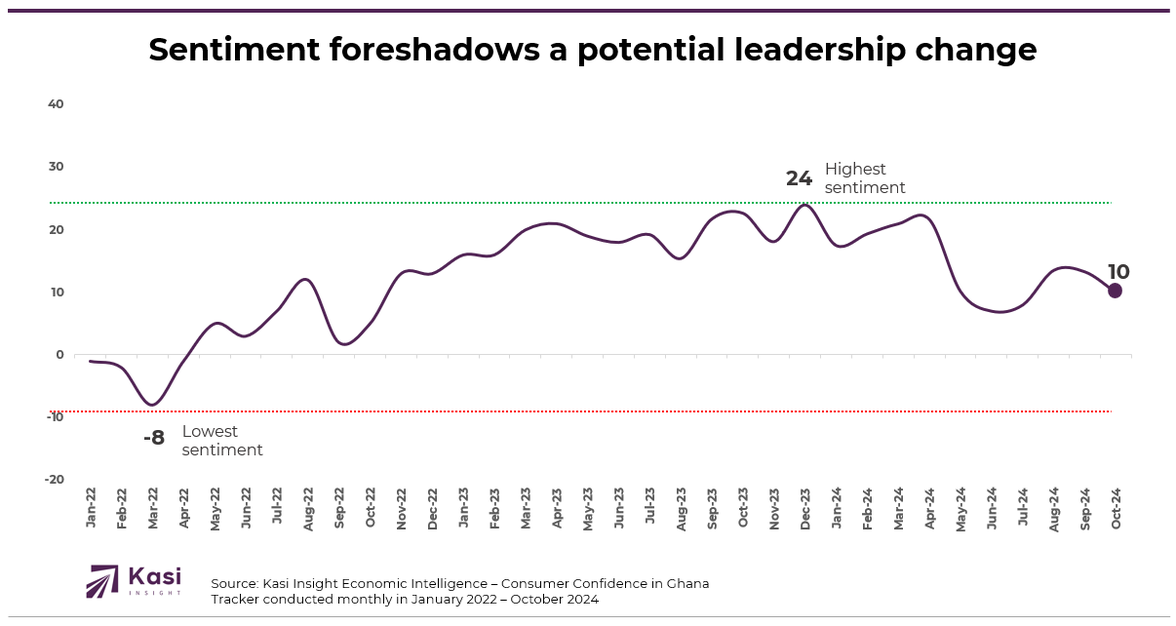
The year 2023 saw more pronounced shifts. Sentiment peaked at +23 in October, reflecting growing optimism among the population. However, this was tempered by intermittent declines throughout the year, including notable dips in June and November when sentiment fell to +18. These fluctuations highlight persistent concerns over unemployment, governance, and ongoing economic pressures.
In 2024, sentiment became increasingly volatile. Scores began at +18 in January, dropped sharply to a low of +10 in May, and rebounded slightly to +14 in August before tapering off toward the election period. These swings underscore a public mood torn between cautious hope for change and frustration with the slow pace of economic improvement.
As Ghana approaches its general elections in just one week, the ICS data provides critical insights into the electorate’s mood. With an average sentiment score of +15 and a volatility rate of 106%, sentiment reflects a restless population grappling with mixed emotions. These sentiment trends, while not necessarily indicating outright support for any party, suggest that the ruling New Patriotic Party (NPP) may struggle to maintain its grip on power. Meanwhile, the opposition National Democratic Congress (NDC) stands poised to capitalize on widespread dissatisfaction with the status quo, making the upcoming election a potential turning point in Ghana’s political landscape.
In the dynamic interplay of economic sentiment and democratic processes, Ghana stands on the brink of a transformative moment as it approaches the 2024 General Elections. These elections are not merely a contest for political power but a referendum on the ruling New Patriotic Party (NPP)’s stewardship amidst fluctuating consumer confidence. The Kasi Index of Consumer Sentiment (ICS) has captured a volatile public mood—ranging from cautious optimism to periods of frustration—reflecting the economic and socio-political challenges shaping the electorate’s perceptions.
Facing growing dissatisfaction over issues like rising living costs, unemployment, and environmental concerns such as illegal mining, the NPP risks losing its mandate for the first time. These sentiments, fueled by frustrations with economic management and governance, are poised to play a decisive role in shaping voter behavior. With an average sentiment index of +15 and a volatility rate of 106%, the data highlights a restless electorate grappling with economic uncertainty and a desire for change. This election has the potential to redefine Ghana’s political landscape, underscoring the profound influence of economic conditions on governance and the public’s trust in leadership.
Share on socials using this caption: 📉 Ghana’s 2024 elections are just a week away, and consumer sentiment data highlights growing public frustration with economic conditions. Could this be the turning point for leadership in Ghana? #Election2024 #GhanaDecides #ChangeIsComing #SentimentIndex
2124 views
Share article
Trust Is Becoming Economic Infrastructure
Consumer confidence loses momentum in October
Confidence plateaus in September as caution defines household behavior