Paul Cheloti Mulongo
June 3, 2025
Share article


Kasi Insight’s Sustainability tracker reveals how consumer attitudes toward environmental issues are evolving across Africa. Conducted annually in key markets, the tracker provides a deep dive into which environmental concerns matter most, what consumers expect from businesses, and what actions they view as essential for sustainable growth.
In Ghana, the data reveals a growing global emphasis on sustainability, though support for businesses integrating environmentally sustainable practices remains surprisingly low. Only 32% of Ghanaians are likely to support or choose such businesses, while slightly more than half 53% are unlikely to do so, and 15% remain neutral.
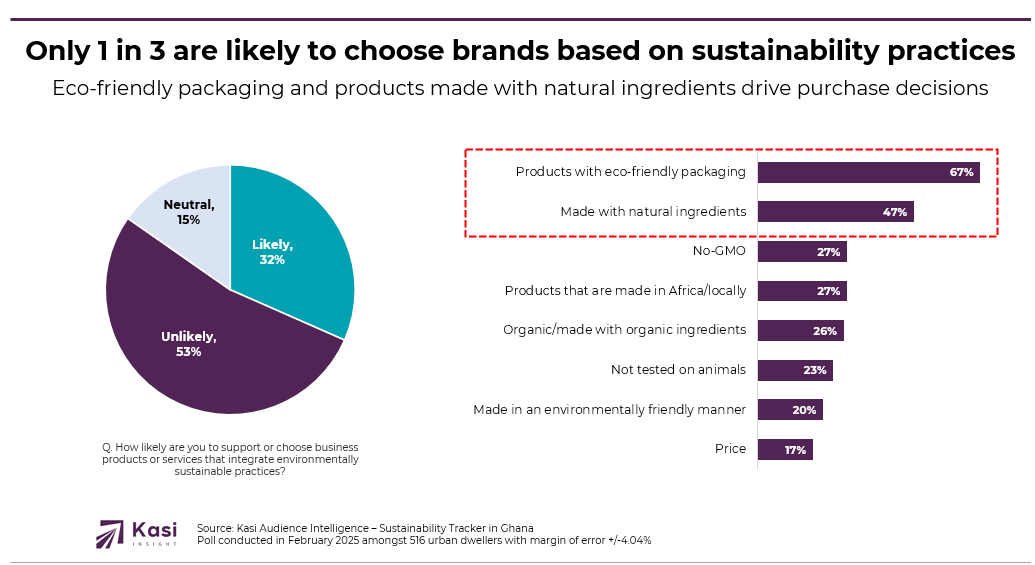
However, when it comes to actual purchasing factors, two sustainability features play a much stronger role. Eco-friendly packaging (67%) and natural ingredients (47%) dominate consumer preferences, far outpacing other considerations like local production (27%), non-GMO (27%), organic certification (26%), or ethical testing (23%). Surprisingly, price ranks lowest (17%), suggesting that consumers are willing to pay more for meaningful, tangible green features.
When the data is segmented by gender and age generation, key patterns emerge. Eco-friendly packaging and natural ingredients remain the top two priorities across segments showing a broad consensus on what "sustainable" looks like to consumers. Gen X, however, demonstrate a more balanced and expansive view of sustainability. In addition to prioritizing packaging and ingredients, they also value where and how products are made, showing greater appreciation for locally produced and ethically manufactured goods.
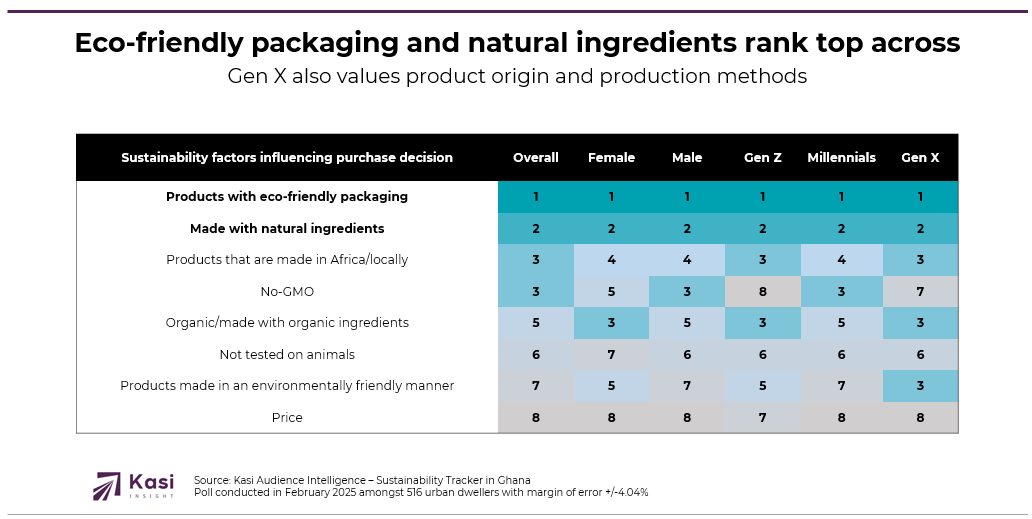
Meanwhile, Gen Z stands out by ranking “non-GMO” much lower than other groups, possibly signaling shifting definitions of what counts as “natural” or “clean.” The consistent low ranking of price across all groups shows that sustainability when clearly communicated can override cost concerns.
The data shows that Ghanaians are most influenced by visible sustainability features especially eco-friendly packaging and natural ingredients. Brands should prioritize these in product design, marketing, and packaging to directly impact purchase decisions.
Given that consumers are hesitant to support businesses based on broad sustainable practices, brands need to build awareness and trust over time by transparently showcasing their wider commitment to sustainability. Storytelling around efforts like renewable energy use, waste reduction, and ethical sourcing can gradually shift perceptions, especially when presented in a relatable and transparent way.
Generational differences further refine this strategy. Gen Z and Millennials may respond best to digital campaigns and influencer-driven content, while Gen X values local production and ethical practices. Ultimately, the brands that succeed will be those that don’t just talk about sustainability but integrate it into the product experience in a way that feels authentic, practical, and personal.
Share on socials using this caption: ♻️ In Ghana, consumers care more about eco-friendly packaging than corporate green pledges. Only 32% support sustainable businesses but 67% choose products with eco-friendly packaging. Want to drive change? Make sustainability visible, practical, and personal. #Sustainability #Ghana #ConsumerTrends #EcoPackaging #KasiInsight
1247 views
Share article
The Future of AI in Africa Lies in Smarter Decisions, Not Just Smarter Models
Africa’s Critical Minerals: From Hidden Resource to Economic Catalyst
Perceptions of climate inaction persist among Ghanaian consumers, driven by income disparities