Sandra Beldine Otieno
April 16, 2024
Share article


In a calibrated move, the Bank of Uganda’s Monetary Policy Committee raised the Central Bank Rate by 25 basis points to 10.25% on April 8, 2024, following a series of adjustments aimed at stabilizing the economic landscape. After reducing the rate to 9.50% in August 2023 and maintaining it through February 2024, the rate was increased by 50 basis points to 10% in March and subsequently to 10.25%.
This action, which is part of a continuous effort to steer the nation’s economy towards stability, has brought borrowing costs to the highest level since May 2017 but does not surpass the historical peak rate of 23% established in November 2011. This increment, carefully chosen in the context of gently receding headline inflation, considers diverse economic elements, such as agricultural inflation trends and service sector cost adjustments, alongside addressing the shilling’s sensitivity to the ebbs and flows of foreign investment and robust domestic corporate demand. While current inflation forecasts are on a downward trajectory, the bank remains vigilant about the potential upward pressures in the forecast horizon, keeping a close watch on geopolitical, energy, and global financial variables that could impact economic stability.
The Bank of Uganda’s monetary policy decisions and their subsequent impact on consumer sentiment, as reflected by the Kasi Insight’s Index of Consumer Sentiment (ICS), show a complex interplay. Initially, the steadiness in the Central Bank Rate (CBR) through 2023—held at 9.50% from August to December—mirrors a gradual recovery in consumer confidence. This stability likely provided a reassuring backdrop against which consumer sentiment improved, as evidenced by a sharp increase in confidence to 23 in July and then 20 in December.
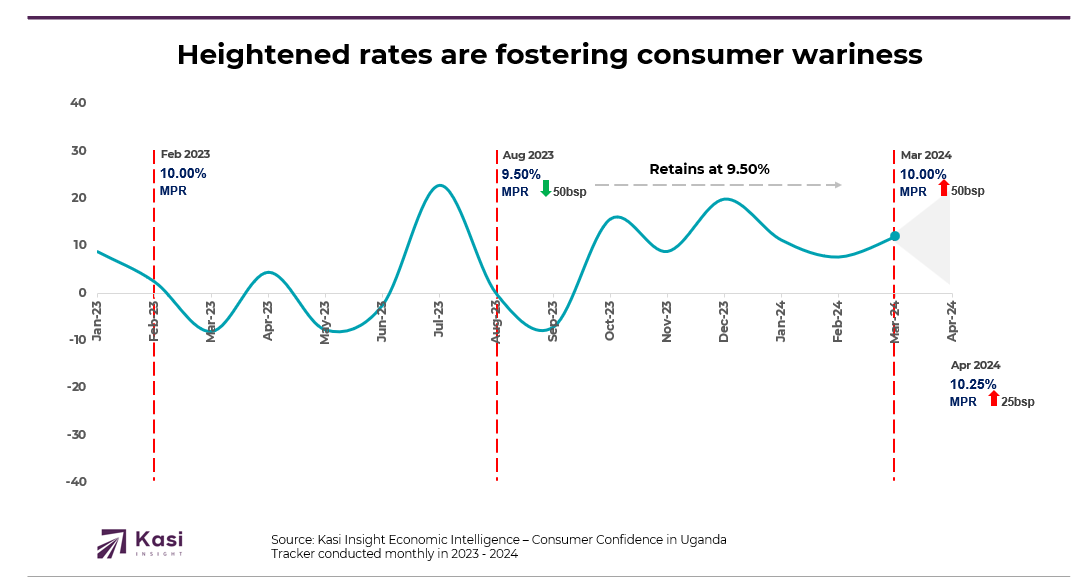
However, as the rate was incremented to 10% in March 2024 and further to 10.25% in April 2024, the Index displayed a cautious optimism, suggesting that while consumers may perceive these increases as necessary for curbing potential inflation, there remains an underlying concern about the broader economic implications. This evolving sentiment underscores a nuanced reaction to monetary tightening, where initial confidence may gradually give way to apprehension if rates continue to rise.
The recent increase of the Central Bank Rate (CBR) to 10.25% is set to significantly impact Ugandan businesses by raising borrowing costs. This hike will likely slow down business expansion and deter new investments due to increased financing costs. Moreover, higher borrowing rates may reduce consumer spending, particularly affecting retail, and consumer services sectors. Businesses in these areas will need to innovate to maintain sales and customer engagement.
The policy change also aims to stabilize the Ugandan shilling and lessen its susceptibility to foreign investment flows, presenting challenges for businesses heavily involved in imports or foreign transactions. These businesses may need to adopt sophisticated financial strategies like hedging to manage exchange rate risks. Given these dynamics, Ugandan businesses must focus on long-term strategic planning and efficiency improvements to navigate these changes. While sectors such as real estate might see decreased demand due to higher mortgage rates, sectors like technology that are less reliant on consumer financing could face fewer impacts.
The Bank of Uganda’s incremental adjustment of the Central Bank Rate to 10.25% serves as a deliberate and strategic response to evolving economic indicators, such as mild inflation and shifting market dynamics. This cautious approach underscores the dual objective of stabilizing the Ugandan economy while fostering an environment conducive to sustainable growth. As evidenced by fluctuations in Kasi Insight's Index of Consumer Sentiment, there is a discernible shift towards consumer caution, reflecting broader apprehensions about the future economic landscape and its impact on personal finances and business operations. Policymakers must therefore continue to navigate this complex terrain with agility, ensuring that monetary policies not only address immediate economic pressures but also enhance the resilience and long-term stability of the economy. The interaction between monetary policy, consumer behavior, and business responses highlights the nuanced challenge of fostering economic development while managing inflation and maintaining currency stability. As Uganda moves forward, it will be crucial for economic strategies to remain responsive to both global trends and domestic needs, ensuring a balanced and progressive economic trajectory.
Share on socials using this caption: Bank of Uganda’s Central Bank Rate sees a 25 basis points surge to 10.25%, igniting strategic shifts in business landscapes! 📈💼 Amidst rising borrowing costs, consumers and businesses in Uganda navigate challenges while seeking growth and resilience. #MonetaryPolicy #EconomicShifts
2537 views
Share article
Trust Is Becoming Economic Infrastructure
Consumer confidence loses momentum in October
Confidence plateaus in September as caution defines household behavior