Sandra Beldine Otieno
March 15, 2024
Share article



In February, consumer confidence experienced a positive shift, moving up by two points and leaving behind the stagnation that characterized January. This uptick was propelled by a three-point rise in the index measuring expectations for future economic conditions, alongside a subtle but impactful one-point improvement in the index of current economic conditions.
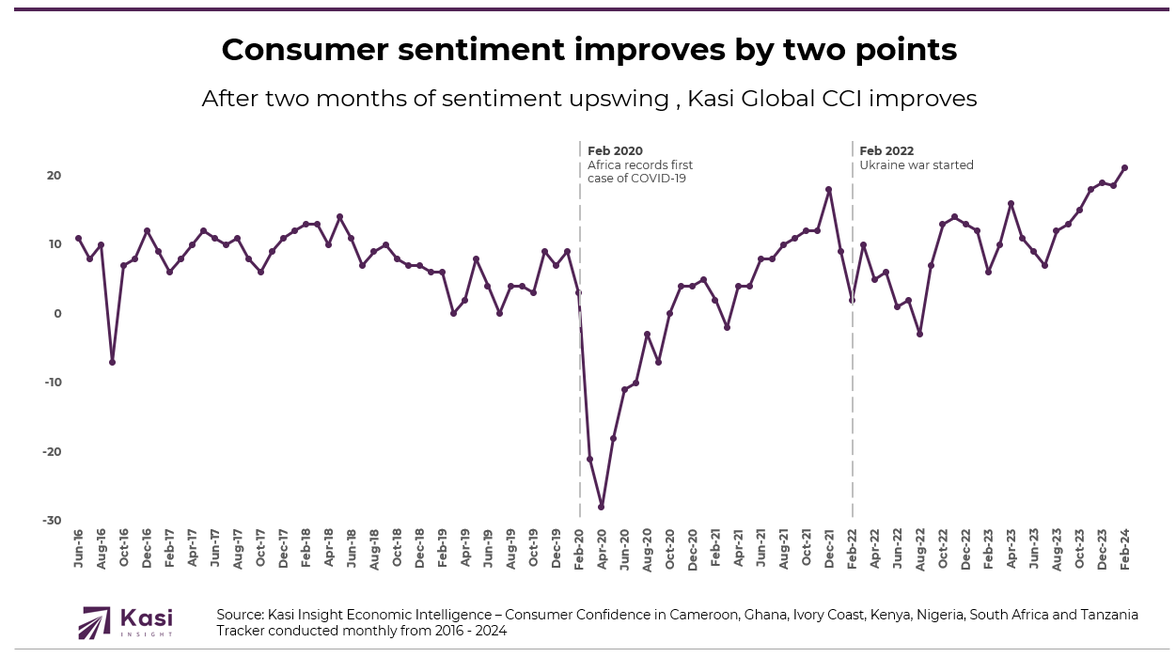
In February, Africa experienced a notable reversal from the downturn observed in household indices during the previous months, signaling a partial recovery in the face of ongoing economic challenges. This period saw an improvement in several key financial indicators, suggesting a gradual easing of the pressures on household budgets that had been exacerbated by rising living costs.
The personal finance index, which assesses individuals' financial situations, climbed by three points, hinting at a slight improvement in consumers' financial health. Despite the ongoing crisis, this rise suggests a resilience in personal financial conditions. On the other hand, the household spending index, a measure of consumer expenditure, leaped by eight points. This significant increase contrasts sharply with the minor two-point decrease in the household income index, underscoring a complex interplay between income dynamics and spending behaviors.
Moreover, discretionary spending and job prospect indices both moved up marginally by one point each, reflecting a cautiously optimistic outlook on employment opportunities and discretionary expenditures. These modest gains indicate a tentative improvement in the job market and a slight increase in spending on non-essential items. Additionally, broader economic sentiment, as captured by the general country economic conditions index and the general city economic conditions index, both improved by two points. This advancement signals a growing optimism about the broader economic landscape, despite the challenges posed by the escalating cost of living and its impact on household budgets.
Consumer sentiment showed contrasting trends across the countries monitored. In Kenya, there was a remarkable uplift in consumer confidence, with an eight-point increase signaling a robust improvement in the economic mood among Kenyans. This positive change was supported by significant leaps in key indices: the country’s economic conditions index soared by 19 points, city economic conditions by 16 points, and future expectations by 12 points. These increases reflect a growing optimism and a brighter outlook on Kenya's economic landscape among consumers. Additionally, the Kenyan Shilling saw substantial gains against major currencies, appreciating 10.68% against the USD, 10.75% against the Sterling Pound, and 10.55% against the Euro. By month's end, exchange rates stood at Kshs 143.59, Kshs 181.88, and Kshs 155.59 respectively. This currency appreciation was partly driven by strong investor interest in the Eurobond buyback tender of 2014, which was notably oversubscribed, alongside boosts from improved diaspora remittances and tourism inflows, pointing to a surge in investor confidence.
In contrast, Tanzania experienced an 8-point decline in consumer confidence, a sign of deteriorating economic sentiment. This downturn was marked by a 17-point reduction in both the personal finance and discretionary spending indices, and a 14-point decrease in the current conditions index, reflecting broader economic challenges. This period also saw the CHADEMA opposition party organizing a protest in Mwanza on February 13, advocating for constitutional and legal reforms towards free and fair elections, and the continuation of the new constitution drafting process. The protest led to increased police presence and caused minor transport disruptions, with potential cancellations or rerouting of public transport services in affected areas. While the protest was intended to be peaceful, the risk of isolated skirmishes between police and protesters was present, adding to the period's complexities.
For brands operating across the African continent, the rebound in consumer confidence in February offers nuanced insights and strategic directions. The observed variance in consumer sentiment across countries emphasizes the necessity for tailored marketing and sales strategies. In regions like Kenya, where there's a notable surge in consumer confidence, there’s an opening for brands to introduce new products or expand their footprint. Conversely, in places like Tanzania, where sentiment has dipped significantly, the focus might need to shift towards value propositions and customer retention. The uptick in personal finance and household spending indices signals a growing optimism about financial situations, suggesting consumers may be more open to increasing their spending, presenting an opportunity for brands to launch premium offerings. Yet, the slight decline in the household income index warrants a balanced approach to pricing to maintain accessibility for consumers facing income challenges.
Moreover, the overall improvement in economic optimism highlighted by the indices suggests that brands should invest in marketing efforts that mirror this positivity, emphasizing the quality and value of their products. The slight improvements in discretionary spending and job prospects indices indicate a consumer base that, while optimistic, remains cautious about the future, suggesting a strategic focus on emphasizing long-term value and cost-effectiveness could resonate well. This period of varying consumer confidence also highlights opportunities for geographic expansion and diversification, suggesting that regions with rising consumer sentiment might offer more fertile grounds for growth. The dynamic nature of consumer confidence, with its fluctuations and regional differences, underscores the importance of adaptability and responsiveness for brands.
Share on socials using this caption: 🌍✨ African Consumer Confidence is on the Rise! ✨🌍 February brought a wave of optimism across Africa, as consumer confidence broke free from stagnation! 📈💪 This surge is powered by a notable increase in future conditions and a boost in current sentiments. #AfricanEconomy #ConsumerConfidence #EconomicResilience #FutureIsBright
2031 views
Share article
Trust Is Becoming Economic Infrastructure
Consumer confidence loses momentum in October
Confidence plateaus in September as caution defines household behavior