Sandra Beldine Otieno, MSc
June 13, 2025
Share article



In May, consumer confidence in Africa improved by 4 points, reflecting renewed momentum after April’s modest recovery. The gain was driven by a strong 7-point increase in the current conditions index, which more than offset a 2-point decline in the future expectations index. While households reported better income, spending, and job outlooks, concerns about longer-term prospects persisted. The overall sentiment pointed to strengthening short-term resilience despite lingering uncertainty about the future.
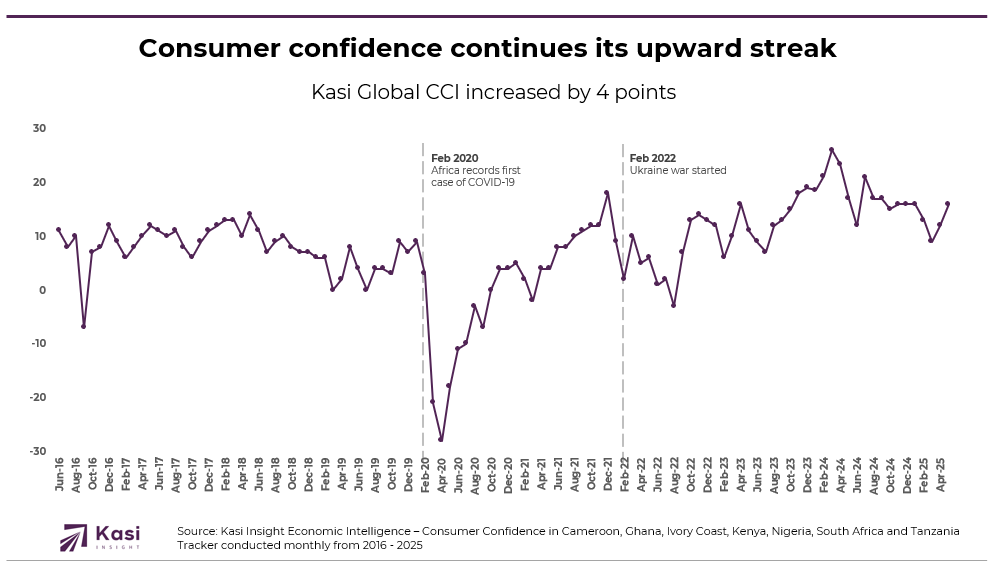
In May, household indicators showed a broader and more consistent recovery in consumer sentiment, with gains across nearly all categories. The household income index rose by 3 points, reflecting continued improvements in earnings and income stability. The personal finance index also increased by 2 points, indicating that more households felt in better control of their financial situation. These steady gains point to a gradual rebuilding of household financial confidence.
This time, the renewed optimism was reflected more clearly in spending behavior. The discretionary spending index jumped by 8 points, suggesting that consumers felt more comfortable making non-essential purchases. The household spending index also rose by 3 points, signaling a broader willingness to engage in day-to-day consumption. These improvements mark a shift from the caution observed in April, potentially fueled by improved job security and local economic momentum.
Labor market sentiment improved as well, with the job prospect index increasing by 6 points. This shift suggests that concerns around employment are beginning to ease. Perceptions of the broader economic environment were mixed. While the general city economic conditions index rose by 7 points, indicating growing confidence in urban economic recovery, the general country economic conditions index declined by 2 points. This divergence suggests that while local outlooks are improving, national-level confidence remains fragile amid ongoing structural or political challenges.
At the halfway mark of the year, African consumers are showing renewed signs of confidence, but the recovery remains cautious and uneven. More households are feeling financially stable in the short term, with improved income levels, better job prospects, and a rise in discretionary spending. Yet despite this progress, future expectations have softened. Consumers are still watching their wallets, making intentional choices, and prioritizing needs over wants. This is not a return to pre-crisis spending, it is a recalibration of value.
For brands, the message is clear. This is the time to double down on what matters most to consumers right now. Affordability, transparency, and usefulness are at the center of every purchasing decision. Brands must deliver practical solutions through flexible pack sizes, accessible pricing, and simple payment models. Communication should be honest, grounded, and focused on helping consumers manage the realities they face every day. Campaigns that feel out of touch with financial constraints risk losing relevance quickly.
Market differences are becoming more pronounced and require tailored approaches. Sentiment is rising in Ivory Coast, Ghana, Nigeria, and Cameroon, offering space for brands to cautiously reintroduce innovation and experience-led engagement. In contrast, confidence has dipped in South Africa and Kenya, where brands must focus on consistency, trust, and protection of core value. A one-size-fits-all strategy will not hold. Winning in the second half of the year means staying close to the consumer, reading the room in every market, and responding with empathy and agility.
Share on socials using this caption: 📈💡 In May, consumer confidence in Africa rose again, with stronger income, spending, and job outlooks. But future uncertainty lingers, and cautious decision-making prevails. #AfricaInsights #ConsumerConfidence #SmartMarketing #ResilientBrands
1162 views
Share article
Trust Is Becoming Economic Infrastructure
Consumer confidence loses momentum in October
Confidence plateaus in September as caution defines household behavior