Sandra Beldine Otieno, MSc
April 10, 2025
Share article



In March, consumer confidence in Africa declined by 4 points, continuing its downward trend for a second month. The drop was mainly driven by an 11-point fall in the current conditions index, while the future expectations index dipped slightly by 1 point. Most household indicators weakened, with sharp declines in discretionary spending and job prospects. The household income index was the only metric to improve, rising by 2 points.
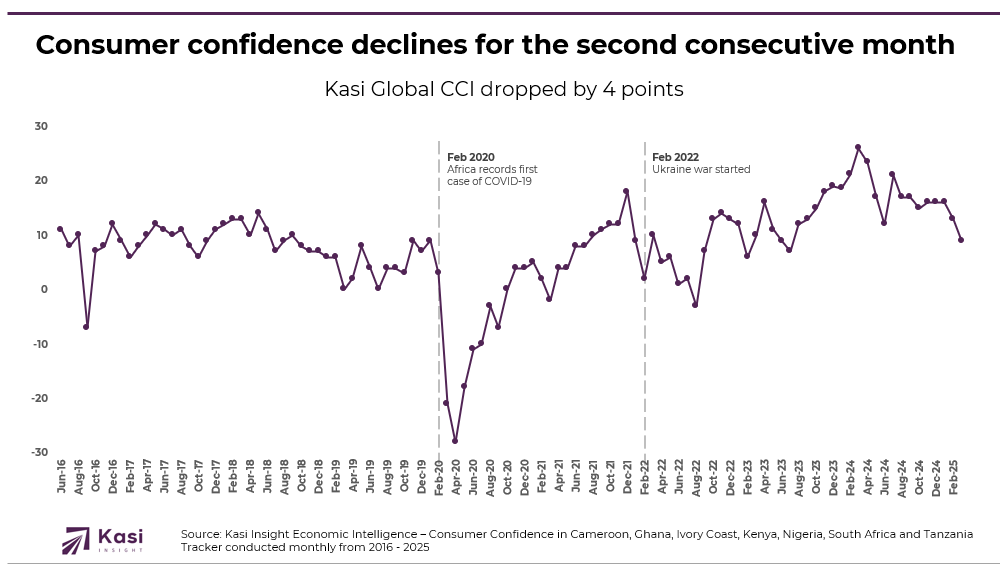
In March, household indices signaled a clear deterioration in consumer sentiment, with most indicators trending downward. The most significant decline was seen in the discretionary spending index, which fell by 12 points. This steep drop highlights consumers’ growing reluctance to spend on non-essential items, likely driven by tightening household budgets and broader economic uncertainty. The household spending index also declined by 3 points, reinforcing the cautious shift in day-to-day spending behavior. Adding to this caution, the general city economic conditions index fell by 4 points, suggesting a weakening sense of stability in the local economic environment where consumers make most of their financial decisions.
Job-related sentiment also took a hit, with the job prospect index falling sharply by 11 points. This decline suggests that confidence in the labor market is weakening, potentially affecting how households plan. The personal finance index, which measures consumers’ perception of their financial situation, edged down by 1 point, pointing to ongoing strain on personal budgets. Meanwhile, the general country economic conditions index remained unchanged at 24 points, signaling stagnation in how consumers view the national economy. These combined signals reflect a growing sense of vulnerability, where both immediate circumstances and future expectations appear increasingly uncertain.
The household income index was the only measure to improve, rising by 2 points. While this uptick may reflect modest gains in earnings or informal income streams, it was not enough to lift overall sentiment. The broader trend suggests that any income improvements are being outpaced by rising costs or persistent economic unease. With national outlooks flat and city-level sentiment declining, March marked a turning point where financial resilience appears to be slipping, and caution is becoming the prevailing mood.
With consumer confidence declining for a second consecutive month in March and household indices reflecting widespread financial strain, brands should shift their focus from aspiration to affordability. The steep 12 point drop in discretionary spending highlights a clear move toward cautious, needs-based consumption. In this environment, brands should emphasize value, functionality, and cost-effectiveness—positioning products as essential, helpful, or budget-friendly rather than aspirational or status-driven. Clear communication around usefulness and savings will be more effective than lifestyle promises that feel out of reach.
As job prospects deteriorate and personal financial pressures mount, brands should make purchasing easier and more flexible for consumers. This includes offering smaller pack sizes, bundling products for better value, and running consistent price promotions. Brands should also explore flexible payment models that reduce the immediate financial burden, such as pay-later options or subscriptions with clear, affordable terms. The goal should be to lower barriers to purchase while reinforcing reliability and empathy. Consumers are more likely to support brands that understand their situation and offer realistic solutions.
Brands should also respond to regional shifts in sentiment with localized strategies. While confidence rose in Ghana, other key markets like Nigeria and South Africa saw sharp declines. A uniform approach will fall flat. Instead, brands should use country-level insights to tailor messaging, adjust pricing, and prioritize different product lines depending on market resilience. In lower-confidence markets, the focus should be on protecting share and supporting core needs. In more optimistic environments, brands can cautiously reintroduce innovation or experience-driven offerings. By staying close to consumers’ evolving financial and emotional states, brands can remain relevant and resilient.
Share on socials using this caption: 📉💸 Consumer sentiment continues to slide in Africa. March saw a second straight month of declining confidence, with sharp drops in spending and job outlooks. Consumers are tightening budgets, and brands need to respond with empathy and value. #ConsumerConfidence #AfricaInsights #SpendingTrends #EconomicOutlook
1352 views
Share article
Trust Is Becoming Economic Infrastructure
Consumer confidence loses momentum in October
Confidence plateaus in September as caution defines household behavior