Sandra Beldine Otieno
May 31, 2024
Share article



The consumer sentiment in Morocco, as tracked by Kasi Insight's Index of Consumer Sentiment (ICS) from January 2023 to April 2024, illustrates dramatic fluctuations that mirror the volatile economic landscape and its effects on consumer perceptions. The year 2023 started with cautious optimism, with consumer sentiment climbing from a modest 9 in January to a robust 33 by May. However, this positive outlook was short-lived, as sentiment sharply dropped to -37 in July, indicating a significant downturn in consumer confidence likely triggered by adverse economic events or unfavorable fiscal policies.
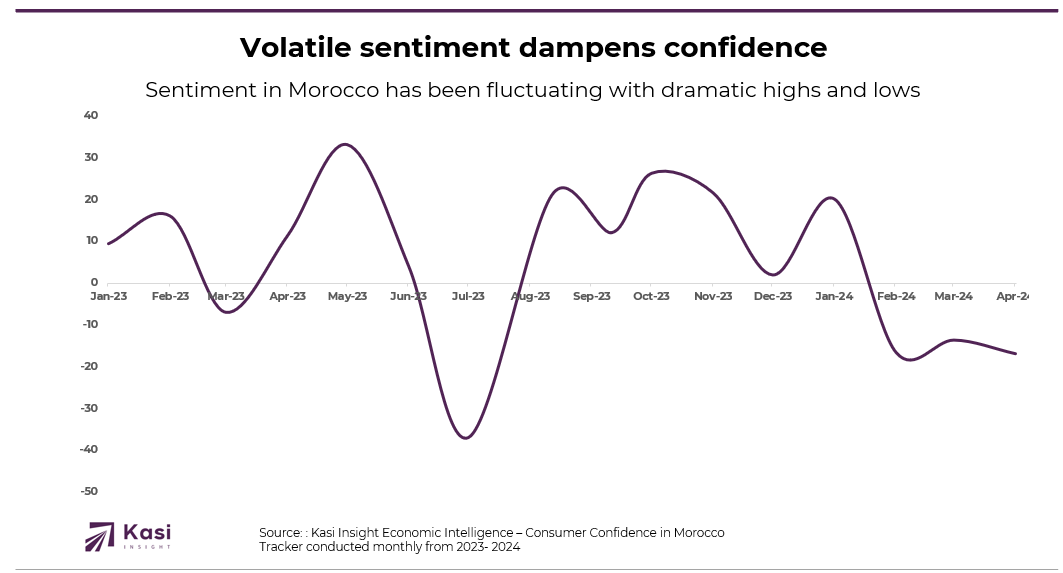
The latter half of 2023 saw a partial recovery, with sentiment improving to 26 in October before stabilizing. However, as 2024 began, consumer sentiment again trended negatively, persistently lingering in the negative zone with a score of -17 recorded in both February and April. This continued negative sentiment underscores the fragile economic conditions impacting Moroccan consumers and highlights the importance of closely monitoring consumer sentiment as a critical indicator for economic health and strategic planning.
In the first quarter of 2024, a significant proportion of Moroccan consumers reported experiencing price increases across various categories, signaling severe inflationary pressures. Utilities were the most affected, with 74% of consumers noticing price hikes, closely followed by education and household furniture at 72% and 69%, respectively. Price increases were also significant in transportation, food & beverages, and communication, with 68% to 66% of consumers reporting hikes, directly affecting their daily living costs.
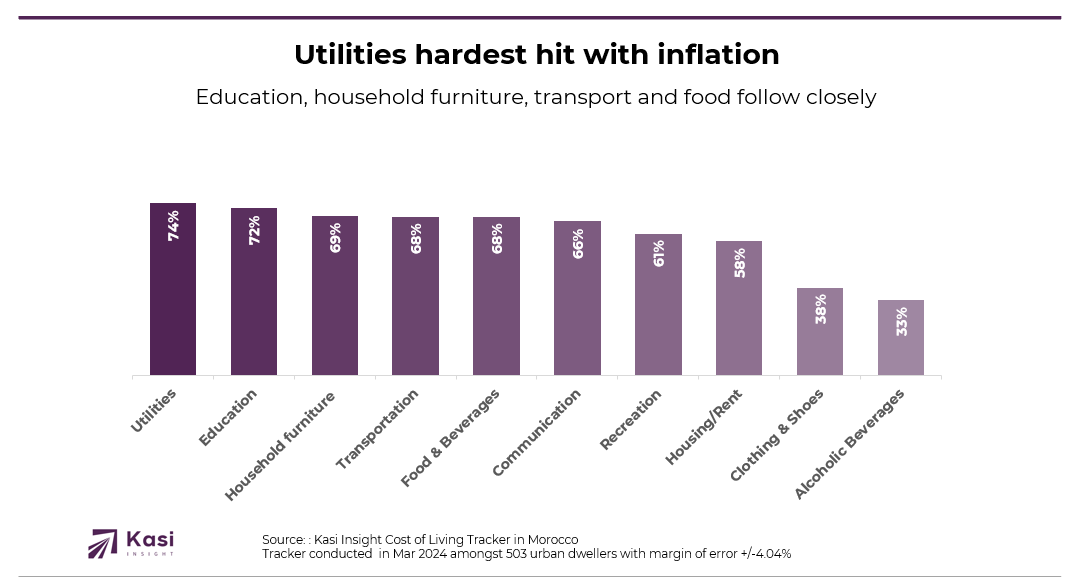
Moreover, even recreational activities and housing/rent were perceived as more expensive by 61% and 58% of consumers, respectively. Less essential categories like clothing & shoes and alcoholic beverages also saw notable price increases, reported by 38% and 33% of consumers, respectively. This widespread perception of rising costs across both essential and non-essential sectors vividly illustrates why consumer pessimism remains prevalent, reflecting broader economic instability.
In response to these economic pressures, all demographic groups have prioritized changing their purchasing habits as their primary strategy to cope with inflation, indicating a broad shift towards more economical buying choices. This adaptation reflects a proactive approach to managing increased costs, consistent across Gen X, Millennials, and Gen Z. Utilizing community services emerged as the second most common strategy across all groups, suggesting a collective reliance on communal resources to alleviate personal financial burdens. Similarly, making lifestyle changes to reduce costs ranked third, indicating a widespread tightening of budgets among all demographics, such as dining out less frequently or opting for public transportation.
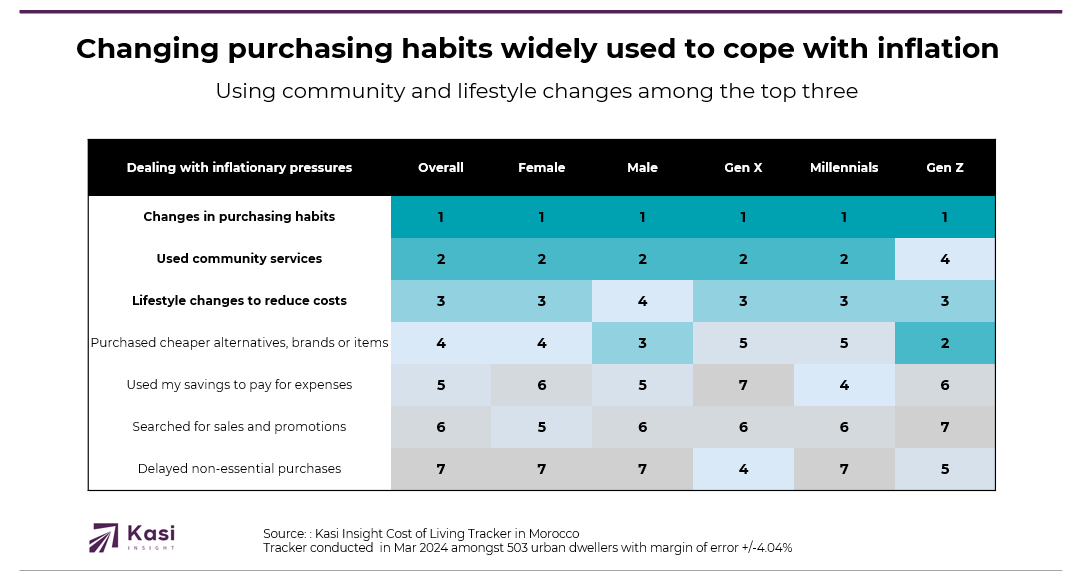
The preference for purchasing cheaper alternatives varied, with Gen Z placing it higher (second) compared to Millennials (fifth), highlighting Gen Z's heightened price sensitivity and possibly tighter budgets. Meanwhile, the use of savings to pay for expenses showed differences, with Millennials ranking it fourth, indicating financial pressures despite career stability, whereas Gen X, with potentially better financial planning, ranked this strategy last (seventh), suggesting a more robust financial standing. These coping strategies reveal not just immediate reactions to inflation but also deeper insights into the financial health and priorities of different demographic segments. The uniform move towards thriftiness alongside the strategic use of community resources and savings highlights how each demographic navigates economic challenges differently.
The widespread shift towards more economical purchasing habits indicates a need for brands to focus on price sensitivity and value offerings. Introducing competitively priced products, offering meaningful discounts, or enhancing perceived value through innovative bundling or added services could be key to maintaining customer loyalty as budgets tighten.
Transparency and clear communication are equally important. In an environment where consumers are increasingly discerning, it is crucial for brands to articulate the benefits, cost savings, and quality of their products clearly. Being transparent about how products meet the economic needs of consumers can help build trust and sustain a loyal customer base despite challenging economic conditions.
Moreover, diversifying product lines can provide a significant advantage. Given that demographics like Gen Z are seeking cheaper alternatives while Millennials may use savings for higher-quality purchases, offering a spectrum of products that cater to various financial thresholds can help capture a broader market. This strategy not only attracts cost-conscious consumers but also appeals to those who are willing to invest more in perceived value.
Share on socials using this caption: 📉📊 Inflationary pressures in Morocco are eroding consumer confidence, leading to a shift towards thrifty habits and increased price sensitivity. Utilities, education, and furniture see the highest price hikes, affecting daily living costs and prompting consumers to prioritize economical buying choices. 💸🔍 #EconomicTrends #ConsumerSentiment #MoroccoEconomy #Inflation #ThriftyLiving #PriceSensitivity #MarketInsights #Budgeting #CostOfLiving
2275 views
Share article
Trust Is Becoming Economic Infrastructure
Consumer confidence loses momentum in October
Confidence plateaus in September as caution defines household behavior