Sandra Beldine Otieno, MSc
August 13, 2024
Share article



In July, consumer confidence in Africa successfully reversed its previous downward trajectory, showing a notable improvement of nine points after three months of consecutive declines. This positive shift was primarily driven by a significant nine-point increase in the index of current conditions, paired with a ten-point rise in the index of future expectations. These changes indicate a more optimistic outlook among consumers, suggesting a potential rebound in economic sentiment across the region.
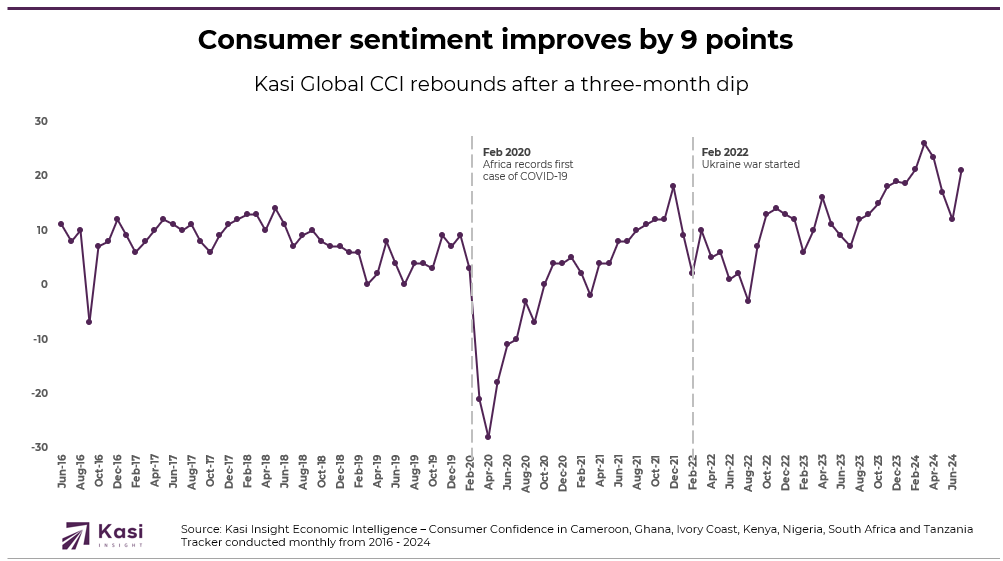
In July, Africa witnessed a notable rebound in its economic indicators, reversing the negative trend seen in the preceding months across all household indices. The household income index saw a modest rise of 3 points, while the personal finance index experienced a substantial improvement, increasing by 10 points, signaling stronger financial health among consumers.
The discretionary spending index, which gauges non-essential consumer spending, increased by 8 points, indicating a return to more liberal spending habits. Moreover, the household spending index, a critical measure of overall consumer expenditure, surged by 18 points, reflecting a significant resurgence in consumer confidence and spending power. Similarly, the job prospects index, which reflects public sentiment about employment opportunities, also improved significantly, rising by 10 points. This suggests an optimistic employment outlook, potentially driven by an economic upturn.
Furthermore, the general economic conditions of the country and cities also saw improvements, with the national economic conditions index rising by 7 points and the city-specific index by 10 points. These upticks indicate a broader economic recovery, with increasing optimism about the economic environment both nationally and locally. This pattern of robust consumer behavior and improving economic indicators points to a promising trajectory for continued economic recovery and stability across the region.
Consumer sentiment in Cameroon saw a notable uplift in July, climbing by 7 points. This positive shift was underpinned by a substantial 13-point increase in both the general country and city economic conditions indices, complemented by a 12-point rise in the household spending index. These improvements reflect a broader economic stabilization. Economic forecasts have painted a promising picture, projecting steady GDP growth and low inflation, which likely contributed to bolstering consumer confidence. This favorable economic climate has been further enhanced by governmental policies that have fostered a conducive environment for business operations and consumer spending.
Contrastingly, Nigeria experienced a decline in consumer sentiment by 3 points, largely driven by a significant 10-point drop in the discretionary spending index and a 7-point fall in the personal finance index. This downturn can be attributed to the economic hardships and governance issues that have been at the forefront of national concerns. The month was marked by widespread protests, indicative of the public’s growing frustration with inflation, rising costs of living, and a perceived lack of transparency in government actions. These protests not only highlighted the economic strains faced by consumers but also contributed to a heightened state of political unrest, further eroding confidence in the market. The government and police's response to these protests, although aimed at maintaining order, may have inadvertently intensified consumer apprehension, influencing spending behaviors and overall consumer sentiment negatively.
For brands, the resurgence in consumer confidence across Africa in July presents a pivotal moment to recalibrate marketing strategies and amplify engagement. The broad improvements in household indices, especially the substantial rise in household and discretionary spending, suggest consumers are feeling more optimistic and financially stable. This newfound consumer confidence can translate into increased demand for a variety of products, particularly in luxury and discretionary categories. Brands can seize this opportunity to innovate, expand their offerings, and enhance marketing campaigns to capture the attention of an increasingly willing customer base.
Moreover, the distinct regional variations in consumer sentiment, with improvements in countries like Cameroon, Ghana, Kenya, South Africa, and Ivory Coast, and declines in Nigeria and Tanzania, call for a nuanced approach to market entry and expansion. Brands should consider tailoring their strategies to align with local economic conditions and consumer sentiments. This might involve ramping up marketing efforts and distribution in regions showing positive trends while maintaining a cautious and perhaps more targeted approach in areas where consumer confidence remains low. Such a strategic regional focus can help brands optimize resources and ensure their messages resonate effectively with diverse consumer groups.
Additionally, the improvement in indices related to personal finance and job prospects indicates a recovering economic environment, which can foster consumer spending and loyalty. Brands that anticipate these shifts and adapt quickly can build deeper connections with their customers. Offering value-added services, personalized experiences, and loyalty rewards can further cement consumer trust and loyalty. As the economic landscape shows signs of recovery, brands that stay informed and agile, adjusting to the evolving needs and expectations of consumers, are likely to thrive and outpace their competitors in this rejuvenating market.
Share on socials using this caption: 🌍📈 July marks a notable rebound in consumer confidence across Africa, signaling economic optimism! Discover the key factors fueling this positive shift and how it varies from region to region. Don't miss out—read the full article now! #EconomicRecovery #ConsumerTrends #MarketInsights
4516 views
Share article
Trust Is Becoming Economic Infrastructure
Consumer confidence loses momentum in October
Confidence plateaus in September as caution defines household behavior