Sandra Beldine Otieno, MSc
July 17, 2024
Share article



In June, consumer confidence in Africa persisted in its downward trajectory for the third consecutive month, declining by five points. This reduction was influenced by a seven-point drop in the index of current conditions and a five-point decrease in the index of future conditions, indicating a worsening outlook among consumers.
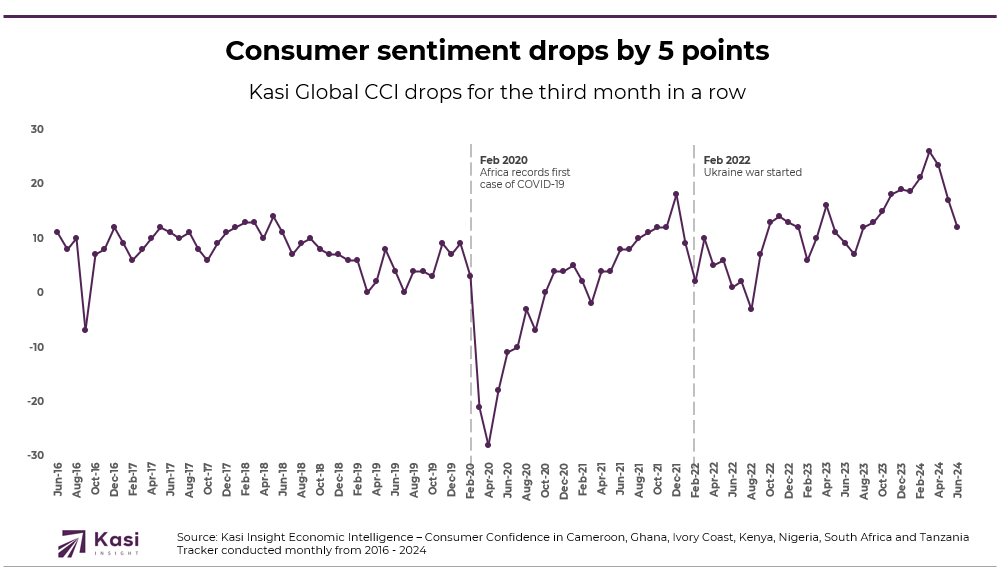
In June, Africa's economic outlook remained bleak, continuing the downward trend seen in previous months across various household indices. While there were minor improvements in household income and personal finance indices, which increased by two and one point respectively, these gains were overshadowed by significant declines in more critical areas.
The discretionary spending index fell by seven points, and the household spending index saw a dramatic decrease of 20 points, indicating a significant pullback in consumer expenditure amid growing financial insecurity. Similarly, the job prospects index declined by seven points, reflecting a worsening employment outlook.
Furthermore, the general economic conditions both nationally and in cities also experienced declines, with the country’s index dropping by two points and the city index by four points, highlighting a pervasive pessimism about the economic environment. This pattern of cautious consumer behavior and economic uncertainty suggests a challenging path ahead for recovery and stability in the region.
In Tanzania, consumer sentiment rose by 19 points, supported by a notable 33-point increase in the personal finance index and a 24-point improvement in the city economic conditions index. This surge in optimism is largely attributed to recent economic reforms and government initiatives aimed at boosting economic growth. The government has implemented policies that improved infrastructure, facilitated business operations, and attracted foreign investments, creating a more favorable economic environment. Additionally, stable political conditions and effective governance, including efforts to combat corruption and improve public services, have fostered trust and optimism about the country’s future. Significant improvements in key sectors such as agriculture, which saw a 15% increase in productivity, tourism, with a 20% rise in tourist arrivals, and manufacturing, which experienced a 12% growth in output, have all contributed to the overall increase in economic activity and employment opportunities, further enhancing consumer confidence.
In contrast, South Africa experienced a dramatic 52-point drop in consumer sentiment, driven by steep declines across several indices: the index of current conditions plummeted by 57 points, and the index of future expectations fell by 50 points. This severe downturn is attributed to multiple interrelated factors. Load reduction measures have severely disrupted daily life and economic activities, while rising electricity prices have compounded financial burdens on consumers, stretching household budgets thinner and reducing discretionary spending. Additionally, the political landscape has further eroded confidence, with the coalition government failing to inspire trust. The recent elections reshuffled the parliamentary landscape, diminishing the long-standing dominance of the African National Congress (ANC) and resulting in political uncertainty. These factors combined—load reduction, rising electricity prices, and a fragmented, mistrusted coalition government—have led to a substantial decline in consumer sentiment, reflecting widespread economic and political dissatisfaction among South Africans.
For brands, the persistent decline in consumer confidence and the weakening performance across various household indices in Africa signal a need to adjust strategies and expectations. The significant drops in discretionary spending and household spending indices indicate that consumers are tightening their budgets and prioritizing essential purchases. This trend suggests that luxury and non-essential goods may see a decline in sales, prompting brands to emphasize value, affordability, and necessity in their marketing efforts to better resonate with budget-conscious consumers.
Regional variations in consumer sentiment also highlight the importance of tailored strategies. While countries like South Africa, Cameroon, Ghana, and Kenya experienced declines in consumer confidence, Ivory Coast, Nigeria, and Tanzania saw improvements. Brands should focus their efforts and resources on regions with more positive consumer sentiment, such as Tanzania, while adopting conservative approaches in areas where confidence has declined. Additionally, building stronger customer relationships through flexible payment options, discounts, and loyalty programs can help brands retain customer loyalty and ease financial pressures for consumers during these challenging times.
Adapting product offerings to meet the changing needs of consumers is also crucial. Focusing on essential goods and cost-effective solutions will be key as consumers prioritize necessary expenditures. Brands must closely monitor economic indicators and consumer sentiment indices to remain agile and responsive to further changes in the economic landscape. By staying informed and adjusting strategies accordingly, brands can navigate the challenges presented by declining consumer confidence and economic uncertainty, positioning themselves for resilience and success in a shifting market environment.
Share on socials using this caption: 📉📊 June saw a continued dip in consumer confidence across Africa, with major drops in household spending and job prospects. Some regions faced steep declines, while others showed resilience. #EconomicTrends #ConsumerConfidence
3927 views
Share article
Trust Is Becoming Economic Infrastructure
Consumer confidence loses momentum in October
Confidence plateaus in September as caution defines household behavior