Sandra Beldine Otieno, MSc
November 25, 2025
Share article



October signaled a renewed loss of momentum for consumer confidence in Africa. Despite isolated gains in household spending and job sentiment, sharp declines in income, personal finances, and economic outlook overshadowed any positive signals. With six out of seven markets posting declines, the continent’s consumer landscape remains defined by heightened uncertainty and cautious spending behavior.
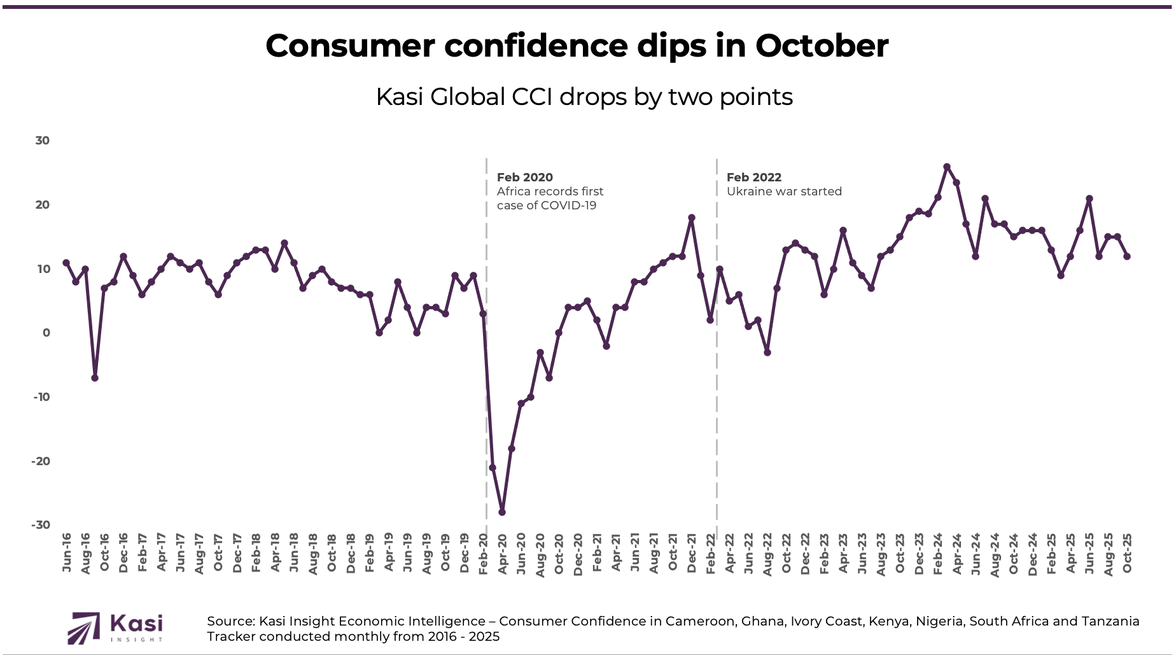
After two months of relative stability, the overall index declined, driven primarily by a six-point drop in future expectations, while current conditions remained subdued at –20 points. This shift reflects growing uncertainty about the economic outlook and a lack of improvement in consumers’ immediate financial environment.
Household-level sentiment also deteriorated. Income perceptions fell by 7 points and personal finance by 5 points, signalling tighter budgets and reduced financial control. Non-essential spending softened as the discretionary spending index dropped by 2 points, though essential expenditure showed slight resilience with a 3-point improvement in the household spending index. Labour market views offered a modest counterbalance, with job prospects rising by 2 points, indicating some optimism despite widespread caution.
Broad economic perceptions weakened significantly. The general city economic conditions index dropped by 7 points, and the general country conditions index declined by 9 points, highlighting growing concerns about both local and national trajectories. Overall, October marked a clear reversal of the stability recorded in September. Rising household pressure, weakening expectations, and broad-based declines across most tracked measures underscore a fragile consumer landscape, with confidence now increasingly vulnerable to both domestic and macroeconomic uncertainties.
Consumer sentiment remains cautious as the holiday season unfolds. Households are still prioritizing stability and disciplined spending, with modest improvements in income and local outlook failing to translate into stronger purchasing momentum. Financial strain continues to influence decision making, and many shoppers are approaching the festive period with a focus on essentials, value, and careful budgeting rather than indulgence or aspirational purchases.
In this climate, brands need to communicate with clarity, sincerity, and real relevance. Consumers are actively seeking products that offer tangible benefits, dependable quality, and pricing that aligns with the realities of their financial situation. Messaging that feels empathetic and grounded in everyday challenges will resonate far more than extravagant or overly optimistic holiday themes. Brands that show they understand the pressures families are facing, and position their products as supportive tools for navigating a constrained festive season, will earn deeper trust and stronger loyalty.
As the final quarter progresses, the market calls for thoughtful strategy and purposeful presence. Where financial pressure is intense, brands should reinforce reliability, affordability, and reassurance. In environments showing early signs of resilience, measured innovation anchored in practicality and accessible value can stimulate cautious festive engagement. The brands that succeed in this season will be those that combine consistent value with genuine empathy and a clear understanding of consumer reality, helping shoppers celebrate meaningfully within their means.
Share on socials using this caption: 📈🔎 In October, consumer confidence across Africa declined after two months of stability, driven by falling income perceptions, weaker personal finances, and sharper pessimism around national and city economic conditions. With the holiday season and households under increased financial pressure, brands must lean into practicality, empathy, and genuine value to stay relevant and supportive.#AfricaInsights #ConsumerTrends #HolidaySeason2025
708 views
Share article
Trust Is Becoming Economic Infrastructure
Confidence plateaus in September as caution defines household behavior
Restless sentiment, divided opposition, and the path to continuity in Cameroon