Sandra Beldine Otieno
June 23, 2024
Share article



In May, consumer confidence in Africa continued its downward trajectory, dropping by seven points after previously declining trends. This decline brought the index down from its recent levels, influenced by an eight-point decrease in the index of future conditions and a three-point drop in the index of current conditions, signaling worsening perceptions among households.
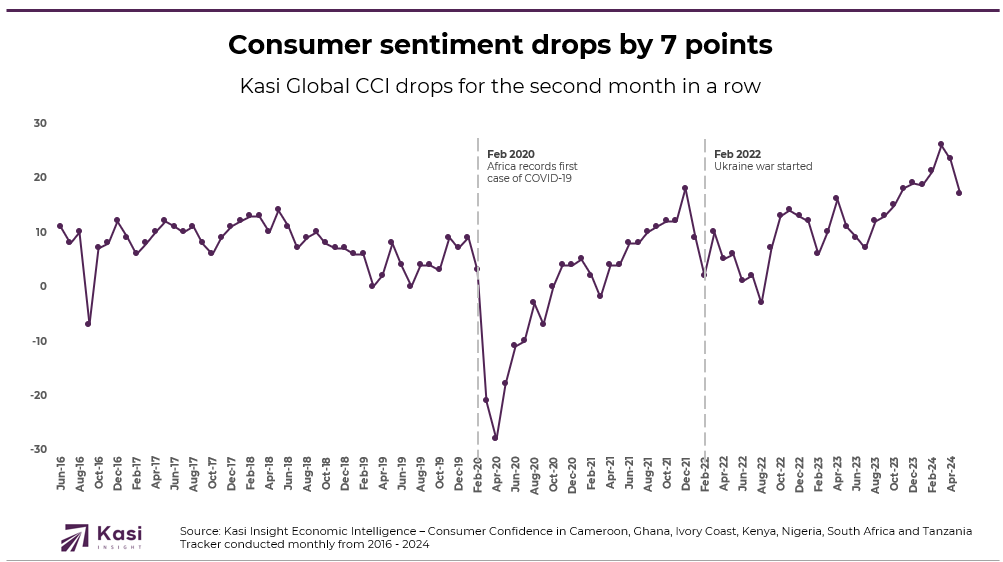
In May, Africa continued to see a general decline in household indices, similar to the previous month, highlighting persistent economic challenges. The only bright spots were job prospects, which improved by two points, and household spending, which remained steady at 22 points, consistent with April's levels.
The personal finance index witnessed a substantial drop of 15 points, indicating a significant worsening in individuals' perceptions of their financial health. This considerable decline points to increasing financial pressures that could weaken consumer confidence and economic stability. The household income index also decreased by 8 points, suggesting a reduction in household earnings that may influence overall economic security and consumer spending capacity.
Discretionary spending decreased by 8 points as well, emphasizing a tightening of household budgets. This reduction shows a shift towards prioritizing essential expenditures amid growing economic uncertainties. Conversely, the improvement in job prospects suggests some resilience in employment opportunities, potentially reflecting positive developments in certain sectors despite the broader economic downturn.
Additionally, the indices measuring general economic conditions in the country and cities saw declines of 10 and 8 points, respectively. These drops signal a cautious and less optimistic outlook on the economic environment, reflecting broader apprehension about future economic conditions and growth prospects.
In Nigeria, consumer sentiment rose by two points, supported by a notable 13-point increase in the household spending index and a 9-point improvement in the country's economic conditions index. This rise in optimism is largely attributed to recent policy measures announced by President Bola Tinubu. In Abuja on Tuesday, he signed three Executive Orders focused on oil and gas sector reforms, aimed at enhancing Nigeria's competitiveness on the global stage. During a meeting with ExxonMobil Upstream Company's President Liam Mallon, President Tinubu highlighted that these reforms are designed to streamline operations and reduce challenges for oil companies in Nigeria, promising a more favorable business environment.
In contrast, South Africa saw a significant 18-point drop in consumer sentiment, driven by sharp declines across several indices: personal finance plummeted by 36 points, discretionary spending fell by 28 points, and the country's economic conditions index decreased by 27 points. This downturn is closely linked to the outcomes of the recent elections. Held on May 29, the elections reshuffled the parliamentary landscape, diminishing the ANC's long-standing majority for the first time since 1994. With only 159 of the 400 seats, the ANC fell short of the majority needed to govern alone. The Democratic Alliance (DA) and MK party, under the controversial leadership of former president Jacob Zuma, secured 87 and 58 seats respectively, while smaller parties like the Economic Freedom Fighters (EFF) and the Inkatha Freedom Party (IFP) also made gains, marking a new era of political diversity and challenges.
In the face of challenging economic conditions across much of Africa, brands operating within this space can derive strategic direction from recent trends in consumer sentiment and household indices. Despite an overall dip in consumer confidence, certain areas such as job prospects and household spending stability have shown resilience, offering a beacon of hope. Brands can align themselves with resilient sectors that exhibit signs of growth or stability, adapting their products and marketing strategies to meet the evolving needs of these industries.
The variation in consumer sentiment across different countries—such as the increase in Nigeria and stability in Ghana—underscores the importance of localized strategies. Brands need to tailor their approaches to the specific economic and cultural contexts of each market, leveraging local insights to maximize relevance and impact. This includes focusing on essential goods and services, as consumers prioritize these in times of economic uncertainty. Brands that emphasize the value and necessity of their offerings can maintain relevance and continue to engage customers effectively.
Building and maintaining trust with consumers becomes crucial during economic downturns. Brands should focus on transparency, reliability, and customer service excellence to strengthen relationships with consumers. Investing in areas where household spending remains stable indicates where consumer priorities lie, allowing brands to position their products as investments in stability or quality of life. Innovative solutions such as flexible pricing models, bundled offerings, or loyalty programs can also help brands navigate these turbulent times, potentially leading to stronger positions and better opportunities for growth once economic conditions improve.
Share on socials using this caption: 📉 May saw a 7-point dip in Africa's consumer confidence, driven by falling future and current conditions. Job prospects slightly improved, but Nigeria outshone others with a gain, while South Africa faced the steepest drop. 🌍💼 #EconomicInsights #ConsumerConfidence #AfricaEconomy
1578 views
Share article
Trust Is Becoming Economic Infrastructure
Consumer confidence loses momentum in October
Confidence plateaus in September as caution defines household behavior