Sandra Beldine Otieno, MSc
August 13, 2025
Share article



July marked a sharp reversal in consumer sentiment across Africa, reflecting growing concerns about both current conditions and the future outlook. The widespread declines across household and macroeconomic indicators suggest mounting pressures on consumer wellbeing and confidence amid shifting economic realities.
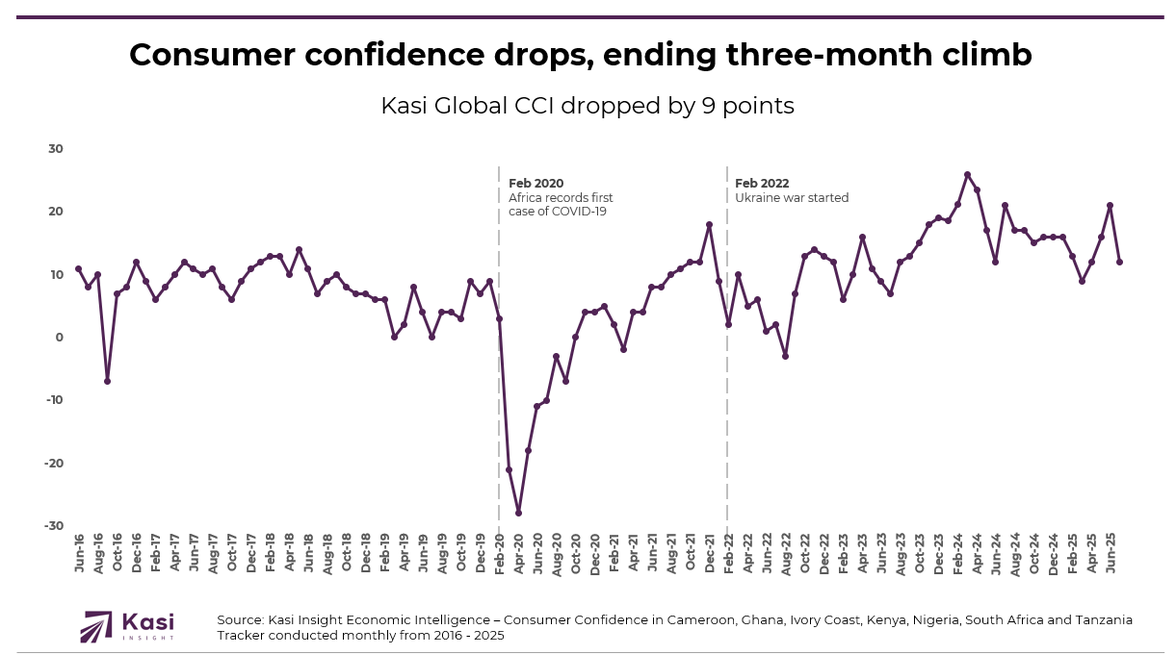
After three months of steady gains, consumer confidence fell as household conditions weakened across the board. The household income index declined by 11 points, pointing to reduced earnings and mounting pressure on daily budgets. The personal finance index slipped by 4 points, signaling growing concern over individuals' ability to manage their finances. Together, these declines reflect a loss of financial control that had been gradually building in previous months.
This shift in sentiment led to a marked contraction in consumer spending. The discretionary spending index recorded a steep 13-point drop, the largest this year, as households cut back on non-essential purchases. The household spending index also declined by 5 points, indicating a broader slowdown in day-to-day consumption. Consumers appear to be retreating from earlier optimism, reverting to cautious behaviors in the face of economic pressure.
The labor market outlook worsened significantly, with the job prospects index falling by 12 points, reflecting deepening uncertainty around employment opportunities. Broader economic perceptions also turned negative. The general city economic conditions index fell by 9 points, and the general country economic conditions index dropped by 6 points. These declines suggest that household anxiety is now reinforced by weakening confidence in the broader economic environment.
The steady recovery in consumer confidence across African markets has given way to renewed caution. In July, households responded to mounting financial pressure by pulling back on spending and reassessing their priorities. What had emerged as a tentative sense of optimism in previous months has shifted toward restraint. Daily decision-making is now shaped by uncertainty, and spending patterns reflect a growing desire to maintain control in the face of rising economic stress.
This shift signals more than a temporary slowdown. It reflects a deeper adjustment in the way consumers are approaching their finances. Spending is being guided by necessity rather than desire. Households are leaning into discipline, focusing their energy and resources on essentials, and limiting their exposure to risk. The appetite for anything that feels uncertain, extravagant, or non-essential has declined. Confidence in income stability is fading, and broader concerns about the economy are weighing on everyday behaviour.
In this context, the role of brands becomes more important, not less. Consumers are still engaging, but they are engaging on their own terms. What they expect now is not inspiration but support. Products must be reliable, accessible, and useful. Messaging must reflect a clear understanding of the pressures people are facing. Brand behaviour must demonstrate consistency, humility, and intent. Consumers are watching how companies respond, and they are forming impressions that will last well beyond the current moment.
Market variation remains important. While some countries are showing signs of resilience, most are experiencing heightened sensitivity and increased financial strain. This demands more deliberate market strategies. Brands need to prioritize presence and consistency in vulnerable areas, while carefully reintroducing value-driven innovation where there is still space to do so. What matters now is not just what brands offer, but how and when they show up. Relevance, empathy, and trust are the currencies that will carry brands forward in a period defined by discipline.
Share on socials using this caption: 📉⚠️In July, consumer confidence fell by 9 points, ending a three-month climbing streak. Households pulled back on spending as income pressure and job concerns intensified. Brands must double down on value and relevance. #AfricaInsights #ConsumerTrends #ValueMatters
2026 views
Share article
Trust Is Becoming Economic Infrastructure
Consumer confidence loses momentum in October
Confidence plateaus in September as caution defines household behavior